Lost civilisations
Babylon
Babylon grew from a Euphrates city under Hammurabi into Nebuchadnezzar II's capital, and its Ishtar Gate now stands in a Berlin museum.

At a glance
1792 to 1750 BCE
Approximate reign of Hammurabi
605 to 562 BCE
Reign of Nebuchadnezzar II
575 BCE
Approximate date of the Ishtar Gate
1899
Year Koldewey's excavation began
539 BCE
Year Cyrus the Great took the city
A river city that became a capital
Babylon stood on the banks of the Euphrates and was the capital of Babylonia, the alluvial plain between the Euphrates and the Tigris.
The city became important after the fall of the empire of the Third dynasty of Ur, and Babylonia's political power then had its ups and downs over the next thousand years or so.
Hammurabi reigned from about 1792 to 1750 BCE. He walled and beautified the city.
Nebuchadnezzar II rebuilds the city
Nebuchadnezzar II became king in August 605 BCE when Nabopolassar died, and he ruled until 562 BCE.
He is credited with rebuilding his capital as the most splendid city in the Near East.
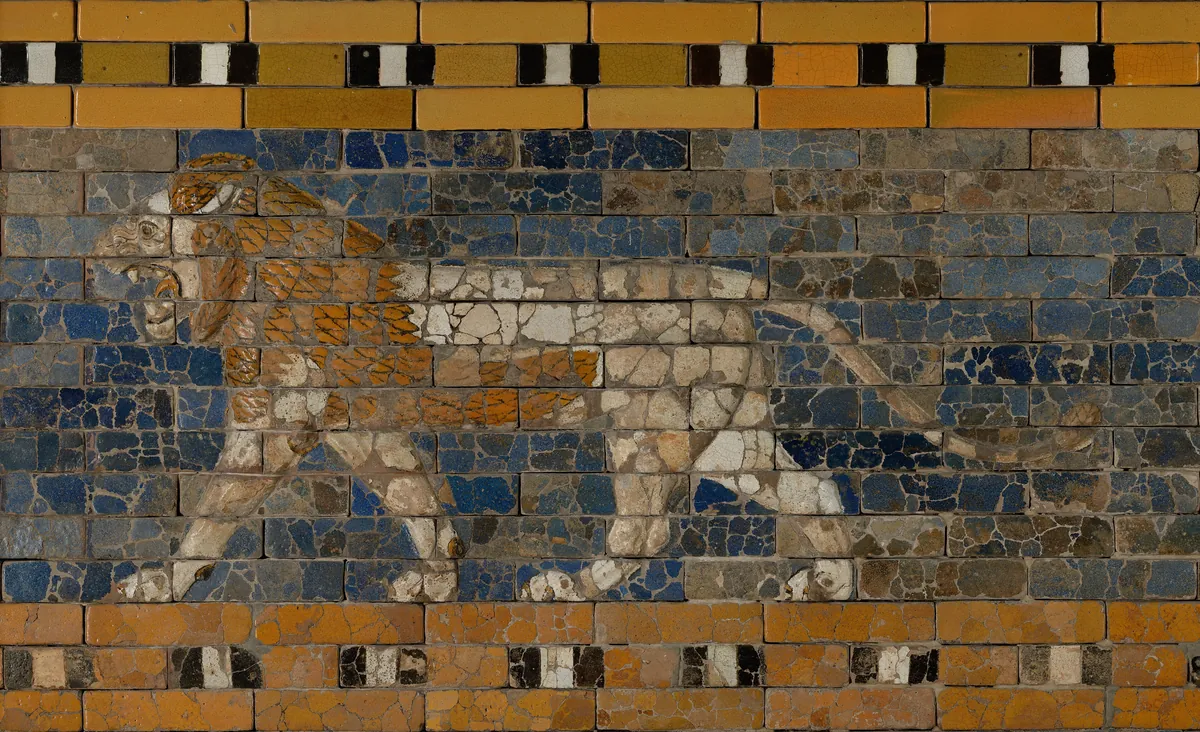
The Ishtar Gate and the great walls date to about 575 BCE. The gate was decorated with glazed figures of animals, including lions.
The gate was faced with blue glazed bricks.
From the mound to Berlin
Robert Koldewey, a pupil of Heinrich Schliemann, excavated Babylon between 1899 and 1917.
Koldewey first noticed colourful fragments on the ground east of the Kasr, the palace mound, in June 1887. In December 1897 he carried some to Berlin, where the director of the Royal Museums recognised their importance.
Digging began on 26 March 1899 with a cut through the east front of the Kasr. Koldewey later wrote that the discovery of these enamelled bricks was one of his reasons for choosing Babylon for excavation.
A reconstruction of the gate was assembled in the 1930s from Koldewey's findings and is displayed at the Pergamon Museum in Berlin.
In the 1980s the government of Saddam Hussein built a copy of the gate at the site in Iraq.
Repair works at Babylon ordered by Saddam Hussein in the 1980s were not carried out by archaeologists or restoration professionals, and the result was described as disastrous.
Conquest, neglect and abandonment
In 539 BCE the brief period of Babylonian political supremacy ended, when Cyrus the Great took the city.
Under Persian rule Babylon continued to flourish and became an administrative capital of the Achaemenid Empire.
Alexander the Great took Babylon in 331 BCE and intended to make it his residence. He died there in 323 BCE.
Seleucus I Nicator ordered the building of a new Greek city, Seleucia, and Antiochus later resettled Europeans from Babylon there.
The Parthians conquered Babylonia in 141 BCE, and by then the city's decline had begun. The emperor Trajan found the ruins disappointing when he visited in 116 to 117 CE.
The Muslim Arab conquest of 651 CE swept away what remained, and the city was eventually abandoned and buried by sand.
Sources
- World History Encyclopedia, Babylon: The Gate of the Gods
- Livius.org, Babylon
- Livius.org, Nebuchadnezzar II
- JSTOR, From Babylon to Berlin: The rebirth of the Ishtar Gate