Oceans
The Challenger Deep
NOAA puts the deepest known point of the ocean at about 10,935 metres. Two men reached it in the Trieste on 23 January 1960.

At a glance
10,935 metres
Depth of the Challenger Deep, NOAA figure
35,797 feet
Depth reached by Trieste in 1960
4 h 47 min
Length of the 1960 descent, Navy figure
16,000 psi
Pressure at the bottom, more than
2,550 km
Length of the Mariana Trench, more than
The deepest known point
The Challenger Deep is the deepest known part of the ocean. It lies beneath the western Pacific, at the southern end of the Mariana Trench, several hundred kilometres southwest of Guam.
NOAA puts its depth at approximately 10,935 metres (35,876 feet). NASA gives a measured maximum of 10,910 metres, and the US Navy's 1960 account gives 35,797 feet, about 10,911 metres.
The average depth of the ocean is about 3,682 metres, so the Challenger Deep is roughly three times deeper than the typical ocean.
If Mount Everest were set in the Challenger Deep trough, its top would still be more than a mile below the surface.
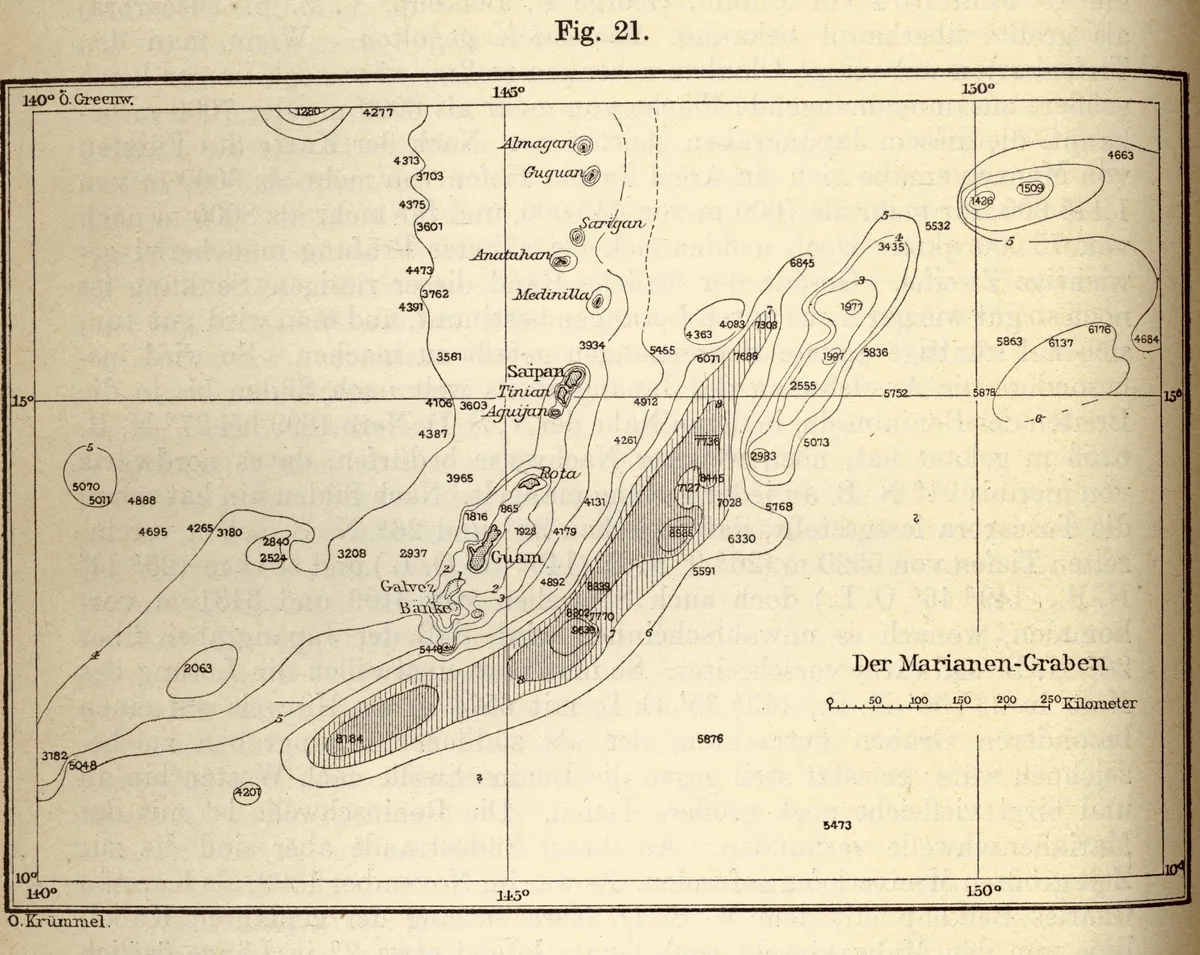
The Mariana Trench measures more than 2,550 kilometres long and 69 kilometres wide on average. It formed by subduction, where the Pacific Plate plunges downward into the mantle.
A name from 1875
The deep is named after HMS Challenger, whose crew first sounded the depths of the trench in 1875.
That survey used a weighted rope and recorded 4,475 fathoms, or 8,184 metres.
A British survey vessel, Challenger II, surveyed the Mariana Trench in 1951.
In 1984 a Japanese survey vessel mapped the trench with a multibeam echo sounder.
The 1960 dive
On 23 January 1960, Lieutenant Don Walsh of the US Navy and Jacques Piccard reached the bottom of the Challenger Deep in the bathyscaphe Trieste.
The US Navy acquired the Trieste in 1958, after several years of operations in the Mediterranean.
Gasoline in the hull supplied buoyancy: about 22,000 gallons by the Navy's account, and 22,500 gallons by MIT's.
The descent took 4 hours and 47 minutes by the Navy's count, and about four and a half hours by MIT's. The bottom was at about 35,800 feet.
The depth gauge read 37,800 feet, but it turned out to have been calibrated incorrectly. MIT's account says it was calibrated for fresh water.
The crew stayed about 20 minutes on the bottom, and the ascent took about three hours.
Pressure, cold and sound
Atmospheric pressure in an average home or office is 14.7 pounds per square inch. At the bottom of the Mariana Trench it is more than 16,000 pounds per square inch.
Almost 7 miles of water overhead produce this hydrostatic pressure, which is part of the reason the Challenger Deep is so little explored.
Below 1,000 metres the deep ocean has no sunlight, and temperatures stay near freezing, around 3.9 degrees Celsius.
In 2015 a hydrophone recorded sound at the bottom of the Challenger Deep for about 23 days. The soundscape was dominated by earthquakes, the moans of baleen whales and a typhoon passing overhead.
Later visits and protection
In 2012 the film director James Cameron made a solo dive to the bottom of the Challenger Deep in the submersible DEEPSEA CHALLENGER.
Most of the Mariana Trench is a US protected zone, part of the Marianas Trench Marine National Monument established in 2009.
Sources
- NOAA National Ocean Service, How deep is the ocean?
- NASA Scientific Visualization Studio, Bathymetry and topography visualization
- Naval History and Heritage Command, H-041-6: Bathyscaphe Trieste's deep dive
- Oregon State University, Mariana Trench: seven miles deep, the ocean is still a noisy place
- University of Texas at Austin Marine Science Institute, Deep sound
- NOAA National Centers for Environmental Information, Planet Postcard: The Mariana Trench
- Naval History and Heritage Command, Bathyscaph Trieste
- MIT News, Deep-sea pioneer dives into history
- NOAA, Seven miles deep, the ocean is still a noisy place
- NOAA Ocean Today, The deep ocean