Animals and nature
Honeybees
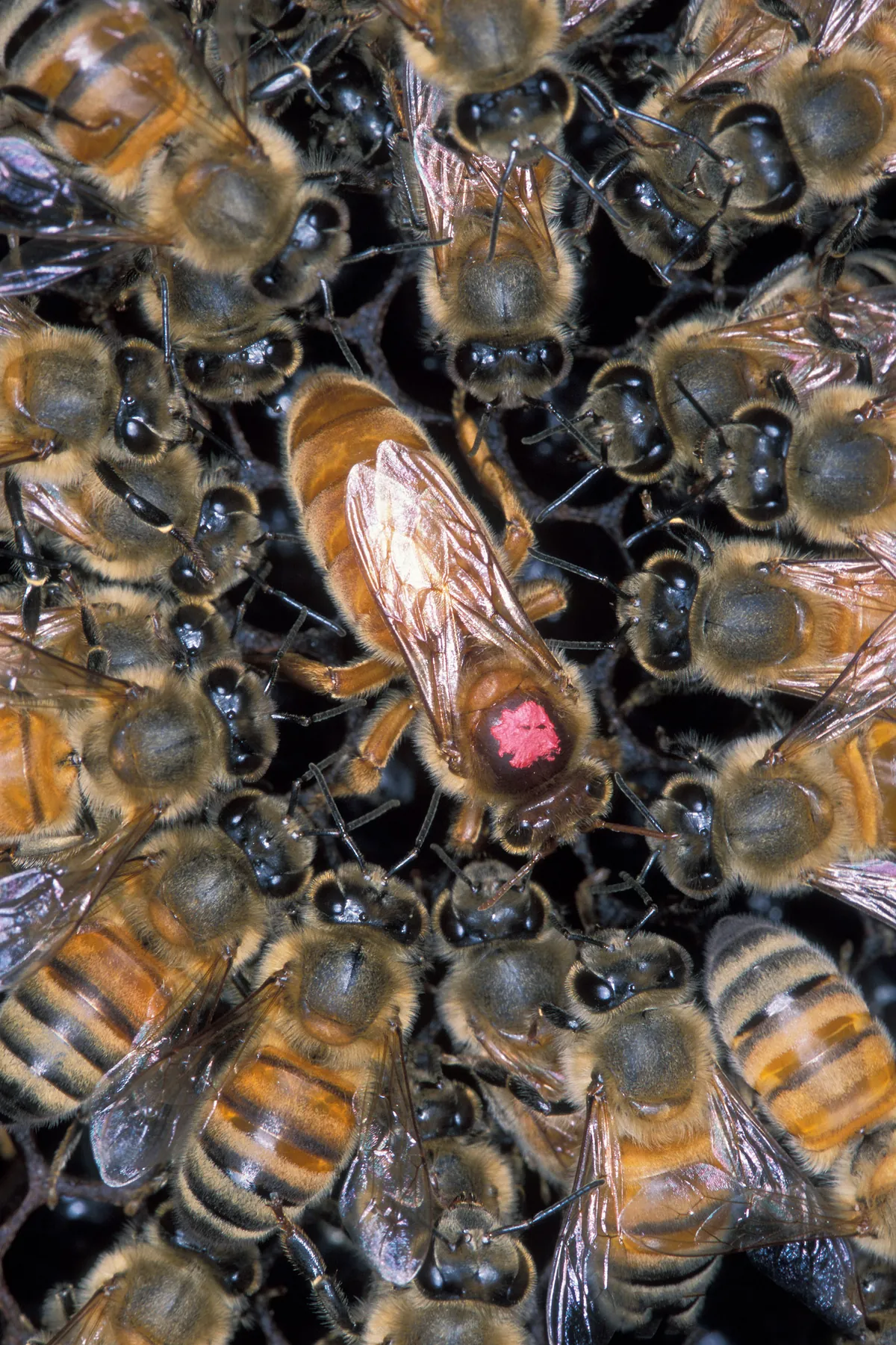
One worker makes about 1/12 of a teaspoon of honey in her life, yet a colony can hold up to 60,000 bees and a queen can lay 1,500 or more eggs a day.

At a glance
60,000 bees
About the largest worker count in one colony
1/12 teaspoon
Honey one worker makes in her lifetime
1,500 or more eggs a day
Queen's laying rate; some accounts say over 2,000 at peak
45 days
Average lifespan of a worker
2 km
Distance foragers may travel upwards of
Tens of thousands under one roof
A single western honey bee colony can have upwards of 50,000 female workers, and other accounts give colonies of 60,000 or more.
The efficiency of a colony rises as it grows, up to a maximum of about 60,000 workers.
All workers are female daughters of the queen. They take on different jobs as they age, starting with tasks in the nest and ending as foragers.
Drones are present mainly in late spring and summer. Their main job is mating with queens from other hives, and they eat three times as much food as workers.
When cold weather arrives, drones are left to starve unless the colony has no queen.
A short working life
A worker bee lives about 6 weeks in summer, and the average is given as 45 days.
Workers reared in the fall may live up to 6 months.
In her lifetime a worker bee produces only about 1/12 of a teaspoon of honey.
A hive may produce 60 pounds of honey a year, and some produce 100 pounds.
Foragers may travel upwards of 2 kilometres (1.3 miles) to gather nectar and pollen.
The waggle dance
A returning forager dances to tell nestmates the distance, direction and quality of a food source.
The angle of the straight run, measured from vertical, gives the direction of the food relative to the sun. A run pointing straight up the comb means the food lies toward the sun.
The duration of the straight run signals distance: longer runs mean farther sources.
A round dance, in which the bee runs in narrow circles, is used for food less than 50 metres from the hive and gives no direction.
Karl von Frisch and his students decoded the dance. In 1973 he shared the Nobel Prize in Physiology or Medicine with Konrad Lorenz and Nikolaas Tinbergen.
The life of a queen
The queen is the only female in the hive that reproduces, and her primary duty is to lay eggs.
At peak production she can lay 1,500 eggs a day, or up to 250,000 in a year. Other accounts put a quality queen at over 2,000 eggs a day.
A queen develops in about 16 days from egg to emergence, and her cell is capped about 9 days after the egg is laid.
A newly emerged virgin queen spends 5 to 8 days in the hive before her mating flight.
A queen's productive life averages 2 to 3 years. The University of Delaware says queens can live as long as 5 years, and Penn State Extension says seven or more.
Pollination worth billions
The western honey bee is the main species responsible for bee pollination worldwide.
Animal pollinators contribute to the production of 87 global crops, and animal pollination contributes to about 30 percent of global food production.
In the United States, pollination services are valued at about USD 15 billion to USD 16 billion a year, with about USD 12 billion of that linked to honey bees.
Sources
- University of Delaware, The colony and its organization
- Penn State Center for Pollinator Research, Happy National Honey Bee Day
- University of Florida IFAS Extension, Keep the sweetness coming: celebrate National Honey Bee Day
- Arizona State University, Bee colony life
- North Carolina State Extension, The honey bee dance language
- Nobel Prize Outreach, The Nobel Prize in Physiology or Medicine 1973
- University of California Agriculture and Natural Resources, A honey of a gift
- Penn State Extension, An introduction to queen honey bee development
- National Library of Medicine, Overview of bee pollination and its economic value for crop production