Historical figures
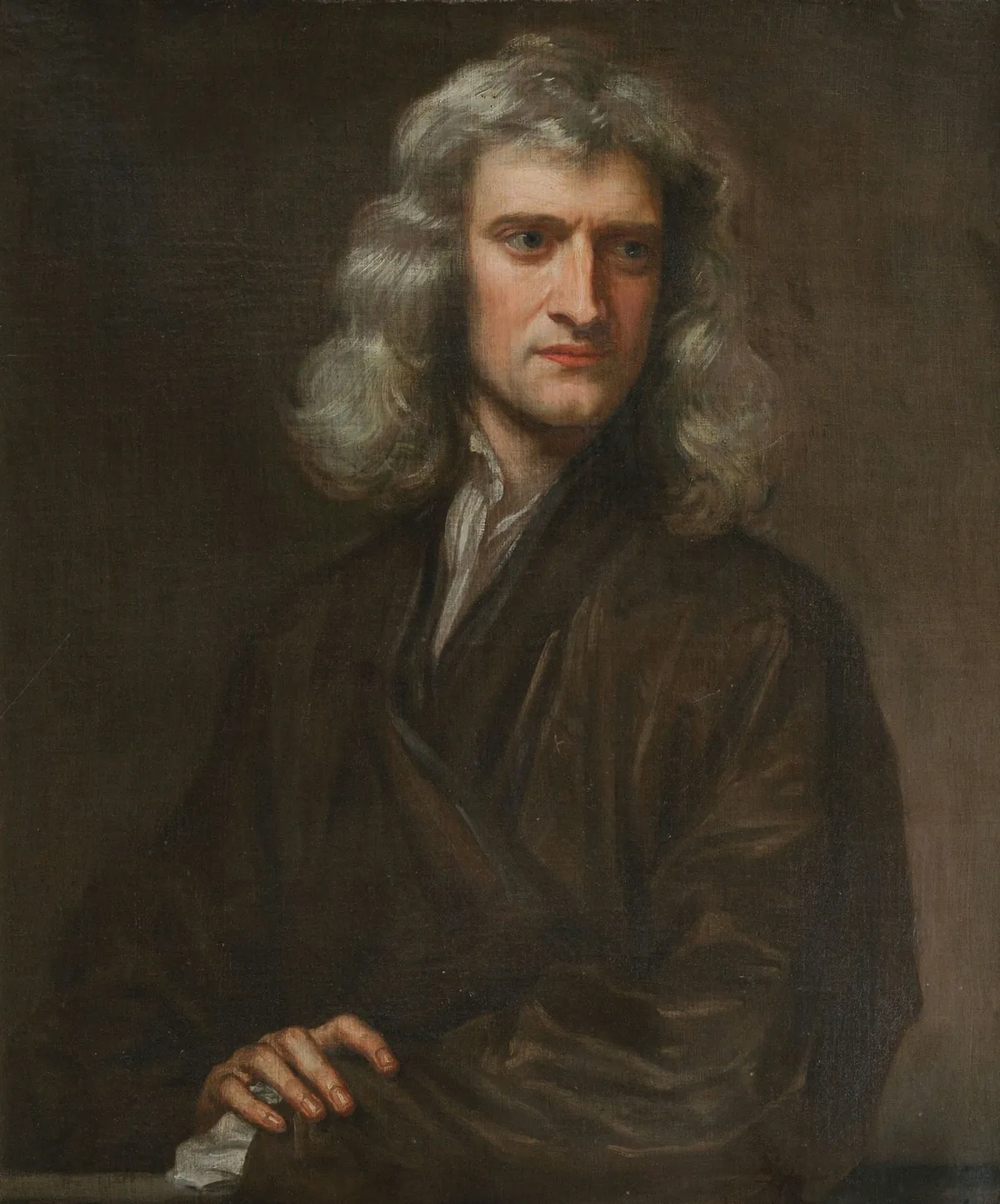
Isaac Newton
His Principia of 1687 took about three years to write and set out the law of universal gravitation, and a cannonball shows how orbits work.

At a glance
1687
Year the Principia was published
1699
Year he became Master of the Mint
1669
Year he became Lucasian Professor
1704
Year Opticks was published
7.9 km/s
Speed for a circular low Earth orbit
Woolsthorpe, Trinity and the plague years
Newton was born at Woolsthorpe Manor, near Grantham in Lincolnshire, on Christmas Day 1642 by the calendar then in use. The corrected Gregorian date is 4 January 1643.
He entered Trinity College, Cambridge, on 5 June 1661 as a sizar.
The plague closed Cambridge in the summer of 1665, and Newton returned to Lincolnshire. There he made early advances in calculus, optics and gravitation.
In a notebook known as the Waste Book, which he began using in 1664, Newton had developed the method of calculus by 1665.
In 1669 he became Lucasian Professor at Cambridge after Isaac Barrow resigned. His first lecture course, on optics, began in January 1670.
He was elected a Fellow of the Royal Society in 1671.
Three years on one book
In August 1684 Edmond Halley told Newton about a Royal Society discussion of planetary motion, which prompted Newton to prove his theories.
The Principia was the product of roughly three years of intense work, mainly in 1684 to 1687, although many of its ideas date back to the 1660s.
Halley oversaw the printing in London. On 5 July 1687 he wrote to Newton: 'I have at length brought your Book to an end, and hope it will please you.'
The Principia was published in Latin in 1687, revised in 1713 and 1726, and translated into English in 1729.
The book set out the law of universal gravitation. It also explained comets, tides, the precession of the Earth's axis and the Sun's disturbance of the Moon's motion.
Critics felt Newton described gravitation without explaining it, because the Principia addressed how gravity operates but not its cause.
A cannonball that keeps missing
In the cannonball thought experiment, a projectile of negligible mass is launched from a giant mountain on Earth, with air drag ignored.
A projectile that keeps falling toward Earth but keeps missing it is in orbit, so an orbit is a state of perpetual free fall.
A speed of about 7.9 kilometres per second gives a circular low Earth orbit. A slower projectile crashes into Earth.
Between about 7.9 and 11.2 kilometres per second the path is an ellipse. At or above the escape velocity of about 11.2 kilometres per second the projectile leaves on an open path.
Opticks and the colours of light
Opticks, published in 1704, covered the colours of thin sheets, Newton's rings and the diffraction of light.
A revised Latin edition of Opticks appeared in 1706.
The Mint, a knighthood and Westminster Abbey
Newton moved to London in 1696 as Warden of the Royal Mint. He became Master of the Mint in 1699 and held the office until his death.
He became President of the Royal Society in 1703 and was re-elected annually for the rest of his life.
Queen Anne knighted him in 1705.
Newton died at Kensington on 20 March 1727 by the calendar then in use, which is 31 March by modern reckoning.
He was buried in Westminster Abbey on 28 March 1727. His grave is in the nave, in front of the choir screen, close to his monument.
The monument, designed by William Kent and carved by Michael Rysbrack, was finished in August 1730 and unveiled the following year.
Sources
- University of St Andrews, Isaac Newton (1643 - 1727) - Biography
- Westminster Abbey, Sir Isaac Newton
- University of Cambridge, Sir Isaac Newton's Cambridge papers added to UNESCO's Memory of the World Register
- Isaac Newton Institute, Isaac Newton's Life
- Cambridge University Library, Newton Exhibition
- University of Nevada, Las Vegas, Figure: Newton's cannonball shows being in orbit is to be falling perpetually