Psychology
Optical illusions
Three classic illusions show vision at work: arrowheads that change a line's length, a room that resizes people, and two squares of identical grey.

At a glance
1889
Year Müller-Lyer published his illusion
1,878 people
Respondents in the cross-cultural illusion study
1995
Year of Adelson's checker shadow image
Arrowheads that stretch a line
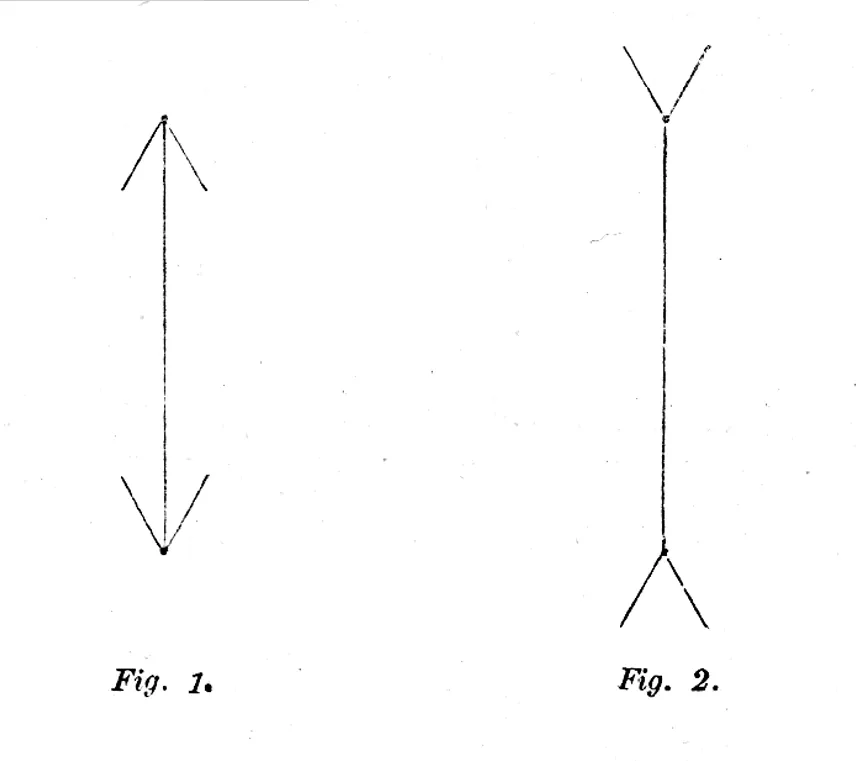
Franz Müller-Lyer published his illusion in 1889. Two lines of equal length look unequal when the fins at their ends angle in on one and out on the other.
Richard Gregory's 1968 perspective explanation reads the figure as a room, where an "angles in" configuration is the front side of an object and an "angles out" configuration is the far end of a room. The brain takes the first to be closer and, given equal retinal sizes, concludes that its line is shorter, though Bach notes Segall and colleagues criticised the explanation in 1968.
Müller-Lyer's original figure showed two double-ended arrows. Michael Bach's demonstration instead uses the Brentano variant of 1892, in which a central arrow sits between two outer arrowheads and the viewer places its tip at the midpoint.
Whether the Müller-Lyer illusion is universal
A cross-cultural study by Marshall Segall, Donald Campbell and Melville Herskovits collected complete response protocols from 1,878 people in 14 non-European locations and the United States over six years.
The study used five geometric illusions, including the Müller-Lyer. For each, the difference in length between the two segments varied from item to item, and respondents simply said which segment was longer.
On the Müller-Lyer and the Sander parallelogram, the European and American samples gave significantly more illusion-supported answers than the non-Western samples did.
On two horizontal-vertical illusions the pattern ran the other way, with many non-Western samples scoring higher than the European and American ones. The authors stressed this two-way difference.
The authors proposed a carpentered-world hypothesis and a hypothesis about experience with two-dimensional representations of reality, both predicting that Western peoples would be more susceptible. They called both tenable and promising, while acknowledging inadequacies of detail.
The Ames room and how it resizes people
In the Ames room illusion an irregularly shaped room, seen from one specific viewpoint, is perceived as regular and rectangular. That misperception of shape then changes how large people and objects inside it appear.
The illusion is considered one of the best-known geometrical illusions, yet its geometry is often misunderstood. Rooms commonly called Ames rooms in recent studies differ from the original.
A 1997 explanation holds that viewing with one eye through a small aperture, with no retinal disparity or motion parallax, causes a loss of 3-D shape constancy, and the room's appearance shifts toward the rectangular shape of its retinal image.
Tests with a one-tenth-size model Ames room found that interior shape constancy was almost fully restored when the room was viewed with both eyes.
A rectangular room was also significantly distorted when its interior perspective matched that of the Ames room, which supports the loss-of-constancy account.
Researchers have reported conflicting results on whether people see less distortion of their partners in the room, a claim known as the Honi phenomenon. One 1976 study found it among women high in positive feeling for their partner, while a 1980 study of 25 men and 25 women concluded that the phenomenon does not exist.
Two squares, one shade of grey
In Edward Adelson's checker shadow illusion, the squares marked A and B are the same shade of gray, yet they look different. Adelson's image is dated 1995.
Joining the two squares with two vertical stripes of the same grey makes it plain that they match.
The squares have identical luminance, meaning the same number of photons come from each. A viewer who covers everything but the two squares sees them as equal.
The effect arises because the scene reads as three-dimensional, with a cylinder casting a shadow on a checkered plane. The visual system estimates the lighting and judges the material of each square, a light or dark tile in the pattern, whatever the lighting.
Sources
- Michael Bach, Visual Phenomena and Optical Illusions, Müller-Lyer illusion
- Segall, Campbell and Herskovits, in Toch and Smith, Social Perception (1968), hosted by MIT, The influence of culture on visual perception
- Michael Bach, Visual Phenomena and Optical Illusions, Adelson's checker-shadow illusion
- MIT Perceptual Science Group, Checker shadow illusion
- National Library of Medicine (PubMed), Loss of 3-D shape constancy in interior spaces: the basis of the Ames-room illusion
- National Library of Medicine (PubMed), The Ames room and the misunderstood versions and depictions
- National Library of Medicine (PubMed), The Honi phenomenon revisited: factors underlying the resistance to perceptual distortion of one's partner
- National Library of Medicine (PubMed), Reliability, sex difference, and Honi phenomenon in a distorted room