Engineering
The Statue of Liberty
A copper skin as thin as two pennies, hung on an iron frame designed by Gustave Eiffel, rises 305 feet above New York Harbor.

At a glance
2.4 millimetres
Thickness of the copper skin
92.99 metres
Ground to the tip of the torch
46.05 metres
Top of the base to the torch
377 steps
Climb from the ground to the crown
28 October 1886
Date of the dedication
A skin as thin as two pennies
The copper sheeting is 3/32 of an inch (2.4 millimetres) thick, about the thickness of two American pennies placed together.
Bartholdi chose the repoussé technique, in which heated copper sheets were hand-hammered into negative wooden molds. The finished sheets were riveted together and hung on a framework of iron armatures.
The skin is made of roughly 300 hand-hammered plates.
Sources differ on the weight of the copper. Two National Park Service pages give 179,200 pounds (81,300 kilograms) and 176,000 pounds, and the American Society of Civil Engineers gives 62,000 pounds (28,100 kilograms).
Eiffel's iron skeleton
The copper skin is supported by an iron framework designed by Gustave Eiffel, and his iron work was the first piece reassembled on Bedloe's Island.
At the centre, a pylon of four girders about 30 metres (97 feet) tall carries the secondary framework and the armature, and it is tied to the ground through the stone pedestal.
The interior strapwork has 1,800 iron bars. Eiffel's design lets the skin expand or contract with changes in temperature or shifts in the wind.
The statue can sway up to 3 inches in the wind, and the torch up to 6 inches.
Why the iron was replaced
A layer of shellac-coated asbestos was meant to keep the iron and copper apart. It disintegrated and dried out, so moisture and salt air let the two metals act like a battery and corrode.
Restoration began in 1981. The Park Service chose a stainless steel alloy, coated with Teflon, to replace most of the iron framework.
Workers replaced 10,000 linear feet of armature and 30,000 copper rivets, and no more than 12 bars could be removed in any 24-hour period. Ten bars in the right foot were kept as examples of the original puddled iron.
Inspections in 1996, ten years after the project finished, found the earlier corrosion reversed and no new problems.
The green patina
The copper exterior turned green through oxidation.
The patina acts as a natural shield for the copper, and the restoration team kept the verdigris for that reason.
A gift raised in two countries
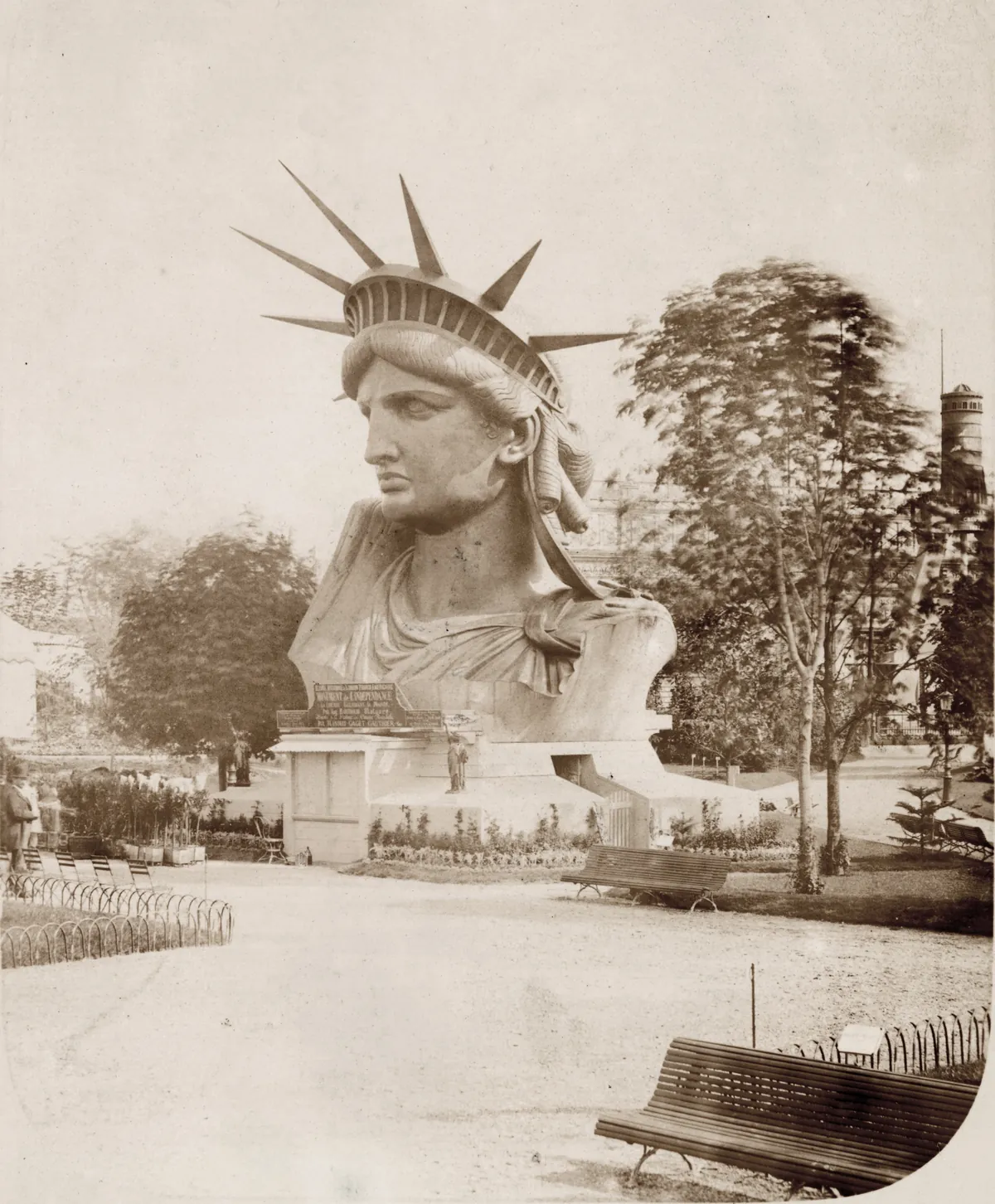
The statue was built in France from 1875 to 1884, then taken apart and shipped to New York in 1885.
The French frigate Isère left Rouen on 21 May 1885 and reached New York Harbor on 17 June 1885.
The statue was reassembled on Bedloe's Island in 1886, once the pedestal was finished, using steam-driven cranes and derricks without scaffolding.
It was dedicated on 28 October 1886. About one million New Yorkers joined the celebrations despite wet and foggy weather.
From 1886 to 1902 the torch served as a lighthouse, and its light could be seen up to 24 miles (39 kilometres) out at sea.
The statue is 151 feet 1 inch (46.05 metres) from the top of its base to the torch. Including the pedestal, the torch tip stands 305 feet 1 inch (92.99 metres) above the ground, and visitors climb 377 steps to the crown.
Sources
- National Park Service, Statue Statistics
- ASCE Metropolitan Section, Statue of Liberty
- National Park Service, Creating the Statue of Liberty
- Architectural Record, From the Record Archives: Restoring the Statue of Liberty
- National Park Service, Statue of Liberty Facts
- PBS NOVA, Rescuing World Monuments: Statue of Liberty
- National Institute of Standards and Technology, The Statue of Liberty Still Stands Tall, Thanks to Science