The human body
The human brain
About 86 billion neurons in roughly 3 pounds of tissue, with most of those neurons packed into the small cerebellum.
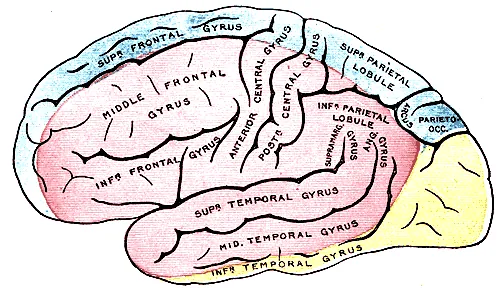

At a glance
86 billion neurons
Nerve cells in the human brain, about
3 pounds
Average adult brain weight, about
100 trillion synapses
Connections between neurons, more than
16 billion neurons
Neurons in the cerebral cortex, about
69 billion neurons
Neurons in the cerebellum, about
Weight and cell counts
An adult brain weighs about 3 pounds on average. At birth it weighs about 1 pound, and by childhood about 2 pounds.
The human brain has about 86 billion neurons. A count of adult male brains, which averaged about 1.5 kilograms, arrived at that figure.
The brain holds about as many other cells as neurons. The same count found around 85 billion non-neuronal cells, and Cleveland Clinic says glial cells are about equal in number to neurons.
In the human brain, neurons form more than 100 trillion connections with other neurons at junctions called synapses.
Where the neurons actually are
The brain has three main parts. The cerebrum is the largest and handles speech, memory, reasoning and movement.
The cerebellum controls balance, posture and coordination, and the brainstem connects to the spinal cord and regulates automatic functions such as breathing and heart rate.
The cerebral cortex weighs about 1,233 grams, which is 82% of brain mass, yet it holds about 16 billion neurons, or 19% of the brain's neurons.
The cerebellum weighs about 154 grams, roughly 10% of brain mass, yet it holds about 69 billion neurons.
Each hemisphere of the cerebrum has four lobes: the frontal, the largest, then the occipital (vision), the parietal (sensory signals and body state) and the temporal (memory, language and emotion).
The two halves of the cerebrum are joined by bundles of nerve fibres called the corpus callosum.
A small organ with a large energy bill
The brain is only about 2% to 3% of body weight, yet it uses about 20% of the body's energy.
The neuroscientist Barry Gordon of Johns Hopkins School of Medicine puts the weight share at three percent. The Quanta Magazine report gives about 2%.
The ten percent myth
There is no scientific evidence that people use only 10% of their brains.
Brain imaging shows that most regions of the brain are active over a 24-hour period. Mayo Clinic neurologist John Henley says that over a day you use 100 percent of the brain.
Gordon says virtually every part of the brain is used and that most of the brain is active almost all the time.
The idea has been linked to the psychologist William James, who wrote that people use only a small part of their possible mental and physical resources.
At any given moment not all regions of the brain fire together, but most are continually active over 24 hours.
Sources
- Cleveland Clinic, Brain: Parts, Function, How It Works & Conditions
- National Institute of Neurological Disorders and Stroke, NIH BRAIN Initiative launches projects to develop innovative technologies to map the brain in incredible detail
- Frontiers in Human Neuroscience, The Human Brain in Numbers: A Linearly Scaled-up Primate Brain
- Scientific American, Do People Only Use 10 Percent of Their Brains?
- Quanta Magazine, How Much Energy Does It Take To Think?
- University of Washington, Neuroscience For Kids: 10% of the Brain Myth