Transport
The Wright brothers
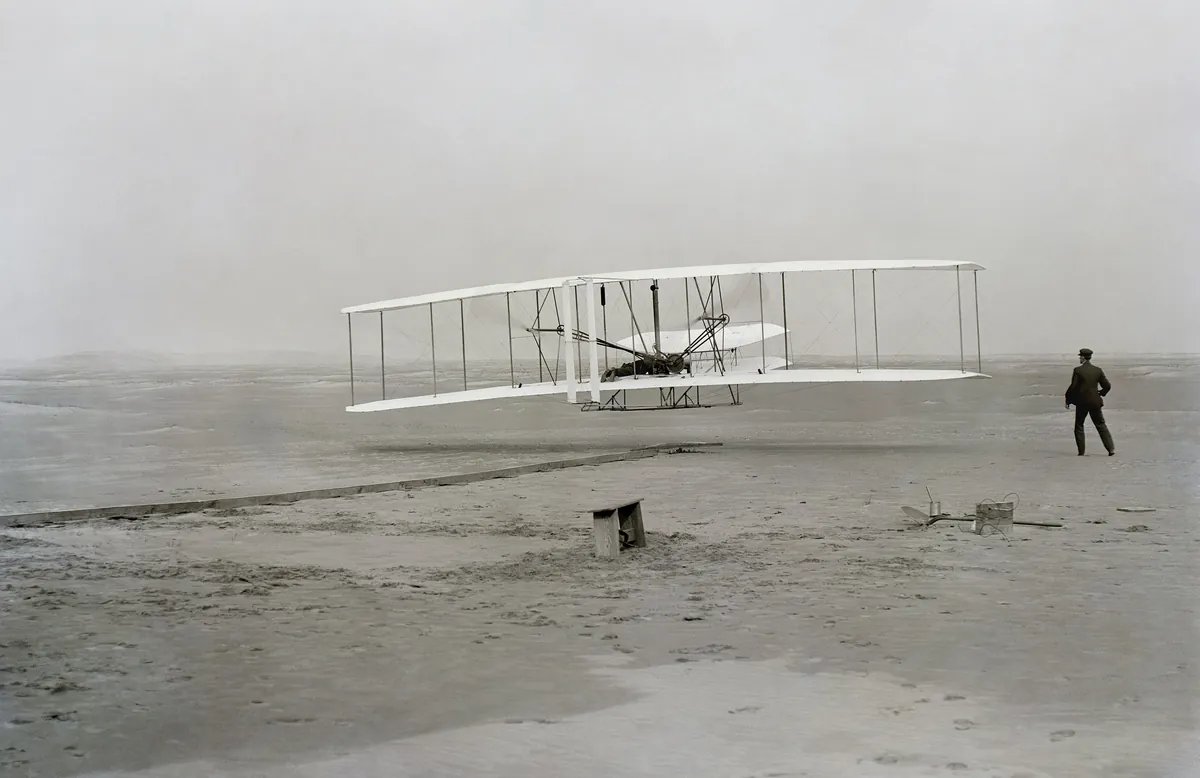
The first powered flight lasted 12 seconds and covered 120 feet, and the last of four flights that day reached 852 feet.

At a glance
12 seconds
Length of the first flight, 17 December 1903
120 feet
Distance of the first flight
852 feet
Distance of the longest flight that day, in 59 seconds
605 pounds
Empty weight of the 1903 Flyer
12 horsepower
Output of the Flyer's engine
The morning of 17 December 1903
Wilbur Wright tried to fly first, on 14 December 1903. He oversteered the elevator after leaving the rail, and the Flyer climbed too steeply, stalled and dived into the sand.
On 17 December Orville Wright released the restraining wire at 10:35 in the morning. The first flight lasted 12 seconds and covered 120 feet.
Orville's groundspeed was 6.8 miles per hour, but he was flying into a 27 mph headwind, so his airspeed was 34 mph.
Five people watched the first flight. Volunteers from the nearby lifesaving station had been signalled before the attempt, and John Daniels took the photograph of the airborne Flyer.
The brothers made four flights that day and took turns at the controls. The longest was Wilbur's last, which covered 852 feet in 59 seconds.
The brothers predicted a cruising speed of 30 to 35 mph for the Flyer, before its first flight.
The highest altitude reached on any of the day's flights was about 10 feet.
A machine of spruce, ash and muslin
The Flyer weighed 605 pounds empty by its maiden flight. The engine alone weighed 170 pounds.
No car maker had a suitable engine, so the Wrights' friend and coworker Charlie Taylor built one from scratch. It was an inline four-cylinder, water-cooled engine producing 12 horsepower.
The wingspan was 40 feet 4 inches, with the right wing extended by four inches to offset the engine's placement.
Two wooden propellers, each 8 feet 6 inches across, turned in opposite directions, driven by a chain transmission.
The frame was made of spruce and ash and covered in unbleached, untreated muslin.
The end of the day, and the years after
After the fourth flight, a gust of wind rolled the Flyer over. It was damaged beyond easy repair and did not fly again.
In 1904 the brothers made 105 flights, totalling 49 minutes in the air, with the Flyer II. They made the first turn and the first circle in the air with that machine.
In the 1905 season they stayed aloft for 262 minutes in 50 flights.
On 5 October 1905 Wilbur flew a world record of more than 24 miles in 39 minutes. By late 1905 the brothers felt they had a practical airplane that they could market.
The 1903 Flyer was shown at the London Science Museum until 1948, when the Smithsonian took ownership.
Sources
- National Park Service, 1903: The first flight
- NASA, 120 years ago: The first powered flight at Kitty Hawk
- National Park Service, The Wright Flyer
- National Park Service, Huffman Prairie Flying Field