Your stomach lining is only days old
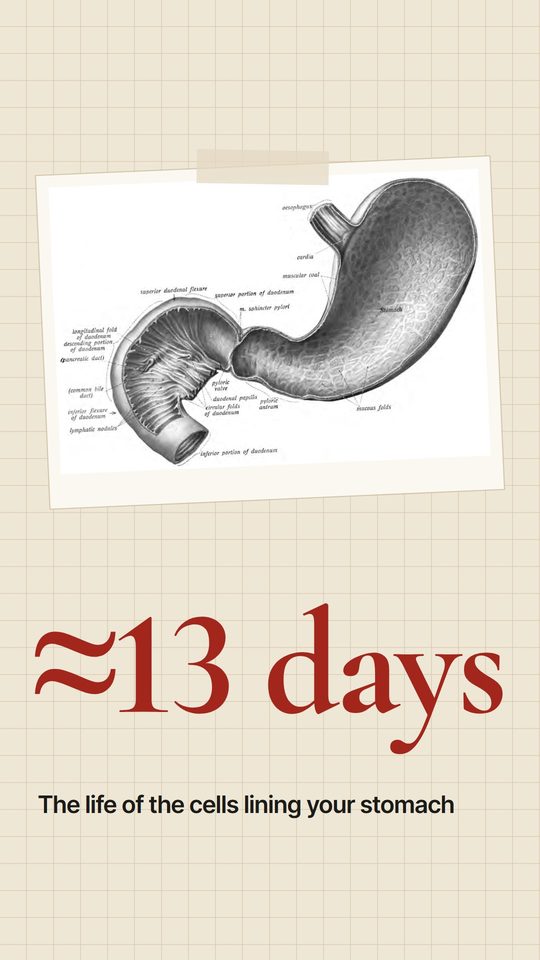
The mucus-making cells lining the inside of your stomach face hydrochloric acid and pepsin, and are constantly shed and replaced. Classic estimates say every few days; a 2021 study of human cell turnover put their average life nearer two weeks. A red blood cell lasts about four months.
 Watch on YouTube
The inner surface of your stomach is only days old. That does not mean the whole organ is replaced so quickly. It applies to the layer of mucus-making cells on the inside, the surface cells that face the contents of the stomach.
Those cells work in a harsh place. They are continuously exposed to hydrochloric acid and pepsin, a protein-digesting enzyme. Together these are capable of digesting tissue, so the lining has to cope with a mixture that could, in principle, break it down.
Its defences are a mucus and bicarbonate barrier, and a steady supply of fresh cells. Stem and progenitor cells in the stomach's tiny glands keep producing new cells. The surface cells among them migrate upward to the stomach's inner surface and are then shed into the stomach.
How long does a surface cell last? Classic estimates say the layer is replaced every few days, and one long-standing figure is about three days. A 2021 study of human cell turnover by Sender and Milo, published in Nature Medicine, put the average lifespan of these cells at 13 plus or minus 9 days. That is nearer two weeks, and the authors acknowledged wide uncertainty.
The fast renewal belongs to the surface layer only. Other cell types in the stomach lining, deeper in the gastric glands, turn over far more slowly. Most of them take about 40 to 70 days, and chief cells last at least six months. Those figures were measured mainly in mice.
For comparison, a red blood cell lives about 120 days, or about four months. The cells at the stomach surface are a fraction of that.
Because the surface cells last from a few days to about two weeks, the cells that lined your stomach a month ago have since been shed and replaced. The lining that met your meals last month is already gone.
Sources
- NPR, Health Shots: How Old Is Your Body, Really? (Adam Cole, 28 June 2016): 'The lining of the stomach, constantly under assault by digestive acid, is renewed every few days.'
- Loyola University Chicago histology slide 124, human stomach: 'the surface epithelium of both the stomach and intestine is normally worn off and replaced totally every few days'
- Sender R. and Milo R., The distribution of cellular turnover in the human body, Nature Medicine 27, 45 to 48 (2021); Methods: lifespan of stomach (mucous surface) epithelial cells estimated at 13 plus or minus 9 days
- University of Alaska Fairbanks Geophysical Institute, Alaska Science Forum: Why doesn't the stomach digest itself? (Larry Gedney, 1983): the surface lining 'completely replaces itself in three days'
- Bartfeld S. and Koo B.-K., Adult gastric stem cells and their niches, WIREs Developmental Biology (2017), accepted manuscript, University of Cambridge repository: 'The pit region has a rapid turnover of about 3 days, while chief cells at the gland exhibit impressive lifespans of at least 6 months'
- Colorado State University, Hypertexts for Biomedical Sciences (R. Bowen), Gastric Secretion: mucous cells 'cover the entire lumenal surface' and secrete a bicarbonate-rich mucus
- Laine L., Takeuchi K., Tarnawski A., Gastric mucosal defense and cytoprotection: bench to bedside, Gastroenterology 135, 41 to 60 (2008), abstract: 'continuous exposure to noxious factors, including 0.1 mol/L HCl and pepsin, that are capable of digesting tissue'
- Laine L., Takeuchi K., Tarnawski A., Gastric mucosal defense and cytoprotection: bench to bedside, Gastroenterology (2008), abstract: defences include the 'mucus-bicarbonate-phospholipid barrier' and 'continuous cell renewal accomplished by proliferation of progenitor cells'
- Yang H., Yang W.-J., Hu B., Gastric epithelial histology and precancerous conditions, World Journal of Gastrointestinal Oncology 14(2), 396 (2022): pit cells arise in the isthmus and 'differentiate during their upward migration to the luminal surface'
- Milo Lab (Weizmann Institute), cellular_turnover data notebook for Sender and Milo 2021, GIT_Epithelial_cells: 'Lifespan of Stomach epithelial cells is: 13 plus or minus 9 days'
- MedlinePlus (US National Library of Medicine), Blood: 'Red blood cells live about 120 days'