Historical figures
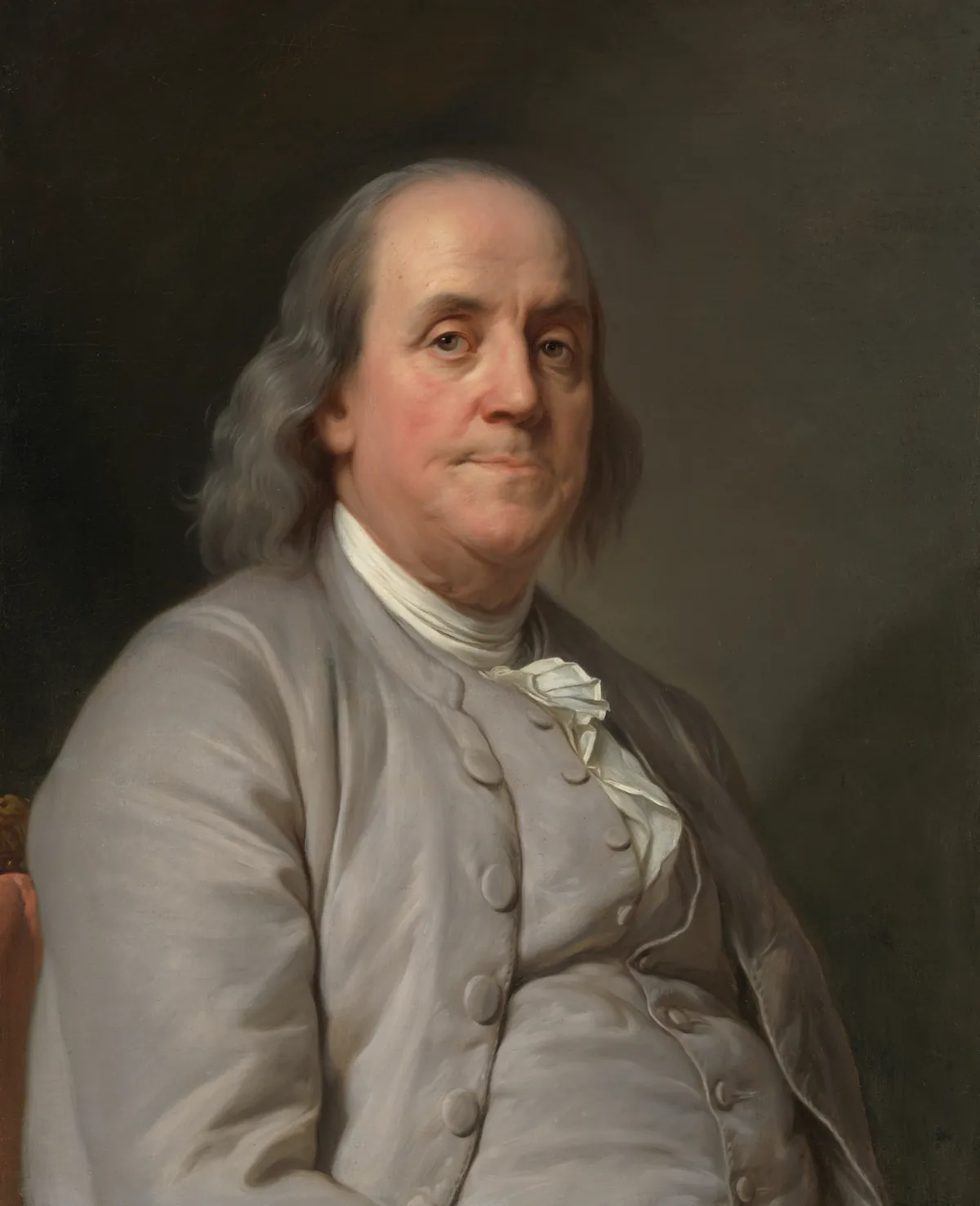
Benjamin Franklin
He drew sparks from a kite string in June 1752, but a French experiment had shown weeks earlier that lightning is electricity.

At a glance
84 years
Age at his death in 1790
1752
Year of the kite experiment
1753
Year the Royal Society awarded him the Copley Medal
1761
Year he completed the glass armonica
4 documents
Founding documents he signed
A Boston printer who became a publisher
Franklin was born on 17 January 1706 in Boston, then a British colony, and died on 17 April 1790 in Philadelphia at the age of 84.
He bought the struggling Pennsylvania Gazette and made it profitable. He retired from printing in 1747 but still received profits from his shop.
Poor Richard's Almanack appeared every year from 1732 to 1758 under the pen name Richard Saunders.
The 'JOIN, or DIE' cartoon ran in the Gazette on 9 May 1754 and is attributed to Franklin.
Letters on electricity and a French rod
Between 1747 and 1750 Franklin wrote five letters on his electrical experiments to Peter Collinson in London. They appeared in April 1751 as Experiments and Observations on Electricity, Made at Philadelphia in America.
In May 1752 Jean-François Dalibard confirmed in France that lightning is electricity, weeks before Franklin's own kite experiment.
On 10 May 1752 at Marly-la-Ville, a retired French dragoon following Dalibard's instructions drew sparks from a 13-metre insulated iron rod during a storm.
In June 1752 Franklin drew sparks from a key on his kite string, which was insulated from his hand by a silk ribbon. He did this before he learned of the French result.
Grounded conductors were installed on the Academy of Philadelphia and the Pennsylvania State House in late summer or autumn of 1752.
Franklin published his lightning rod method in Poor Richard's Almanack in 1753. The Royal Society awarded him its Copley Medal for his work on electricity the same year.
Stoves, glass bowls and double spectacles
The Franklin stove, an iron furnace that gave homeowners more heat with less smoke and less wood, dates to 1741 in one account and 1742 in another.
Franklin did not patent the stove, and he declined to patent his other inventions. He wrote that, since we benefit from the inventions of others, we should serve others with ours 'freely and generously'.
In 1752 he made a flexible catheter to help his brother, who had kidney stones.
Franklin completed his glass armonica in 1761. Each glass bowl was sized and thickened to sound one pitch, so no water was needed.
The bowls were nested on an iron rod turned by a foot pedal, and a player sounded them by touching moistened fingers to the spinning edges.
Mozart and Beethoven were among the composers who wrote music for the armonica.
In August 1784 Franklin wrote to his friend George Whatley that he was 'happy in the invention of double spectacles'.
The date Franklin first made bifocals is not confirmed. One analysis suggests the technology already existed in England in the 1760s.
Public service and the written record
His testimony in 1766 helped lead to the repeal of the Stamp Act, and in 1775 he became the first postmaster general of the United States.
He signed four founding documents: the Declaration of Independence in 1776, the Treaty of Alliance with France in 1778, the Treaty of Peace in 1782 and the Constitution in 1787.
His satirical essay of 1784 about changing sleep schedules to save on candles is often mistaken for a proposal for daylight saving time.
Franklin wrote his Autobiography from 1771 to 1790, and it was published after his death.
Sources
- The Franklin Institute, Benjamin Franklin FAQ
- Physics Today, American Institute of Physics, Benjamin Franklin and lightning rods
- Engineering and Technology History Wiki, IEEE, Milestones:Book “Experiments and Observations on Electricity” by Benjamin Franklin, 1751
- National Constitution Center, Ben Franklin's best inventions and innovations
- The Franklin Institute, Benjamin Franklin's Glass Armonica
- Independence Hall Association, Ben Franklin's inventions: bifocals