Language
Braille
Six raised dots allow 64 combinations, enough for a whole alphabet, and a French teenager began building the system in 1824.

At a glance
6 dots
Dot positions in a braille cell
64 combinations
Possible combinations of the six dots
1824
Year Louis Braille began developing his code
12 dots
Size of the grid in Barbier's earlier system
1878
Year a Paris congress proposed braille as the reference system for all countries
Six dots, sixty-four combinations
A braille cell has six raised-dot positions in two parallel rows of three, numbered 1 to 6.
Sixty-four combinations are possible using the six dots.
Braille uses its six dots to represent each letter and number, and also musical, mathematical and scientific symbols.
Contracted braille uses 180 letter contractions, including 75 shortform words. The phrase you like him takes twelve cell spaces uncontracted and six contracted.
A harness-maker's son goes blind
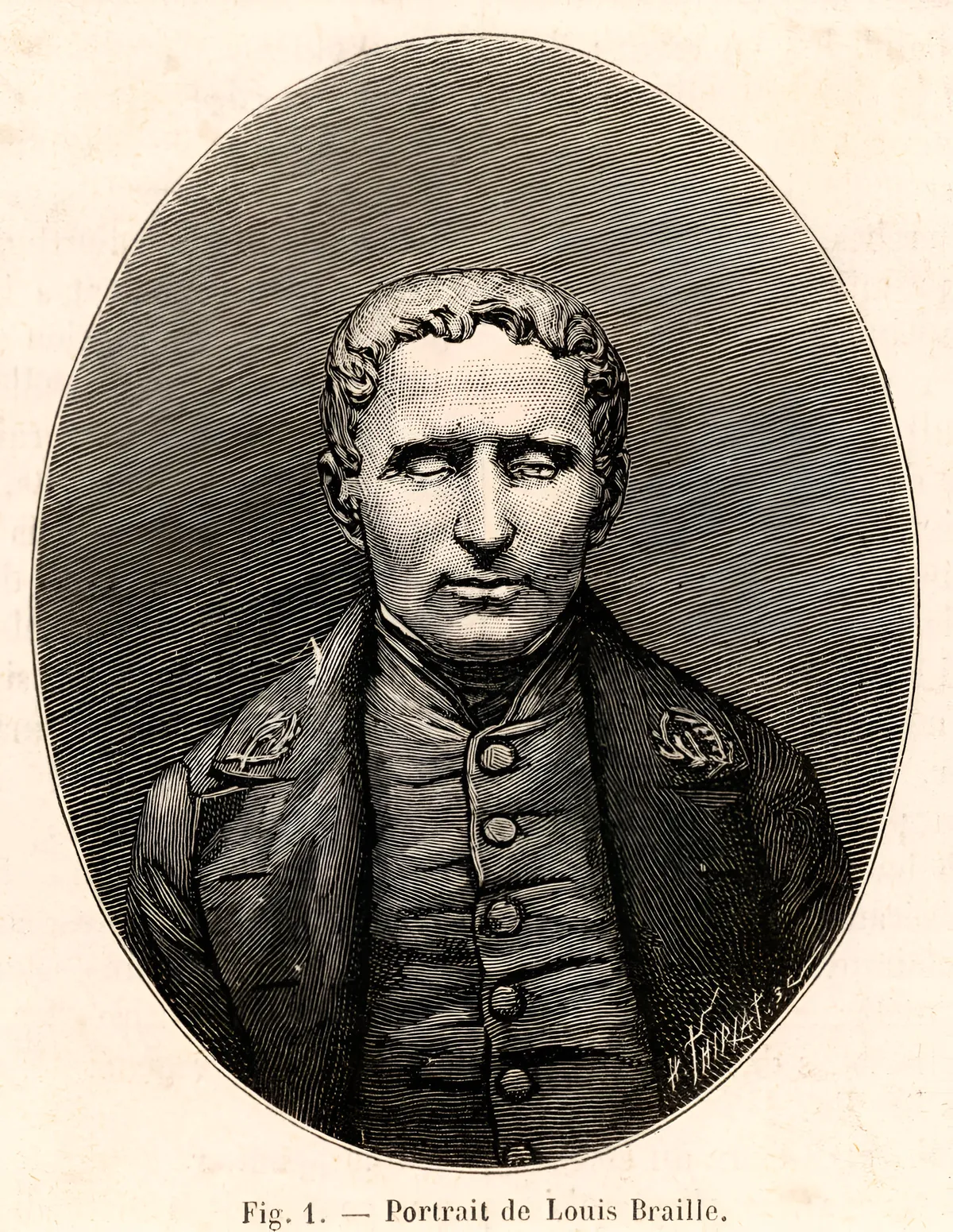
Louis Braille was born in Coupvray, France, on 4 January 1809, the youngest of four children.
His father was a harness-maker whose workshop was attached to the family home.
An accident at the age of three left him blind.
From the age of 10 to 18 he studied at the Royal Institution for Blind Youth in Paris, where books used raised copies of ordinary printed letters that were very hard to read by finger.
Pupils in that system could not write for themselves, because a printing press was needed to make the pages.
Night writing and the twelve-dot grid
Charles Barbier was a former French army officer. His night writing, called Ecriture Nocturne, was a tactile code for sending military messages.
Barbier gave a brief presentation at the Paris school in 1821, when Louis Braille was 12 years old.
Barbier's grids had twelve dots, which did not fit under a fingertip, and he had not tested the system with people who were blind.
Louis Braille liked that the code could be read and written with just a tablet and a pocket stylus. He thought it was limited because it recorded only sounds.
The 1824 redesign
Louis Braille began to develop his own tactile writing code in 1824.
The American Foundation for the Blind says he created it at age fifteen, while the Musee Louis Braille says he refined Barbier's principles between the ages of 12 and 16.
He cut the raised dots from twelve to six so that they fit under the pad of the index finger and could be read faster.
On that base he built a complete alphabet with punctuation, number signs and digits. Barbier's system had been phonetic.
At 19 he adapted the code for music. His method was published in 1829 and again in 1837.
From the Paris school to every language
The sighted world did not accept the system at first, and teaching from raised printed letters carried on for about another twenty years.
Louis Braille was diagnosed with tuberculosis in 1835, and he died at the Institute in Paris on 6 January 1852, aged 43.
In 1878 a congress in Paris on the welfare of blind and deaf people proposed braille as the reference system for all countries. It remained a recommendation, and braille did not become general until the 20th century.
After the Second World War, UNESCO led work to unify braille, first for India and then for Arabic, and later for languages such as French, Spanish and English. Nearly every language now has a braille equivalent.
Louis Braille's body was moved to the Pantheon in Paris in 1952.
World Braille Day is marked on 4 January and has been celebrated since 2019.
Sources
- American Foundation for the Blind, What is braille?
- United Nations, World Braille Day
- Musee Louis Braille, Braille l'inventeur
- National Federation of the Blind, Louis Braille: The Father of Literacy for the Blind
- Perkins School for the Blind, History of braille
- Musee Louis Braille, Reconnaissance universelle
- American Foundation for the Blind, The Final Years of Louis Braille