Language
The Rosetta Stone
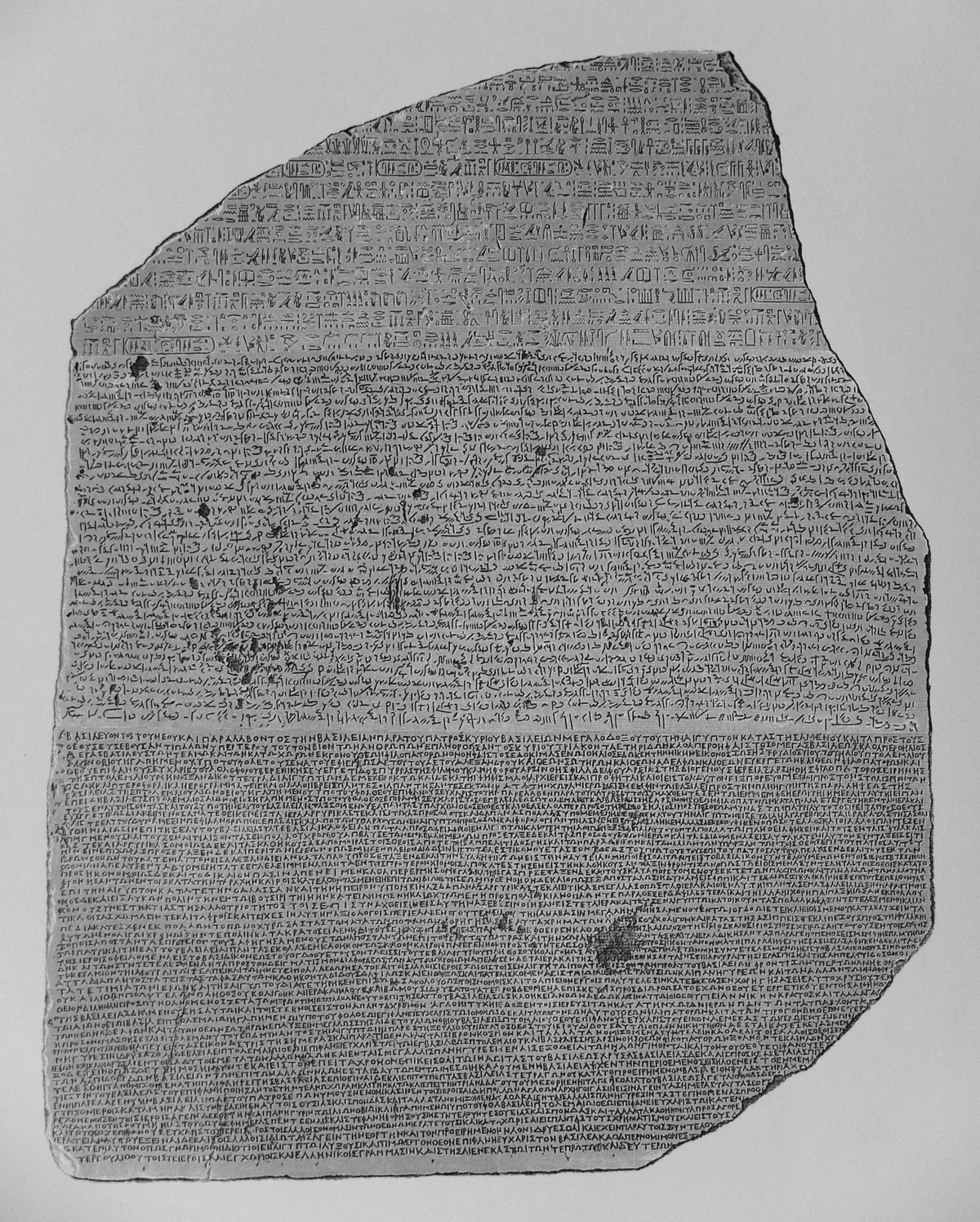
One decree carved in three scripts in 196 BCE let Jean-François Champollion announce the reading of Egyptian hieroglyphs in 1822.

At a glance
196 BCE
Year of the decree on the stone
1799
Year French soldiers found it near Rosetta
3 scripts
Hieroglyphic, demotic and Greek
1822
Year Champollion announced the decipherment
about three-quarters of a ton
Weight of the stone
167 scholars
Brought to Egypt with Napoleon's army in 1798
A wall at Fort Rashid
French soldiers found the stone in July 1799, during Napoleon's campaign in Egypt, while working at a fort near Rashid, a town the French called Rosetta.
Sources give the find as 15 July or 19 July 1799. The slab turned up as a soldier demolished a ruined wall at Fort Rashid, which the French renamed Fort Julien.
Napoleon had sailed for Egypt in May 1798 with 167 scholars, among them astronomers, engineers, linguists, painters and naturalists.
The Egyptian Institute of Arts and Sciences opened in Cairo on 22 August 1798. Its work fed the twenty volumes of Description de l'Égypte, published between 1809 and 1828.
One decree, three scripts
The text is a decree of 196 BCE issued by priests of Memphis to honour Ptolemy V Epiphanes, who ruled from 204 to 180 BCE.
According to the decree, Ptolemy V restored the economy and peace and reduced taxes, and statues and festivals were to be set up in his honour.
The same text appears in hieroglyphic, demotic and Greek. The decree ends by ordering that it be inscribed in holy, native and Greek scripts.
The Greek section states that the three versions carry the same meaning, which is why the stone could help unlock the hieroglyphs.
EBSCO and History describe the stone as basalt, while World History Encyclopedia describes it as an incomplete stela of grey and pink granodiorite. The upper hieroglyphic portion is the most damaged.
It measures 3 feet 9 inches long, 2 feet 4.5 inches wide and 11 inches thick (about 114 by 72 by 28 centimetres), and weighs about three-quarters of a ton.
From Alexandria to London
After the French left Egypt in 1801, the British took the main finds, including the stone, back to Britain.
The stone reached Britain in early 1802 and went first to the Society of Antiquaries in London, where plaster casts were made for universities.
By the end of 1802 it was housed in the British Museum, where it still is, despite repeated calls for its return to Egypt.
Scholars in Cairo had already copied the inscriptions with rubbings, drawings and casts and sent them across Europe, so researchers could work without the stone itself.
Reading the unreadable
The last known use of hieroglyphs dates to 394 CE, at a temple in Upper Egypt.
By about 650 BCE the cursive hieratic script had changed enough to be called demotic, the middle script on the stone.
By about 250 CE Christian Egyptians used Coptic, which mixed demotic and Greek and was the first form of Egyptian to write vowels. Its survival in religious texts helped scholars understand the spoken language.
Thomas Young began work on the hieroglyphs in 1814. He found that some signs marked plurals or numbers, and he published anonymously in 1819.
The Linda Hall Library credits Young with the first real progress on the stone, which, Young argued, made Champollion's success in 1822 possible.
Jean-François Champollion was in Paris by 1807, aged seventeen, working on copies of the inscriptions. He concluded that hieroglyphs were phonetic as well as pictorial.
Champollion announced his decipherment in 1822, with his breakthrough dated to 14 September of that year. He used his knowledge of Greek as a guide.
Sources
- EBSCO, Discovery of the Rosetta Stone
- History, Rosetta Stone found, July 15, 1799
- World History Encyclopedia, Timeline: Rosetta Stone
- Linda Hall Library, Thomas Young