Transport
The flight recorder
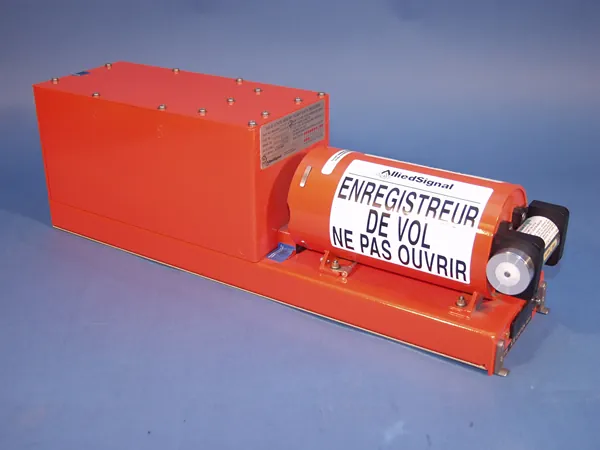
The black box is bright orange, built to survive 3,400 g, and was first designed in Australia by David Warren in the 1950s.

At a glance
3,400 g
Impact each recorder is built to withstand, for 6.5 milliseconds
1,100 °C
Fire each recorder is built to withstand
25 hours
Continuous recording on a flight data recorder
37.5 kHz
Frequency of the underwater locator beacon
1956
Year of Warren's crash-survivable prototype
Warren and the Comet crashes
Dr David Warren of the Aeronautical Research Laboratory at Fishermans Bend, Australia, is credited with inventing the world's first black box flight recorder, in 1953.
He had seen the Minifon, the first miniature tape recorder, at a trade fair at about the time the Comet, the first jet airliner, suffered a series of fatal crashes. He realised that a recorder in the cockpit could keep a record of everything said there.
The Comet accidents Warren responded to happened in 1952 and 1953. In 1956 he designed a crash-survivable prototype called the ARL Flight Memory Unit.
The British Ministry of Aviation later announced that the recorder should be carried on all planes, at first for recording instrument readings.
After the unexplained crash of a Fokker Friendship at Mackay in 1960, the judge at the court of inquiry ordered recorders fitted to all future Australian aircraft. Australia became the first country to require them.
Two recorders in the tail
Large airliners carry two recorders. A cockpit voice recorder captures the sounds in the cockpit, and a flight data recorder logs the aircraft's flight data.
Both are installed in the most crash-survivable part of the aircraft, usually the tail section.
A cockpit voice recorder captures crew voices and radio transmissions on 4 channels. Older units recorded on quarter-inch magnetic tape, and newer ones use digital memory chips.
A flight data recorder keeps 25 hours of continuous recording. A cockpit voice recorder keeps 30 minutes, or 2 hours in solid-state digital units.
US airline rules require the flight data recorder's data to be kept until the airplane has been operated for at least 25 hours.
By regulation, newly manufactured aircraft must monitor at least 88 parameters, such as altitude, airspeed, heading and attitude. Some flight data recorders track more than 1,000.
Orange, not black
The box is not black. US airworthiness rules require each cockpit voice recorder container and each flight data recorder container to be bright orange or bright yellow.
The container must also carry reflective tape on its external surface to help searchers locate it under water.
Each recorder carries an underwater locator beacon that switches on when immersed in water and transmits at 37.5 kHz.
The beacon runs for 30 days once activated, and its battery has a shelf life of 6 years or more.
Built to be found after a crash
Recorders are built to withstand an impact of 3,400 g for 6.5 milliseconds and a fire of 1,100 °C. The NTSB gives the fire duration as 30 minutes.
The container must be mounted to minimise the chance of rupture. It should sit as far aft as practicable, but not where aft-mounted engines could crush it.
An erasable recorder must stop automatically within 10 minutes after crash impact.
A cockpit voice recorder needs an independent backup power source that supplies 10 minutes, plus or minus one minute, of power for the recorder and the area microphone.
Sources
- Defence Science and Technology Group, Australian Department of Defence, Black box flight recorder
- Guinness World Records, First black box aircraft data recorder
- US National Transportation Safety Board, Cockpit Voice Recorders (CVR) and Flight Data Recorders (FDR)
- NBC News, Missing Flight 370, how do black boxes work?
- Cornell Law School Legal Information Institute, 14 CFR § 25.1457 Cockpit voice recorders
- Cornell Law School Legal Information Institute, 14 CFR § 25.1459 Flight data recorders
- Cornell Law School Legal Information Institute, 14 CFR § 121.343 Flight data recorders