Inventions
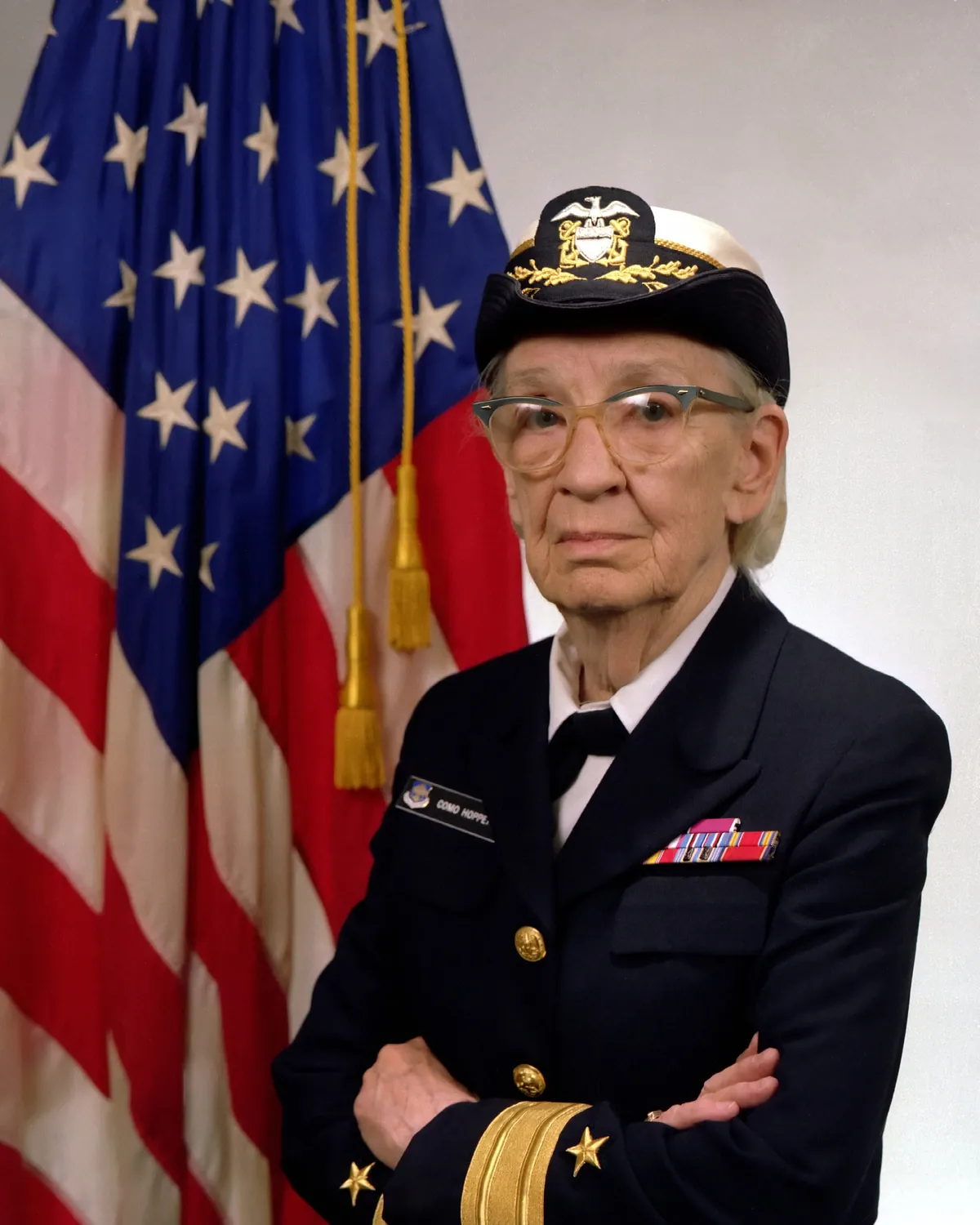
Grace Hopper
Grace Hopper made the 1947 moth famous, but the word 'bug' was already in use in the 1870s. Her lasting work was the compiler and the road to COBOL.

At a glance
1947
Year the moth was taped into the Mark II logbook
1870s
When Thomas Edison was already using the word 'bug'
561 pages
Length of the Harvard Mark I user manual she wrote
1952
Year of her A-0 compiler
1959
Year of the conference that produced COBOL
The moth in Relay 70
On 9 September 1947, a team working on the Harvard Mark II in Cambridge, Massachusetts, reported a moth trapped between the contacts of one of the machine's relays.
The moth was in Relay 70 on Panel F, and the log entry is timed at 15:45.
The team taped the dead moth into the computer's logbook, with the line 'First actual case of bug being found.'
Hopper was a programmer present at the incident, and she made it well known through her many public lectures. She often talked about the moth.
The word 'actual' in the log line suggests that 'bug' already meant a fault, and that this time there was a real insect to match.
A word older than the computer
Edison's patent caveat of early August 1873 contains the earliest version of what became his 'bug trap', a device to isolate a false break in the signal of his quadruplex telegraph, which carried four messages on one wire.
Edison's notebooks from his Menlo Park laboratory show him using the word 'bug' in 1876.
On 13 November 1878 Edison wrote to Theodore Puskas, describing 'bugs' as the small faults and difficulties that show themselves while an invention is being developed.
Thomas Sloane's Standard Electrical Dictionary of 1892 helped fix the term in print and traced its origin to quadruplex telegraphy.
Hopper did not coin the word. Engineers had used it since the 1870s, about seven decades before the moth was found, and the Computer History Museum traces the term to Edison in the 1800s.
A compiler nobody would touch
In 1949 Hopper joined the Eckert-Mauchly Computer Corporation as a senior mathematician, and in the early 1950s she worked on the UNIVAC I and II.
The A-0 system of 1951 to 1952 was a series of specifications that functioned as a linker and loader. The IEEE plaque describes it as the first executable program to translate source code into machine code.
Yale's biography calls A-0, developed in 1952, the first compiler, and the IEEE plaque credits Hopper with coining the term 'compiler'.
The hard part was management. Acceptance took about two years, and she recalled: 'I had a running compiler, and nobody would touch it.'
In 1956 her team ran FLOW-MATIC, the first programming language to use word commands. It was in use on the UNIVAC in 1957.
In 1959 she took part in the CODASYL conference that produced COBOL, and FLOW-MATIC led to the development of that language.
By the 1970s COBOL was the most extensively used computer language in the world.
Honours and a destroyer
In 1973 she became the first woman and the first American to be named a Distinguished Fellow of the British Computer Society.
She received the National Medal of Technology in 1991 and died in 1992 at age 85. She was buried with full military honours at Arlington National Cemetery.
The Navy commissioned the guided-missile destroyer USS Hopper in 1996, and she received the Presidential Medal of Freedom posthumously in 2016.
Sources
- Computer History Museum, This Day in History: September 9, 1947
- Computerworld, Moth in the machine: Debugging the origins of 'bug'
- IEEE Spectrum, Did You Know? Edison Coined the Term 'Bug'
- Thomas A. Edison Papers, Rutgers University, Earliest use of the term 'bug'
- Yale University, Biography of Grace Murray Hopper
- IEEE History Center, Milestones: A-0 Compiler and Initial Development of Automatic Programming, 1951-1952