Inventions
The microprocessor
Intel's 4004 of 1971 packed a processor into 2,300 transistors on one chip, where ENIAC had needed about 18,000 vacuum tubes and a whole room.

At a glance
2,300 transistors
Transistors in the Intel 4004, 1971
about 18,000 vacuum tubes
Tubes in ENIAC, completed 1945
10 microns
Minimum line width of the 4004
174,569 transistors
Transistors in the ENIAC-on-a-chip
1975
Year Moore revised his forecast to a doubling every two years
A computer that filled a room
ENIAC was built between 1943 and 1945 and was reported in the New York Times in February 1946.
It stood 8 feet high and 3 feet wide and ran almost 100 feet in length. It filled a room of 30 by 50 feet.
ENIAC contained about 18,000 vacuum tubes, cooled by eighty air blowers.
It lost roughly one tube every day or two, so engineers ran the tubes well below their maximum voltages to prolong their life.
Setting up a new problem, which meant designing the configuration, connecting wires and setting switches, could take many days.
ENIAC kept running until a lightning strike in 1955.
A calculator order becomes a computer
Busicom, a Japanese calculator company, asked Intel for custom chips. Ted Hoff instead proposed a general-purpose 4-bit computer built from four chips.
Intel introduced the chip family in 1971 as the MCS-4 Micro Computer Set. An advertisement for the first commercially available microprocessor ran in Electronic News in November 1971.
Hoff and Stanley Mazor conceived the 4004 as a 4-bit device, and it was Intel's first integrated CPU.
Federico Faggin joined Intel in 1970 as principal designer and project leader of the chip set. Masatoshi Shima, who worked for Busicom, was assigned that year to assist him.
The 4004 has 2,300 transistors, packed into a low-cost 16-pin package.
The chips were made on 2-inch p-channel silicon-gate wafers, with a die of 12 square millimetres and a minimum line width of 10 microns.
The Busicom 141-PF printing calculator prototype of 1971 was the test bed for the 4004's first commercial use.
After the 4004
Intel announced the 8-bit 8008 in 1972, designed by Hal Feeney under Faggin's supervision.
By 1974 second-generation 8-bit microprocessors from Intel (the 8080) and Motorola (the 6800) had gained wide acceptance.
Doubling on schedule
On 19 April 1965 Gordon Moore, then Fairchild Semiconductor's research director, wrote in Electronics that the number of components on integrated circuits would double every year for the next 10 years.
In 1975 he revised the forecast to a doubling every two years. He had co-founded Intel in 1968.
Between 1971 and 2010 the transistor count of the largest microprocessors roughly doubled about every two years.
The smallest element on a chip shrank from about 50 microns around 1962 to under 0.1 microns, and wafers grew from about 0.875 inches to 300 millimetres.
ENIAC on a chip
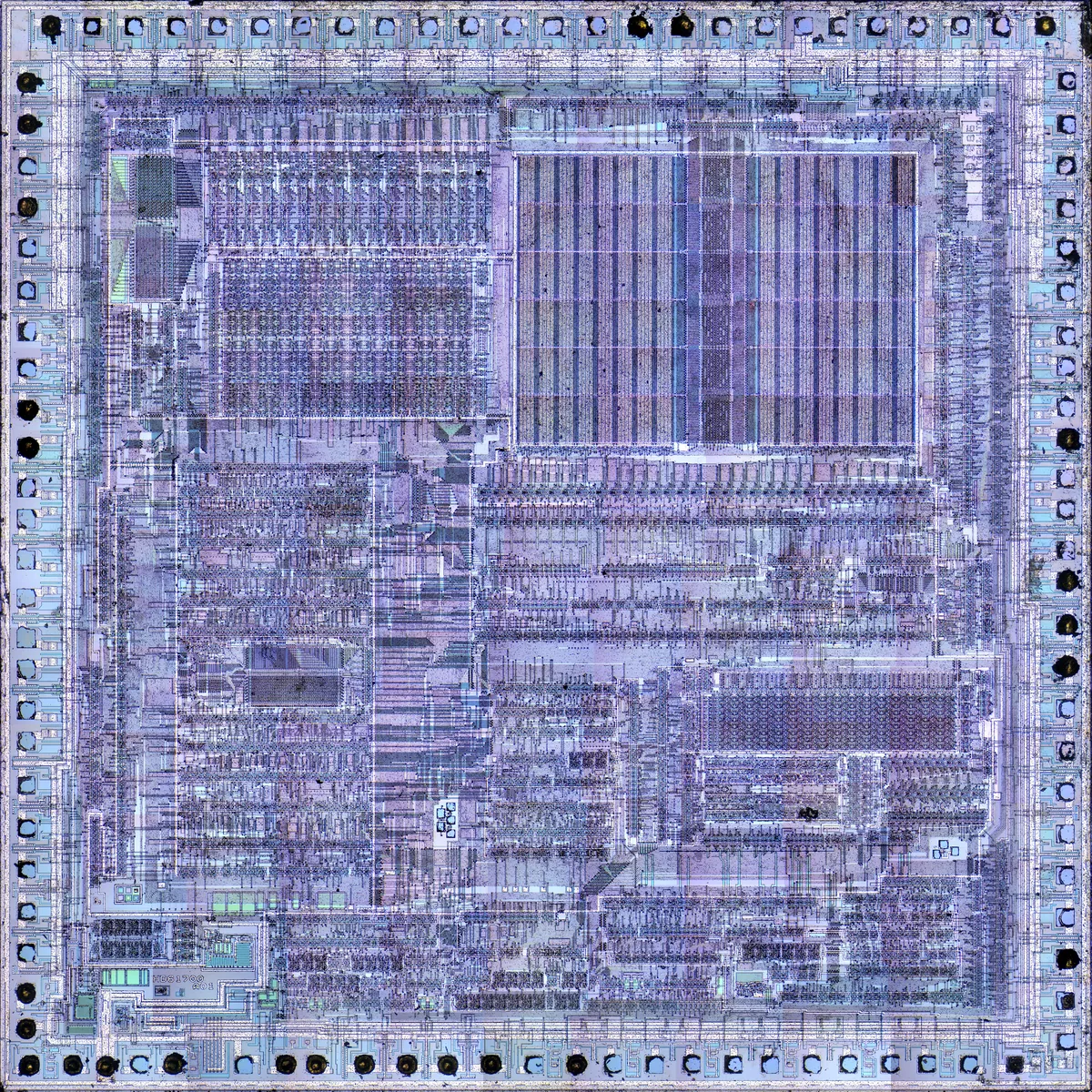
For ENIAC's 50th anniversary, a University of Pennsylvania team recreated its architecture on a single chip measuring 7.44 by 5.29 millimetres.
The chip uses a 0.5 micrometre CMOS process and contains about 174,569 transistors, roughly 76 times the 4004's count.
The team modelled the vacuum tube circuits with transistors and replaced mechanical switches with electronic ones. ENIAC itself used a base 10 number system.
Sources
- Computer History Museum, Revolution: Birth of the Computer, ENIAC
- IEEE History Center, Milestones: Electronic Numerical Integrator and Computer, 1946
- Computer History Museum, Intel's Microprocessor
- Computer History Museum, 1971: Microprocessor integrates CPU function onto a single chip
- Computer History Museum, Moore's Law
- University of Pennsylvania, ENIAC-on-a-Chip
- Computer History Museum, ENIAC chip