Records and extremes
Lake Baikal
Lake Baikal in Siberia is the deepest lake on Earth at 1,642 metres, and it sits in a rift that is still pulling apart.
At a glance
1,642 metres
Maximum depth
20 to 25 million years
Estimated age
23,615 cubic kilometres
Water volume
20 %
Share of the world's unfrozen fresh water, per UNESCO
2 centimetres a year
Approximate widening of the rift
A depth measured by a military survey
Lake Baikal, in Siberia, is the deepest lake in the world, with a maximum depth of 1,642 metres (5,387 feet).
That figure comes from a bathymetric survey run by the Soviet Ministry of Defense's Department of Navigation and Oceanography from 1979 to 1986. The maps were published in 1992 for official use only, and the data were declassified in 1999.
A 1991 dive recorded 1,637 metres, at a time when only the Ministry of Defense held the 1,642 metre figure. The Limnological Institute of the Russian Academy of Sciences now calls 1,642 metres the undisputed depth.
Lake Tanganyika in Africa is the second-deepest lake, with a maximum depth of 1,470 metres.
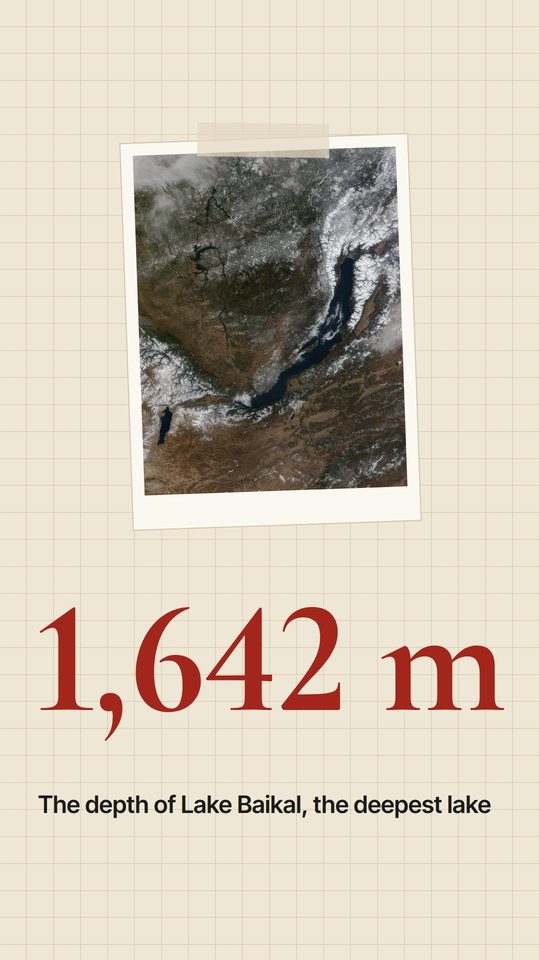 Watch the ShortThe deepest lakes
A rift that is still opening
Baikal fills a tectonic rift in the Earth's crust. The rift is active and is widening the lake by roughly 2 centimetres a year.
The lake is between 20 and 25 million years old, which makes it the oldest lake in the world. UNESCO gives 25 million years, and the US Geological Survey says perhaps more than 25 million.
The water is only the top of the story. The rift floor lies perhaps 8 to 9 kilometres below the surface, and sediment more than 7 kilometres thick fills parts of it.
Researchers began drilling cores from the lake ice in early 1993, and they have taken cores longer than 100 metres. The sediment record is used to study global climate change.
The shallow sediments may hold the only known natural gas hydrates in a freshwater setting.
One fifth of the unfrozen fresh water
Baikal holds about 23,615 cubic kilometres of water, the largest volume of any freshwater lake.
UNESCO puts the lake's share at 20% of the world's unfrozen fresh water reserve. The US Geological Survey gives roughly 20% of the world's surface fresh water.
It contains about as much fresh water as North America's Great Lakes combined, and the Guinness World Records entry says more.
The lake covers about 3.15 million hectares (31,500 square kilometres). It was inscribed as a World Heritage site in 1996.
The Galapagos of Russia
Age and isolation have given Baikal one of the richest and most unusual freshwater faunas in the world. UNESCO calls it the Galapagos of Russia.
The Baikal seal is the only seal that lives primarily in fresh water, and it is endemic to the lake and its connecting rivers. Adults grow to about 1.3 metres and weigh 50 to 130 kilograms.
Sources
- Guinness World Records, Deepest lake
- Limnological Institute, Siberian Branch of the Russian Academy of Sciences, More on the maximum depth of Lake Baikal
- European Space Agency, Africa's ancient Lake Tanganyika
- Guinness World Records, Oldest lake
- UNESCO World Heritage Centre, Lake Baikal
- US Geological Survey, Lake Baikal, a touchstone for global change and rift studies
- University of Michigan Museum of Zoology, Pusa sibirica (Baikal seal)