Records and extremes
The North American X-15
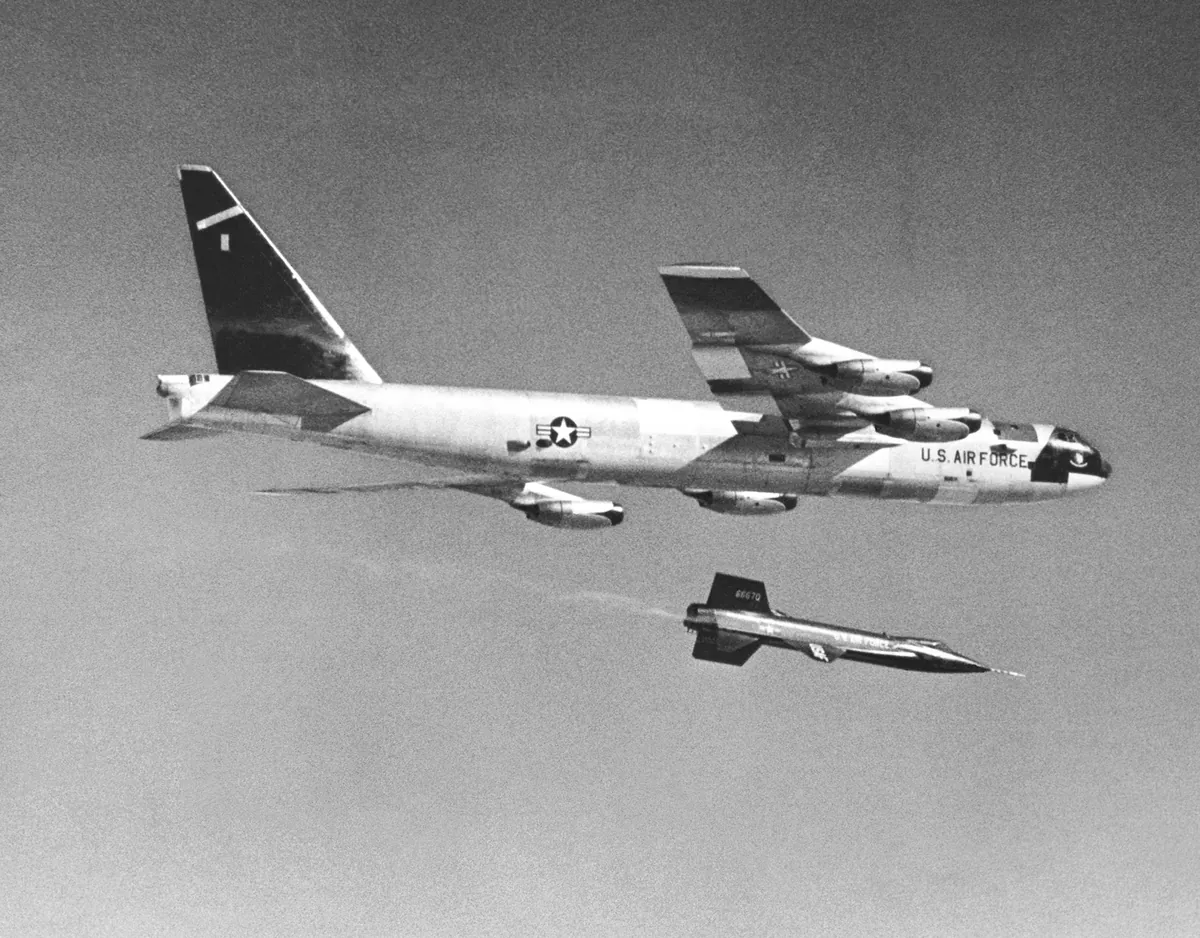
The rocket-powered X-15 was dropped from under the wing of a B-52 at about 45,000 feet and flew 199 missions between 1959 and 1968.

At a glance
199 flights
Missions flown from 1959 to 1968
12 pilots
Men who flew the X-15
45,000 feet
Altitude at which the B-52 released it
A rocket plane carried under a bomber
The X-15 was built by North American Aviation as a joint project of NASA, the US Air Force and the US Navy.
The National Advisory Committee for Aeronautics, NASA's predecessor, began studying the concept in 1952. The Air Force asked for bids on 30 December 1954 and picked North American Aviation on 30 September 1955.
Three aircraft were built. The first rolled out on 15 October 1958, the second on 27 February 1959, and the third, with the XLR-99 engine, joined the fleet in 1960.
A modified B-52 Stratofortress carried the 34,000-pound X-15 under its wing and released it at about 45,000 feet.
The first glide flight was by Scott Crossfield on 8 June 1959. The first powered flight followed on 17 September 1959, reaching Mach 2.11 and 52,341 feet.
Early flights used XLR-11 engines producing 16,000 pounds of thrust in total. The XLR-99, rated at 57,000 pounds of thrust, was built for the X-15 but arrived late.
A typical research mission lasted 8 to 12 minutes, ending in a glide to a dry lakebed landing.
The first powered flight, with Scott Crossfield at the controls, burned for 224 seconds.
Crossfield's later flights reached Mach 2.97 and 88,116 feet. The original research goal was altitudes between 12 and 50 miles.
That first powered flight took place at the Flight Research Center at Edwards Air Force Base, California, on 17 September 1959, with the X-15-2.
Built to take the heat
The skin was Inconel X, a nickel-chrome alloy designed to withstand extreme hypersonic heat, and the aluminium cabin was insulated from it to keep the pilot at a safe temperature.
Thiokol's Reaction Motors Division was chosen in February 1956 to build the XLR-99, a 57,000-pound throttleable single-chamber engine.
Twelve pilots and 199 flights
Between 1959 and 1968, 12 pilots flew 199 missions. Five were from NASA, five from the Air Force, one from the Navy and one from North American Aviation.
Robert A. Rushworth flew the most missions, 34. John B. McKay flew 29 and Joseph A. Walker flew 25.
Neil Armstrong flew seven X-15 flights before becoming an astronaut. Joe Engle flew 16.
Michael J. Adams died on 15 November 1967 when the X-15-3 broke apart.
The last flight took place on 24 October 1968 with William H. Dana at the controls, and funding ended on 31 December 1968.
The program produced more than 765 research reports.
Crossfield's 14th flight, on 6 December 1960, ended the contracted testing program, and North American Aviation then handed the aircraft to the Air Force and NASA.