Inventions
The pendulum clock
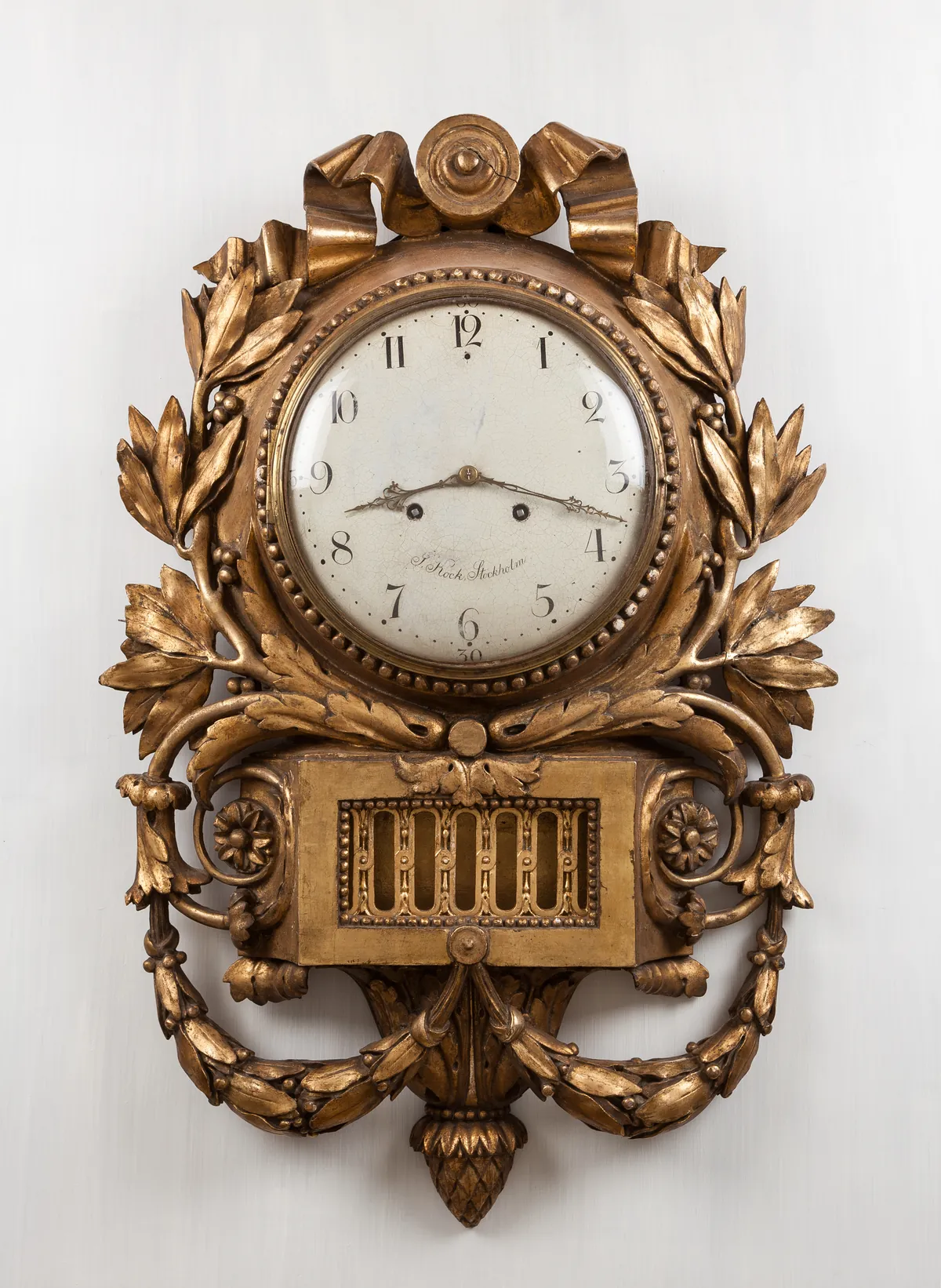
Huygens's pendulum clock of 1656 and 1657 brought daily error down from about 15 minutes, building on Galileo's work on the swinging weight.

At a glance
1656 or 1657
Years given for the first pendulum clock
about 15 minutes a day
Typical error of earlier mechanical clocks
1656
Year Huygens finished his first prototype
Galileo's idea, Huygens's clock
Galileo's first notes on the pendulum date from 1588, and his serious investigation began in 1602.
In 1641, aged 77 and blind, Galileo proposed adapting a pendulum to clocks, and his son Vincenzio helped work out a scheme.
Galileo died in 1642 without building a pendulum clock.
Christiaan Huygens finished a prototype by the end of 1656. NIST dates the first pendulum clock to 1656 on one page and to 1657 on another.
He patented the device on 16 June 1657, and hired a clockmaker in The Hague, Salomon Coster, to construct others.
Why a pendulum keeps time
Galileo found that a pendulum's period does not depend on the amplitude of its swing, a principle called isochronism.
A simple pendulum is not strictly isochronous. Huygens showed this in the 1650s and added cycloidal cheeks to make the swing truly isochronous.
The Royal Society proposed a standard length: the pendulum that took one second to make a half-swing.
From fifteen minutes to fifteen seconds
Early mechanical clocks were accurate to only about 15 minutes per day.
The American Physical Society puts the drift of Huygens's clocks at only 15 seconds per day. NIST says the early clock erred by less than a minute a day.
Before the pendulum clock, the best clocks were useless for astronomical purposes because they gained or lost time irregularly.
Huygens's clocks were far more accurate than the spring-driven table clocks of his era.
Later improvements to the pendulum clock raised its accuracy further.
Beyond the clock face
In 1673 Huygens published a major treatise on pendulums. It described how swing width affects the period and the coupling of oscillators.
Huygens also built pendulum clocks to help measure longitude at sea. They were tested at sea in 1662 and 1686 with mixed results.
In 1675 Huygens designed a pocket watch.
In 1665, while recovering from an illness, Huygens observed coupled oscillation, which he called "an odd kind of sympathy".
In 2000 physicists at Georgia Tech confirmed his explanation of coupled oscillation.
Later pendulum clocks
In 1671 William Clement in London began making clocks with the anchor, or recoil, escapement, which disturbs the pendulum less than the older verge.
The Shortt clock of 1921 used a master pendulum and a slave pendulum. The slave gave the master its gentle pushes and drove the hands, keeping the master free of mechanical tasks.
Pendulum clocks led timekeeping until the quartz clock arrived in 1927.
Sources
- Rice University, The Galileo Project: Pendulum
- National Institute of Standards and Technology, A Walk Through Time: A Revolution in Timekeeping
- National Institute of Standards and Technology, Second: The Past
- American Physical Society, June 16, 1657: Christiaan Huygens Patents the First Pendulum Clock