Oceans
Seawater
Seawater holds 97% of Earth's water and averages about 35 parts per thousand salt. Its blue comes mostly from the water itself, not the sky.
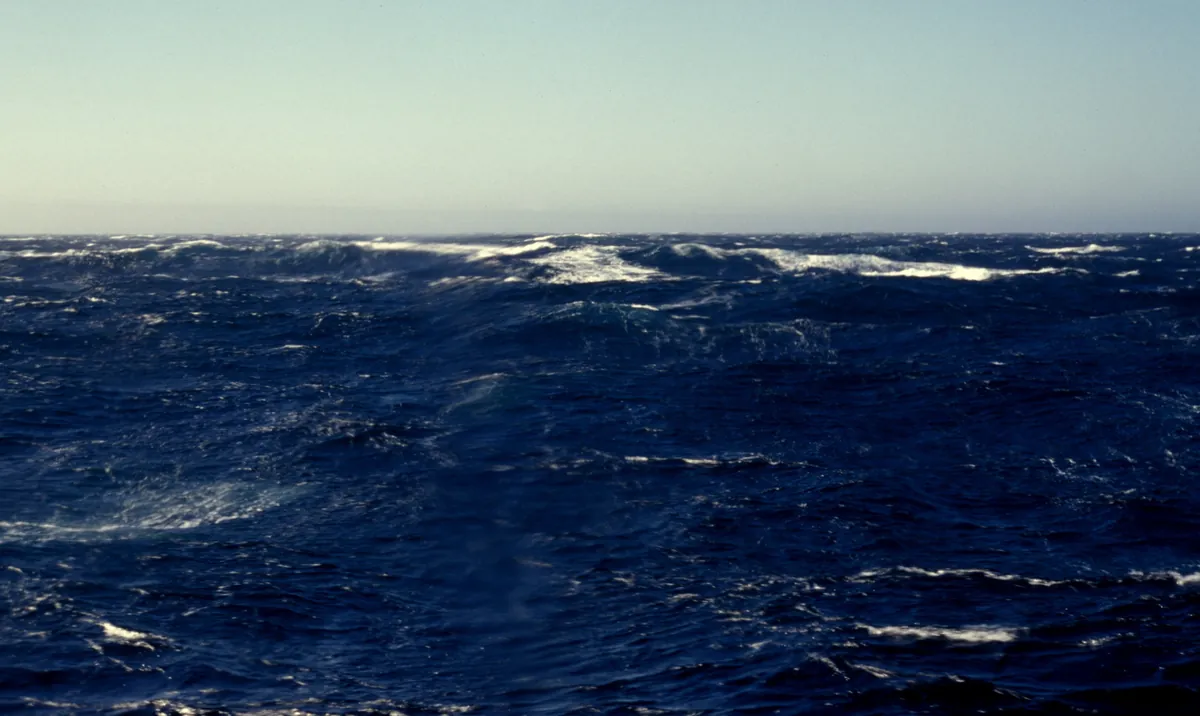

At a glance
97 %
Share of Earth's water held in the ocean
1.335 billion km³
Volume of the ocean, NOAA estimate
35 parts per thousand
Average salinity of seawater
3,682 metres
Average ocean depth
200 metres
Depth beyond which significant light is rare
The volume of the ocean
About 97 percent of the Earth's water is in the ocean. Less than one percent of all water on Earth is fresh.
The US Geological Survey puts the planet's water at over 1,386,000,000 cubic kilometres. NOAA's National Geophysical Data Center estimates that 1,335,000,000 cubic kilometres of it is in the ocean.
The ocean's surface area is about 360 million square kilometres, and its average depth is 3,682 metres.
Why the sea looks blue
The ocean is blue because water absorbs colours in the red part of the light spectrum. Like a filter, this leaves behind the blue part of the spectrum for us to see.
The sky is blue for a different reason: it preferentially scatters shorter wavelengths of light.
The ocean is not blue just because it reflects the sky. On a calm surface seen from a low angle, some of the blue is reflected sky, but reflection does not fully account for the colour of the water.
Water has a slight blue colour of its own. It takes a large quantity, such as the ocean, for humans to notice it, and a drinking glass holds far too little. Looking through a 3-metre tube of purified water, observers report seeing blue.
The sea can take on green, red or other hues as light bounces off floating sediments and particles in the water.
Light and colour with depth
Light may be detected as far as 1,000 metres down, but there is rarely any significant light beyond 200 metres.
The upper 200 metres is the euphotic, or sunlight, zone. The twilight zone runs from 200 to 1,000 metres, and the aphotic zone below 1,000 metres is bathed in darkness.
In clear tropical water the brightly lit zone may extend to about 80 metres, and near the poles it may be less than 10 metres deep.
Blue light penetrates water best, followed by green, yellow, orange and red. Red light is filtered out quickly and effectively never reaches the deep ocean.
Because no red light reaches the depths, deep-sea animals that are red appear black. In the twilight zone, red and black animals predominate.
Salt in seawater
The average salinity of seawater is about 35 parts per thousand, which means about 3.5 percent of its weight comes from dissolved salts. Typical values run from 33 to 37 grams per litre.
Chloride and sodium together make up around 85 percent of the dissolved ions in the ocean. Magnesium and sulfate add another 10 percent.
Salt reaches the sea by two routes: rocks on land eroded by slightly acidic rainwater, whose ions are carried to the sea by rivers, and hydrothermal fluids from vents in the seafloor.
Salinity is generally low at the equator and at the poles, and high at mid-latitudes. Rain dilutes surface water near the equator, and melting ice dilutes it near the poles.
The Atlantic is the saltiest of the five ocean basins. The saltiest ocean water, around 40 parts per thousand, lies in the Red Sea and the Persian Gulf region, where evaporation is high and little fresh water flows in.
Water with a salinity of 35 parts per thousand freezes at about minus 2 degrees Celsius. Sea ice itself holds only about a tenth of the salt that seawater does.
Warm on top, cold below
A thermocline is the transition layer between the warmer mixed water at the surface and the cooler deep water below it, and the temperature drops rapidly across it.
The thermocline is semi-permanent in the tropics, varies with the seasons in temperate regions, and is shallow or absent near the poles, where the water is cold from top to bottom.
In the deep ocean, below about 1,000 metres, temperatures stay near freezing, around 3.9 degrees Celsius.
Sources
- NOAA National Ocean Service, How much water is in the ocean?
- NOAA Ocean Exploration, How much of the ocean has been explored?
- NOAA National Ocean Service, Why is the ocean blue?
- NASA PACE mission, Color determination
- West Texas A&M University, What is it about the ocean that makes it look blue when it reflects the sky?
- Journal of Chemical Education, Why is water blue? (reproduced by WebExhibits)
- NOAA National Ocean Service, How far does light travel in the ocean?
- University of Hawaii at Manoa, Light in the ocean
- NOAA Ocean Exploration, Red light does not reach ocean depths
- NOAA National Ocean Service, Why is the ocean salty?
- NOAA JetStream, Sea water
- NOAA National Ocean Service, What is a thermocline?
- NOAA Ocean Today, The deep ocean