Science
The kilogram
Until 2019 a golf-ball-sized platinum-iridium cylinder near Paris defined the kilogram. Now the Planck constant does.

At a glance
1889
Year the metal cylinder was sanctioned as the unit of mass
40 copies
Similar prototypes made at about the same time
60 countries
Voted to redefine the kilogram in November 2018
6.626 070 15 x 10^-34 J s
Fixed value of the Planck constant in the new definition
A cylinder in a vault near Paris
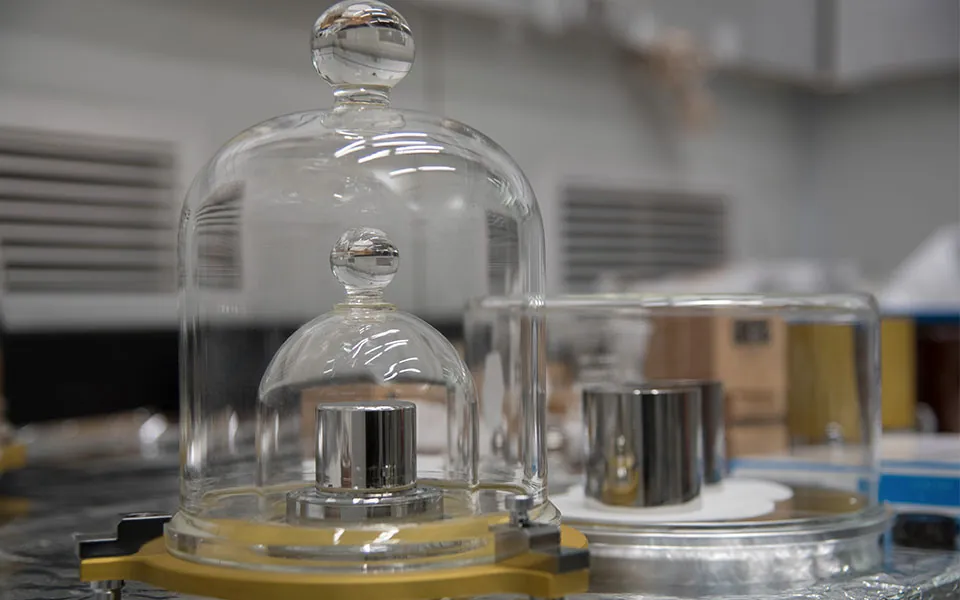
The 1889 definition of the kilogram was simply the mass of the international prototype, an artefact made of platinum-iridium.
The cylinder was cast in 1879 and is about the size of a golf ball. It is an alloy of 90 percent platinum and 10 percent iridium.
Officially the International Prototype of the Kilogram, it had the nickname Le Grand K. It was kept in a triple-locked vault on the outskirts of Paris by the International Bureau of Weights and Measures (BIPM) in Sèvres, France.
In 1889 the 1st General Conference on Weights and Measures sanctioned the prototype and declared that "this prototype shall henceforth be considered to be the unit of mass".
Forty similar prototypes were machined and polished at about the same time to closely match its mass. Most were assigned to member states as national prototypes.
The United States received the fourth and 20th copies, known as K4 and K20, in 1890.
From a litre of water to platinum
In the late 1700s a commission for King Louis XVI proposed a mass unit called the grave, defined as the mass of a litre of water at the ice point.
The French republic instead defined the gram as the mass of 1 cubic centimetre of water at 4 degrees Celsius. A solid metal mass a thousand times heavier was more practical for trade, and on 22 June 1799 the republic adopted a platinum kilogram called the kilogram of the archives.
On 20 May 1875, 17 countries signed the Treaty of the Meter, which embodied the kilogram in a new platinum-iridium artefact of essentially the same mass as the kilogram of the archives.
The trouble with one object
After 1960 the kilogram was the only SI unit still defined by a single manufactured object.
In theory every standard mass in the world was to be compared directly with the cylinder, so the accuracy of every mass measurement depended on how closely reference masses could be linked to it.
Comparisons of the national prototypes with the international prototype showed their masses diverging.
A constant of nature takes over
On 16 November 2018, in Versailles, a group of 60 countries voted unanimously to redefine the SI in terms of unchanging properties of nature.
The change went into effect on 20 May 2019. Four of the seven base units, the kilogram, kelvin, ampere and mole, were redefined in terms of constants of nature.
The kilogram is now defined by taking the fixed numerical value of the Planck constant h to be 6.62607015 x 10^-34 when expressed in the unit J s, which is equal to kg m^2 s^-1, where the metre and the second are defined in terms of c and the caesium frequency.
The new definitions of the kilogram, ampere, kelvin and mole rest on fixed values of the Planck constant, the elementary charge, the Boltzmann constant and the Avogadro constant.
The numerical values of the seven defining constants have no uncertainty.
The prototype is still kept at the BIPM.
Weighing with electricity
The Kibble balance, conceived in 1975 by Bryan Kibble at the UK's National Physical Laboratory, offsets the weight of a test mass with a force produced by a current in a coil within a magnetic field.
It was originally called a watt balance, because the current and voltage it measures multiply to give power in watts.
With the Planck constant fixed exactly, a Kibble balance can measure mass without the cylinder or any physical object.
Sources
- Bureau International des Poids et Mesures, Historical perspective: Unit of mass, kilogram
- National Institute of Standards and Technology, Kilogram: Introduction
- National Institute of Standards and Technology, Kilogram: The Past
- National Institute of Standards and Technology, SI Redefinition
- National Institute of Standards and Technology, Definitions of SI Base Units
- Bureau International des Poids et Mesures, SI defining constants
- Bureau International des Poids et Mesures, SI base units
- National Institute of Standards and Technology, Kilogram: The Kibble Balance