Science
Diamonds
Diamond is almost pure carbon, ranks 10 on the Mohs scale, and the largest stone cut from the 3,106-carat Cullinan weighs 530 carats.

At a glance
99.95 %
Typical share of carbon in diamond
10
Rating on the Mohs scale, the top
about 100 miles
Depth range where diamond forms
3,106 carats
Weight of the Cullinan rough diamond
530 carats
Weight of Cullinan I, cut from the rough
A gem made of one element
Diamond is typically about 99.95% carbon, with the remainder trace elements.
Its crystal structure is isometric, so carbon atoms bond in essentially the same way in every direction. Rough gem diamond most often forms as an octahedron, which resembles two pyramids joined at their bases.
Graphite is also pure carbon but is very soft, because its formation and crystal structure differ. Diamond has a density of 3.513 grams per cubic centimetre and graphite 2.2.
Carbon's allotropes include diamond, graphite, graphene, amorphous carbon and fullerene, each with different physical properties.
Hardest on the scale
Diamond can only be scratched by another diamond.
Friedrich Mohs, a German geologist and mineralogist, created the scale that ranks diamond at 10, the top. Corundum is 9, topaz 8 and quartz 7.
Made deep, and able to burn
Diamond forms under high temperature and pressure within a depth range of about 100 miles beneath the Earth's surface.
Natural diamonds occur in kimberlite, with major sources in Russia, Botswana, the Democratic Republic of the Congo, Canada and South Africa. Microscopic diamond crystals also occur in some meteorites.
Diamond is metastable. Graphite is the most stable form of carbon at room temperature and pressure, but the conversion is so slow that it effectively does not happen.
Carats and the Cullinan
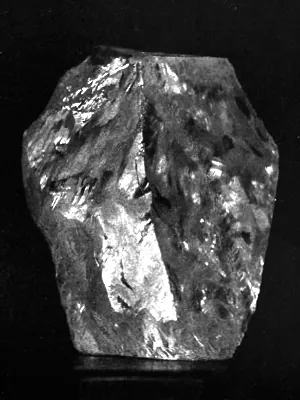
The Cullinan diamond, found in South Africa's Cullinan mine (formerly Premier), weighed 3,106 carats as rough.
The two largest stones cut from it, Cullinan I at 530 carats and Cullinan II at 317 carats, were presented to King Edward VII in 1908 and have been part of the Crown Jewels of England since.
Both stones are described as approximately D-color and potentially flawless.
Mining and trade in 2024
Total world diamond production in 2024 was essentially unchanged from 2023.
In 2024 Russia was the world's leading diamond producer and exporter by volume. Its state-owned mining company accounted for nearly one-third of global natural diamond production.
The United States banned imports of rough and finished gem-grade diamonds from Russia in April 2022. The Group of Seven announced a ban on Russian diamonds in December 2023, and the European Union's version took effect on 1 March 2024.
By value, US diamond imports in 2020 to 2023 came from India (47%), Israel (26%), Belgium (11%) and South Africa (5%).
The United States was one of the world's leading markets for polished diamonds in 2024.
Sources
- Gemological Institute of America, Diamond description
- Royal Society of Chemistry, Carbon: Element information, properties and uses
- National Park Service, Mohs hardness scale
- Gemological Institute of America, The Cullinan Diamond Centennial
- US Geological Survey, Mineral Commodity Summaries 2025: Gemstones