Geography
The Amazon River
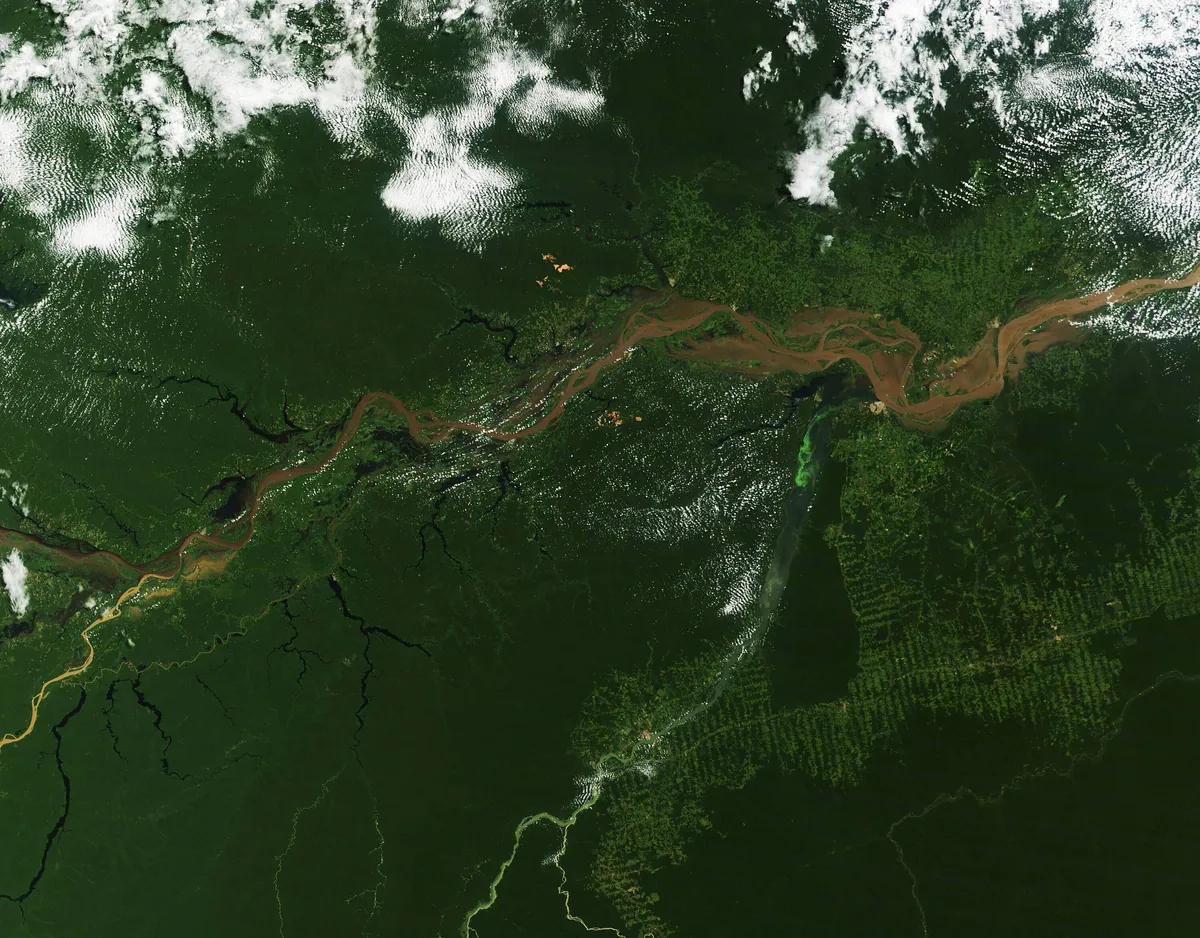
The Amazon carries about a sixth of the river water reaching the oceans, roughly 12 times the flow of the Mississippi.

At a glance
212,000 m³/s
Average discharge, Natural Resources Canada figure
18 %
Share of global river discharge, 1980 to 2009 (2024 study)
6,800 km
Length estimated by a Brazilian team in 2007
more than 6,000,000 km²
Area of the Amazon Basin
3,366
Valid freshwater fish species names listed for the basin, 2020
About a sixth of the river water reaching the sea
The Amazon has an average discharge of 212,000 cubic metres per second, which is more than one-sixth of the world's total river discharge.
A 2024 study reported by NASA found that the Amazon basin discharges 6,789 cubic kilometres of water a year, which is 18 percent of the global discharge of 37,411 cubic kilometres a year averaged over 1980 to 2009.
The Wildlife Conservation Society's Amazon Waters Alliance puts the Amazon's share lower, at 15 to 16 percent of the river water reaching the oceans.
Estimates of the river's discharge have risen over the past two decades as more measurements were made, and the Amazon Waters Alliance now puts the average between 215,000 and 230,000 cubic metres per second.
The Congo, the second-largest river, has an average discharge of 39,600 cubic metres per second, less than one-fifth of the Amazon's.
The Mississippi, the largest river in North America, averages 17,300 cubic metres per second. The Amazon Waters Alliance puts the Amazon's flow at 12 times the Mississippi's and 5 times the Congo's.
The 2024 study estimated that the Amazon basin contains about 38 percent of the world's river water, averaged over 1980 to 2009, the most of any hydrologic region evaluated.
Where the river meets the Atlantic
During the flood season the Amazon pours so much water into the Atlantic that its sediment-laden whitewater can be seen about 160 kilometres offshore.
Because ocean water is colder and heavier, the river's water flows over the surface of the sea.
A basin across northern South America
The Amazon River drains approximately 38 percent of continental South America.
The Amazon Basin covers more than 6,000,000 square kilometres.
Tributaries drain off the Andes along the basin's western edge, where the terrain rises to mountain peaks.
A Brazilian team that travelled to Peru in 2007 placed the river's source on Mount Mismi, and estimated the Amazon at 6,800 kilometres long. The Nile is thought to be 6,695 kilometres long.
Measuring a river's length is difficult because the result depends partly on which source is identified. Before the 2007 claim, the Nile had been regarded as only slightly longer than the Amazon.
A hotspot for freshwater fish
A standardised 2020 database of Amazon Basin fish lists 3,366 valid species names, and its authors say Amazonian fishes make up about 15 percent of all freshwater fish species described worldwide.
The Central Amazon Conservation Complex is the largest protected area in the Amazon Basin, and UNESCO describes it as home to the largest array of electric fish in the world.
It also protects the giant arapaima fish, the Amazonian manatee, the black caiman and two species of river dolphin.
Two dolphins in a falling population
The Amazon basin hosts two very different dolphins: the boto, or Amazon river dolphin, Inia geoffrensis, and the smaller tucuxi, Sotalia fluviatilis.
A 22-year survey in the Mamirauá Reserve in Amazonas State, Brazil, found populations halving every 10 years for botos and every 9 years for tucuxis at the rates then current.
Hunting of dolphins for fish bait developed around the start of this millennium, and it broadly coincided with a perception that numbers of both species were in decline.
Sources
- Natural Resources Canada, Annual large river flow
- NASA Earth Observatory, Global Accounting of Earth's Rivers
- Amazon Waters Alliance, Wildlife Conservation Society, Flow & Floods
- Scientific Data, A database of freshwater fish species of the Amazon Basin
- NASA Earth Observatory, Source of the Amazon River
- UNESCO World Heritage Centre, Central Amazon Conservation Complex
- PLOS ONE, Both cetaceans in the Brazilian Amazon show sustained, profound population declines over two decades