Geography
Magnetic north
A compass points to magnetic north, a drifting Arctic spot that moved at about 55 kilometres a year in a 2007 survey, not to the geographic North Pole.

At a glance
1831
Year James Clark Ross first located the pole
about 55 km per year
Pole's drift speed in the 2007 survey
85.762 °N
Latitude of the pole in 2025, per the World Magnetic Model
780,000 years ago
Most recent reversal of the field
5 years
Longest gap between World Magnetic Model updates
Why a compass does not point at the pole
A compass points toward magnetic north, not true north. True north is the geographic axis on which the planet turns, while magnetic north is where a compass points.
Magnetic north is the point on Earth's surface at which the magnetic field lines point vertically downwards.
Even away from the pole, a compass needle does not aim at the pole. It follows the horizontal component of the magnetic field where the compass is, and not any single point.
Declination: the gap you have to correct
Magnetic declination, sometimes called magnetic variation, is the angle between magnetic north and true north. It is positive when east of true north and negative when west.
Declination changes over time and from place to place, so the correction a walker needs depends on both where and when.
To find a true bearing, add the declination to the magnetic bearing, counting degrees west as negative. A declination of 10 degrees west is written as -10.
Lines of equal declination, called isogonic lines, converge at the pole.
A pole that will not sit still
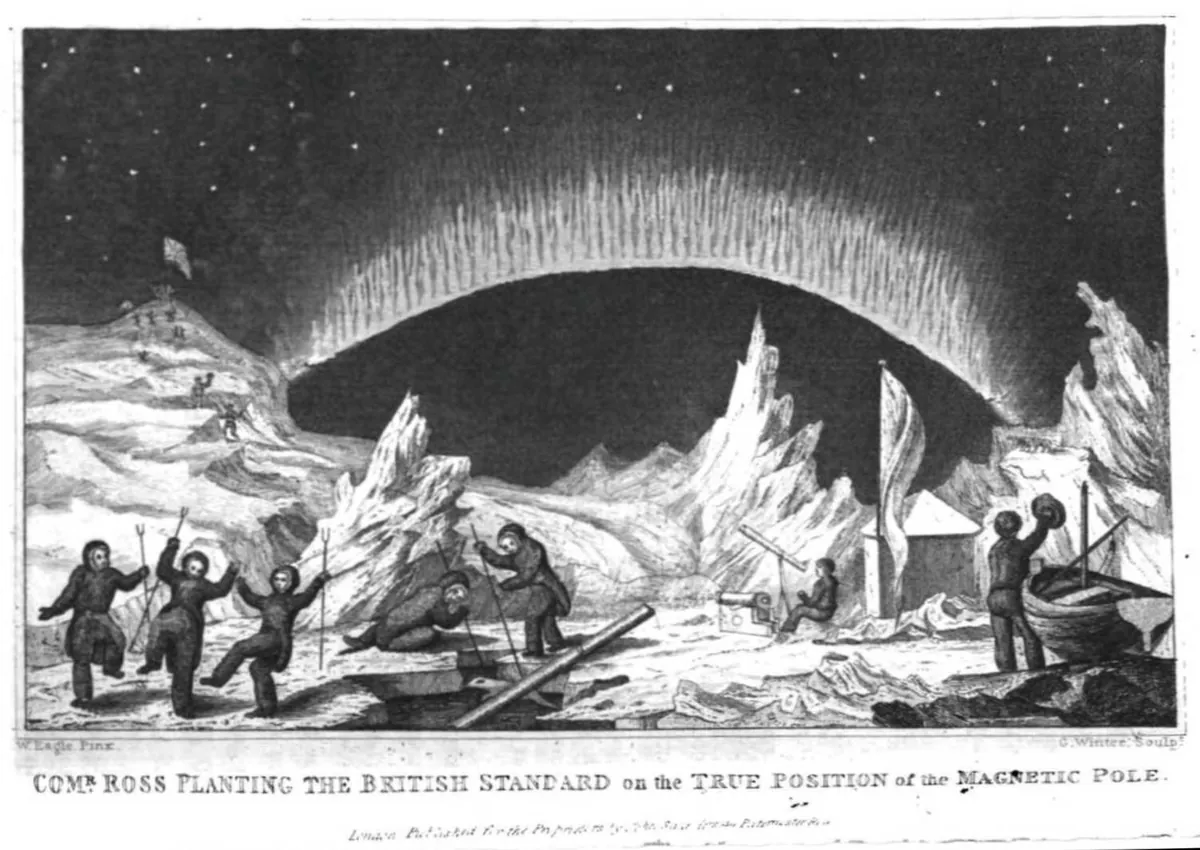
Sir James Clark Ross first located the North Magnetic Pole in northern Canada in 1831.
Since 1831, the pole has been moving across the Canadian Arctic toward Russia.
Magnetic records show the pole meandering about Canada from 1590 until 1990, when it sped up. Over the next 30 years its speed went from less than 10 kilometres a year to almost 60 kilometres a year.
A 2007 survey by a Canadian and French collaboration found the pole moving north-northwest at about 55 kilometres a year. NOAA's account, updated in 2021, says the latest International Geomagnetic Reference Field (IGRF) put the speed at about 45 kilometres a year in the same direction.
In December 2019 the British Geological Survey described the pole as moving at around 50 kilometres a year.
The World Magnetic Model places the North Magnetic Pole at 85.762°N, 139.298°E in 2025. The South Magnetic Pole is at 63.851°S, 135.078°E.
While the north pole sped up, the South Magnetic Pole moved very slowly, drifting around the coast of Antarctica.
What drives the drift
Earth's magnetic field is generated by the flow of liquid iron in the core, which creates electric currents in a way similar to a bicycle dynamo.
The fluid outer core is about 2,250 kilometres thick and made of molten iron and nickel. Nearly all of Earth's magnetic field originates there.
Irregular changes in the liquid outer core are known, but it is not yet possible to say exactly why magnetic north is changing so fast.
When tectonic plates form at oceanic ridges, the field present is frozen into the rock as it cools below about 700°C. This lets scientists reconstruct the field's history for roughly the last 160 million years.
The field has reversed many times, so magnetic north and south have swapped places. The most recent reversal took place about 780,000 years ago.
Sources
- NOAA National Centers for Environmental Information, Tracking Changes in Earth's Magnetic Poles
- NOAA National Centers for Environmental Information, Magnetic Declination
- British Geological Survey, Will Santa get home safely? New World Magnetic Model reveals movements in the Earth's magnetic field
- NOAA National Centers for Environmental Information, World Magnetic Model 2025 Released
- NOAA National Centers for Environmental Information, Wandering of the Geomagnetic Poles
- Flinders University, Did you know that compasses don't actually point true north?
- NASA, Earth's Magnetosphere: Protecting Our Planet from Harmful Space Energy
- European Space Agency, Hearing Earth's magnetic field switch poles 780 000 years ago