Science
X-rays
Wilhelm Röntgen found X-rays in November 1895, and within a year doctors were using them to look at bones.

At a glance
8 November 1895
Evening Röntgen saw a screen glow across his darkened room
0.03 to 3 nanometres
Range of X-ray wavelengths, as NASA gives it
1901
Year of the first Nobel Prize in Physics, awarded to Röntgen
1 year
Time from his announcement to X-rays being established in medicine
A glowing screen in a dark room
Wilhelm Röntgen was professor of physics at the University of Würzburg when he found X-rays in the autumn of 1895.
On 8 November 1895 he was studying radiation from cathode ray tubes at high voltage. Even with the tubes covered in black cardboard, a phosphorescent screen across the room glowed in the dark.
In his own set-up the discharge tube was wrapped in thick black carton and the room was dark. A paper plate coated with barium platinocyanide still fluoresced when it was as far as two metres from the tube.
Röntgen showed that the rays were produced when cathode rays struck a solid object. Because their nature was unknown, he named them X-rays.
Almost everyone else called them Röntgen rays.
The hand with a ring
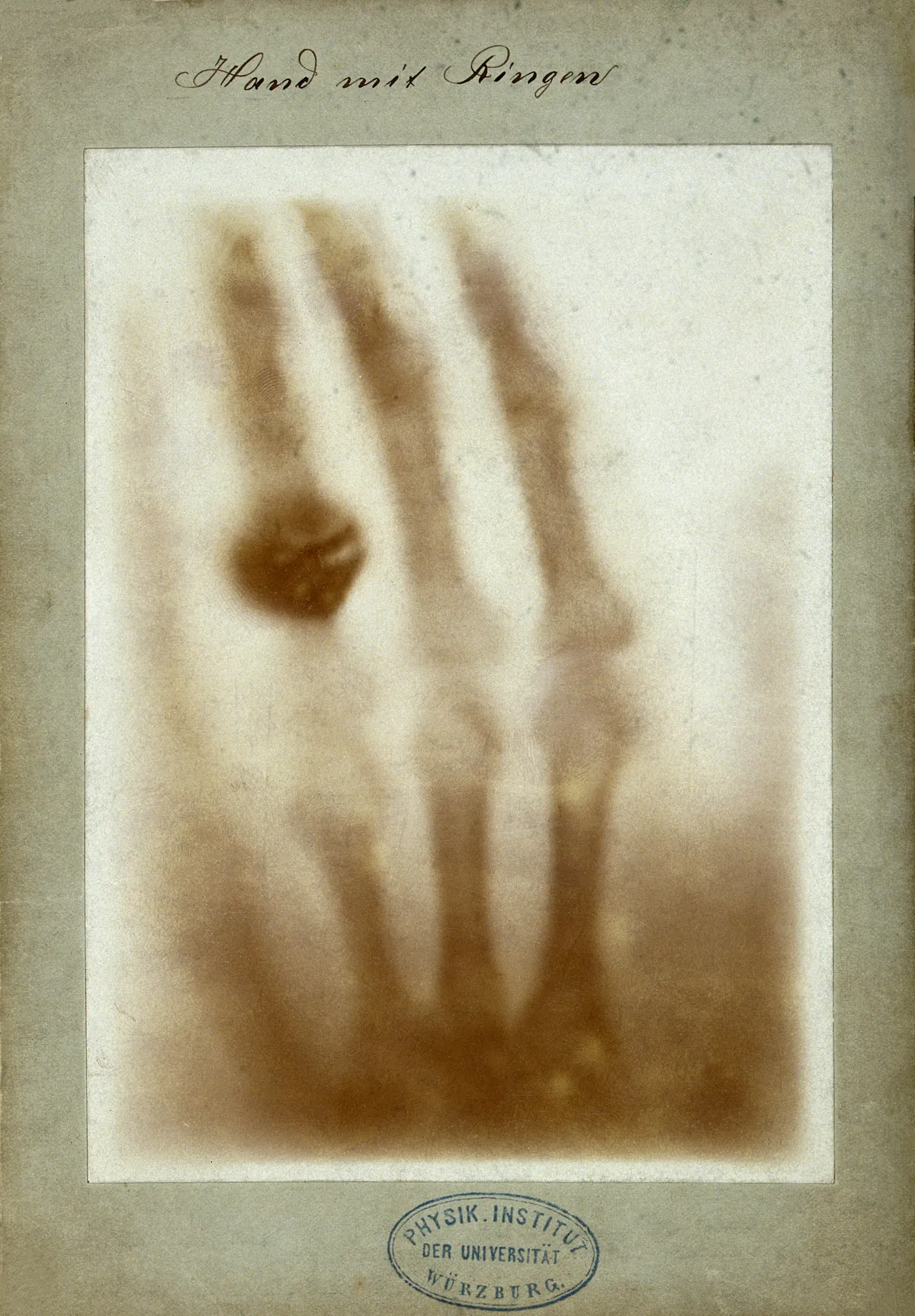
One of his earliest photographic plates showed the hand of his wife, with her wedding ring clearly visible. The image shows the shadows of her bones and the ring.
The Linda Hall Library dates the plate to 22 December 1895. Nobel Prize Outreach calls it the first röntgenogram ever taken, and the plate shows the flesh as a faint penumbra around the bones.
Röntgen spent the weeks that followed testing the rays, six weeks by one account and seven by another.
On 28 December 1895 he submitted a first communication, "On a New Kind of Rays", to the Würzburg Physico-Medical Society.
In January 1896 he gave his first public lecture on the rays and demonstrated them by making a plate of the hand of an anatomist in the audience. That anatomist proposed calling them Röntgen's rays.
From the laboratory to the clinic
Within a year of his announcement, X-rays were an established part of medical diagnosis and therapy.
By February 1896, Edwin Brant Frost had made a plate of a patient's Colles fracture for his brother, a local doctor, which the American Physical Society describes as the first clinical use of X-rays in the United States.
Today medical X-rays are used to find broken bones, herniated discs, pneumonia, kidney stones, certain tumours and swallowed foreign objects, among other problems.
A CT scan is a computerised X-ray procedure. A narrow beam is rotated around the patient, and a computer turns the signals into cross-sectional slices that can be stacked into a three-dimensional image.
X-rays are ionizing radiation, which can harm living tissue. The risk rises with the number of exposures over a lifetime, though the chance of cancer from a medical X-ray is generally considered very small.
Light of a much shorter wavelength
X-rays have much higher energy and much shorter wavelengths than ultraviolet light. NASA gives their wavelengths as between 0.03 and 3 nanometres, so small that some are no bigger than a single atom of many elements.
Because the wavelengths are so small, scientists usually describe X-rays by their energy rather than their wavelength.
Röntgen did not know what the rays were. Max von Laue and his pupils later showed that they are electromagnetic, like light, with a higher frequency of vibration.
Earth's atmosphere blocks X-ray radiation, so telescopes with X-ray detectors must be placed above it.
Dentists use X-rays to image teeth, airport security uses them to see through bags, and hot gases in the Universe emit them.
The first physics Nobel
Röntgen received the first Nobel Prize in Physics, in 1901, "in recognition of the extraordinary services he has rendered by the discovery of the remarkable rays subsequently named after him".
Sources
- Linda Hall Library, Scientist of the Day: Wilhelm Röntgen
- Nobel Prize Outreach, Wilhelm Conrad Röntgen: Biographical
- Nobel Prize Outreach, Wilhelm Conrad Röntgen: Facts
- American Physical Society, November 8, 1895: Roentgen's Discovery of X-Rays
- National Institute of Biomedical Imaging and Bioengineering, Medical X-rays
- National Institute of Biomedical Imaging and Bioengineering, Computed Tomography (CT)
- NASA, X-Rays
- NASA, The Electromagnetic Spectrum