Science
Earth's atmosphere
Air is about 78% nitrogen and only 21% oxygen, and four gases make up nearly all of dry air.

At a glance
78.08 %
Nitrogen in dry air, by volume
20.95 %
Oxygen in dry air, by volume
425.62 ppm
Global mean carbon dioxide, 2025 (preliminary)
1013.2 millibars
Standard air pressure at sea level
5.1 x 10^18 kg
Total mass of the atmosphere, NASA's estimate
Mostly nitrogen, not oxygen
By volume, dry air is about 78% nitrogen and about 21% oxygen. NASA lists 78.08% and 20.95%, and NOAA lists 78.084% and 20.946%.
Argon is the third most abundant gas in dry air, at 0.934% by volume.
Carbon dioxide comes fourth, at about 0.042% of dry air by volume. NASA's table gives it as 420 parts per million.
Nitrogen, oxygen, argon and carbon dioxide together make up nearly all of the gases in dry air.
Everything else is a trace. Neon is 18.18 parts per million, helium 5.24, krypton 1.14 and hydrogen 0.55, by NASA's figures.
Carbon dioxide, measured year by year
NOAA puts the global annual mean carbon dioxide level in dry air at 385.02 parts per million for 2008.
For 2025 the same record gives 425.62 parts per million, a figure NOAA marks as preliminary and subject to recalibration.
The gas that comes and goes
Water vapour is nearly always present in air, at up to about 4% of the volume. NASA gives its typical share as about 1%.
Because water vapour takes up room, it dilutes the other gases. At 4% water vapour, nitrogen falls from 78.084% to 74.96% and oxygen from 20.947% to 20.11%.
Water vapour thins out quickly with height. The upper troposphere holds less than the air near the ground, the stratosphere and mesosphere hold almost none, and the thermosphere contains none.
Near the tropics the lower troposphere can hold up to 4% water vapour, while the poles hold only trace amounts.
Five layers stacked above the ground
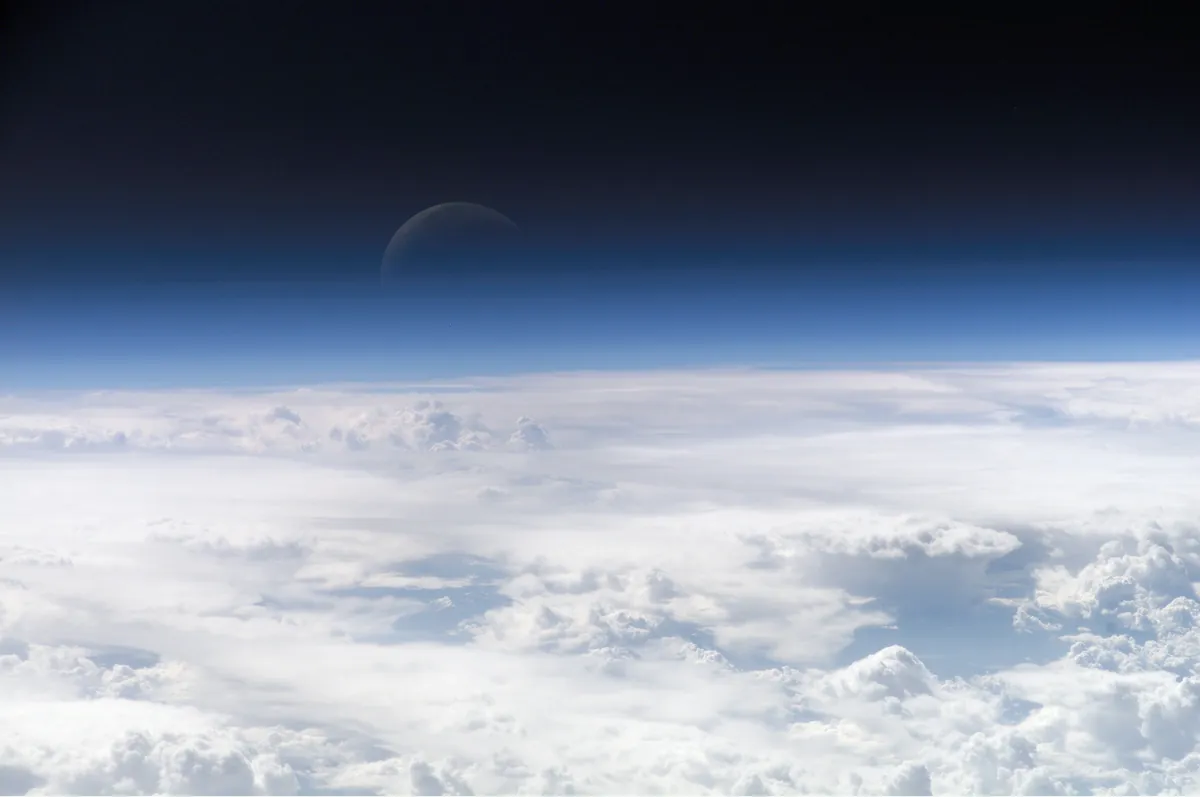
From the ground up the layers are the troposphere, stratosphere, mesosphere, thermosphere and exosphere.
Most weather happens in the troposphere, the lowest layer.
The troposphere is not one height everywhere. NOAA puts its top at 18 to 20 kilometres over the equator, about 9 kilometres at 50 degrees latitude and just under 6 kilometres at the poles. The Met Office gives up to 16 kilometres, and about 9 kilometres at the poles.
Temperature in the troposphere falls with height, from an average of about 17 degrees Celsius to about minus 51 degrees at the tropopause.
NOAA puts the stratosphere's top at around 50 kilometres. It holds 19% of the atmosphere's gases, and its temperature rises with height because heat is released as ozone forms.
Gases in the mesosphere are thick enough to slow meteors, which burn up and leave trails in the night sky.
NOAA places the thermosphere between about 85 and 600 kilometres, and the exosphere from about 600 to 10,000 kilometres. In the exosphere, atoms and molecules escape into space and satellites orbit.
The weight of the air
Standard air pressure at sea level is 1013.2 millibars, or 29.92 inches of mercury.
NASA's Earth fact sheet lists a surface pressure of 1014 millibars and a surface air density of 1.217 kilograms per cubic metre.
NASA estimates the total mass of the atmosphere at 5.1 x 10^18 kilograms.
NASA gives a scale height of 8.5 kilometres and an average surface temperature of 288 kelvin, which is 15 degrees Celsius.
The atmosphere is held in place by its own weight under gravity.
Sources
- NASA, Earth Fact Sheet
- NOAA, The Atmosphere
- NOAA Global Monitoring Laboratory, Global annual mean CO2 data
- UCAR Center for Science Education, What's in the air?
- NOAA, Layers of the Atmosphere
- UCAR Center for Science Education, Atmosphere
- Met Office, The atmosphere
- NOAA, Air Pressure