Earth and weather
Hail
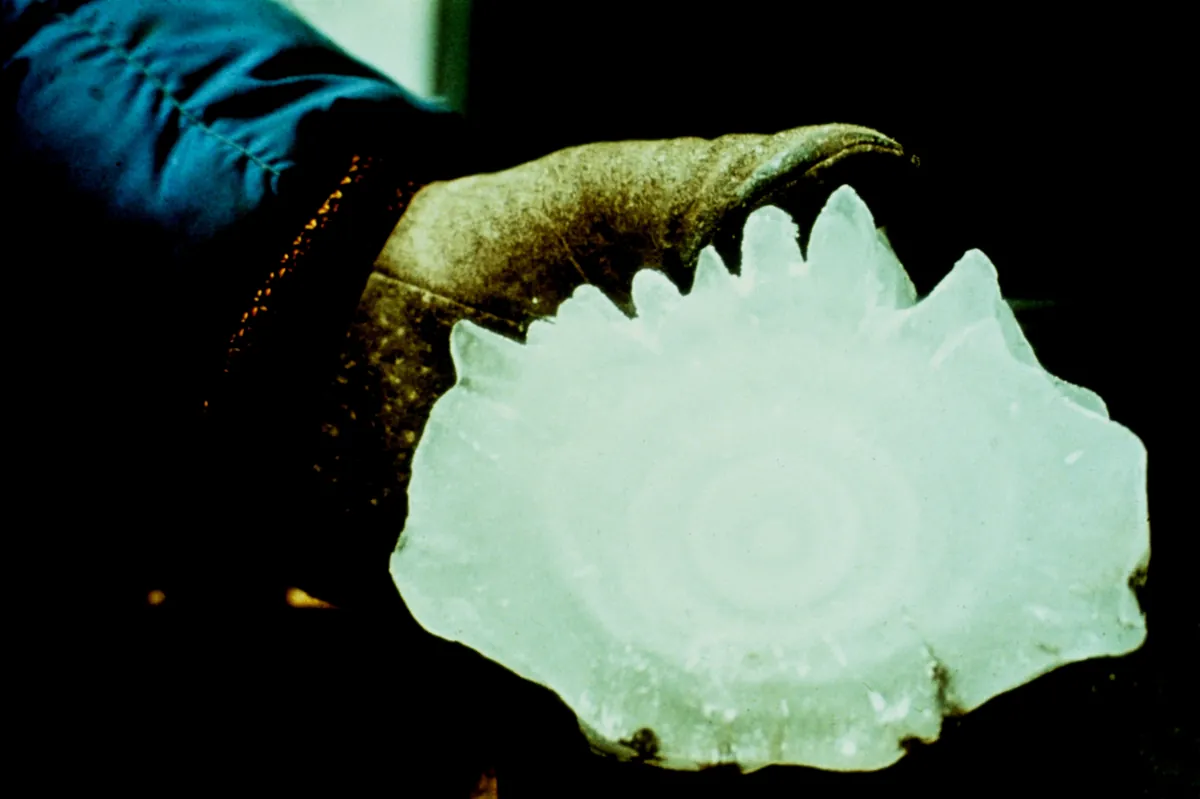
A hailstone grows in layers inside a thunderstorm updraft, and the US record stone, from 2010, measured 8 inches across and weighed nearly 2 pounds.

At a glance
8.0 inches
Diameter of the US record hailstone, Vivian, South Dakota, 2010
1.9375 pounds
Weight of that stone
-10 to -25 °C
Air temperature in the hail growth zone
49 mph
Approximate updraft speed for quarter-size hail
98 mph
Approximate updraft speed for grapefruit-size hail
7 to 9 days a year
Hail days in the central US hail alley
Building a stone in the updraft
Hail is solid ice that forms inside thunderstorm updrafts, which carry raindrops upward into extremely cold air.
A stone starts as a tiny piece of ice blown into a supercooled water droplet, which is a drop that stays liquid below freezing. It then grows by collecting and freezing more of these droplets.
The hail growth zone is the part of the updraft where the air is between minus 10 and minus 25 degrees Celsius.
Near-freezing air lets water spread across a tumbling stone and freeze slowly, so trapped air escapes and the layer is clear ice. In much colder air a droplet freezes on contact, trapping air bubbles and leaving a cloudy layer.
A stone falls once it is too heavy for the updraft to hold up.
How updraft strength sets the size
The stronger the updraft, the larger the hailstones a thunderstorm can produce.
NOAA's table of approximate updraft speeds gives about 49 miles per hour for quarter-size hail and about 64 for golf-ball size. It gives about 98 for grapefruit size and about 103 for softball size.
A supercell thunderstorm can have updrafts as strong as hurricane winds.
Hail the size of a quarter, 1 inch, or larger is considered severe.
Most hailstones are under 25 millimetres across. In very intense storms hail can reach the size of a golf ball or a cricket ball.
The Vivian stone
The largest hailstone on record in the United States fell at Vivian, South Dakota, on 23 July 2010. It measured 8 inches in diameter and weighed 1.9375 pounds (1 pound 15 ounces).
The previous diameter record was 7.0 inches, set at Aurora, Nebraska, on 22 June 2003. The previous weight record was 1.67 pounds, from Coffeyville, Kansas, on 3 September 1970.
The Vivian stone was 18.625 inches around, while the Aurora stone keeps the record for circumference, at 18.75 inches.
The Vivian stone shrank considerably through melting and sublimation between landing and being measured, partly because of a power outage at the home of the person who found it.
Where hail falls most
Florida has the most thunderstorms in the United States, but the National Severe Storms Laboratory says Nebraska, Colorado and Wyoming usually have the most hailstorms. NOAA's JetStream site lists New Mexico, Colorado and Wyoming.
The area where Nebraska, Colorado and Wyoming meet, known as hail alley, averages 7 to 9 hail days a year.
In Florida the freezing level is high enough that hail often melts before it reaches the ground.
The High Plains have the Rocky Mountains upwind, surface elevations of 3,000 to 5,000 feet and the Gulf of Mexico nearby, which together support strong updrafts.
Other areas with damaging hailstorms include China, Russia, India and northern Italy.
Australia's most destructive hailstorm hit Sydney on 14 April 1999, with hailstones the size of cricket balls. It affected 85 suburbs and damaged about 20,000 houses and 70,000 cars.
Sources
- NOAA National Severe Storms Laboratory, Severe Weather 101: Hail Basics
- NOAA, Thunderstorm Hazards: Hail
- UCAR, All hail
- Australian Bureau of Meteorology, Explainer: How does hail form?
- US National Weather Service, Record Hailstone, Vivian, South Dakota
- University of Wisconsin-Madison Space Science and Engineering Center, What is the largest hailstone on record?