Earth and weather
Krakatoa
The 1883 eruption was heard about 4,800 kilometres away, killed about 36,000 people, mostly by tsunami, and cooled the planet for five years.

At a glance
about 36,000 deaths
Killed in the 1883 eruption and its tsunamis
4,800 km
Distance to Rodrigues Island, where the blast was reported heard
3,100 km
Distance to Perth, where the blast was heard
about 20 cubic km
Rock thrown into the atmosphere
5 years
Time for global temperatures to return to normal
The two days in August 1883
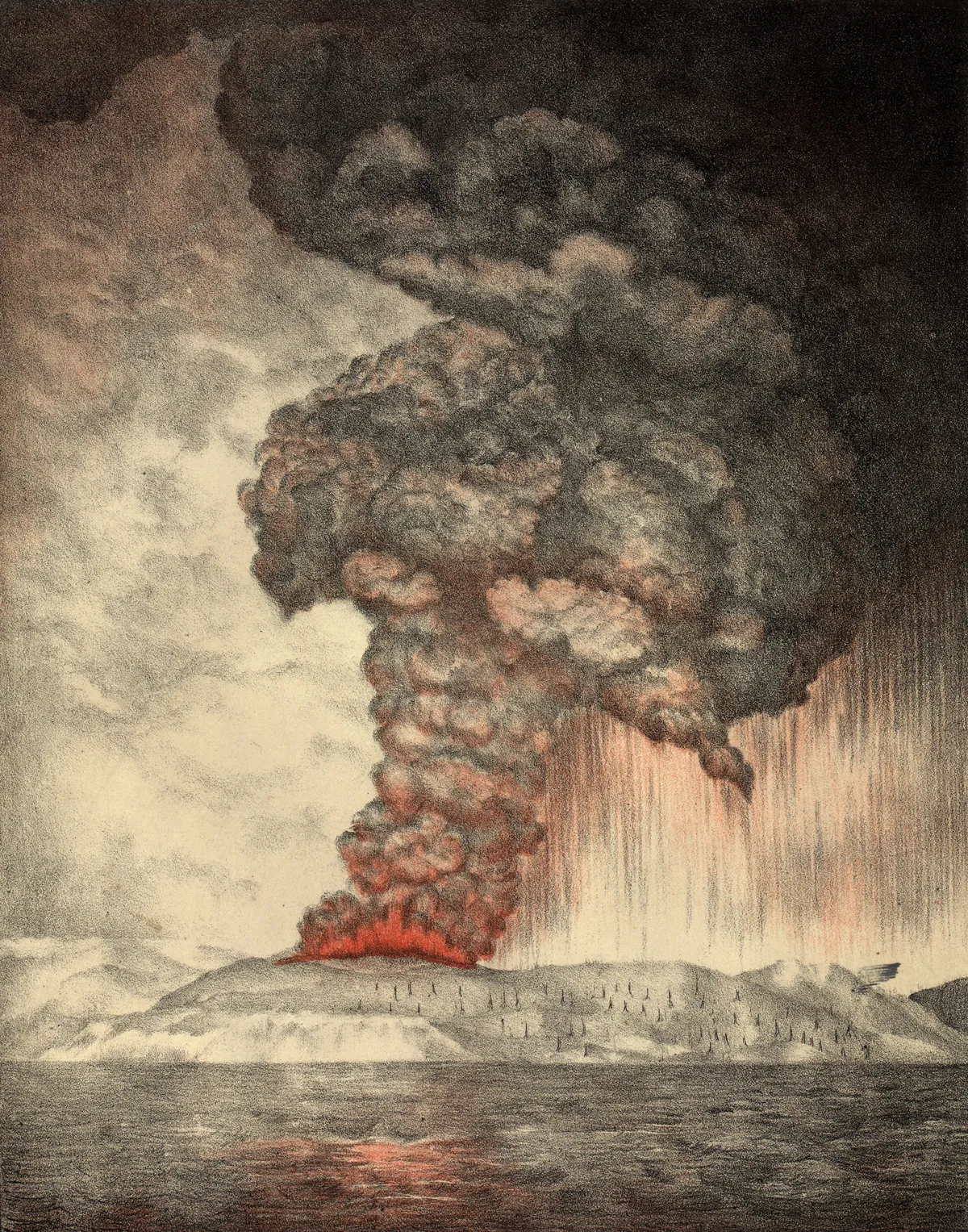
Activity at Krakatau began on 20 May 1883. The major eruption began on 25 August and lasted two days, with the colossal explosion on 26 August.
Roughly 20 cubic kilometres of rock were thrown into the atmosphere, and about two-thirds of the island was destroyed.
The remaining island sank into a caldera about 6 kilometres wide.
Estimates of how high the eruption column rose run from 27 kilometres to 80 kilometres.
Ash covered about 800,000 square kilometres and brought roughly two and a half days of darkness.
The loudest sound on record
The final explosion is considered the loudest sound in recorded history.
The sound was heard across more than 10 percent of the surface of the Earth.
It was heard in Perth, Australia, about 3,100 kilometres away.
Sounds were reported on Rodrigues Island, about 4,800 kilometres away. Another account puts the farthest reports, from Australia and Mauritius, at more than 4,600 kilometres.
Pressure waves from the blast travelled around the globe several times within a few hours, and instruments in Britain and America recorded them. One account counts seven circuits.
The waves and the death toll
About 36,000 people died, and more than 34,000 of those deaths are attributed to tsunamis. One account gives at least 36,417.
Sources give the height of the largest tsunami as between 40 and 46 metres.
The waves destroyed 165 towns and settlements.
The tsunamis were generated when pyroclastic flows entered the sea. Another account says the collapse of the eruption column displaced several cubic kilometres of seawater.
A cooler planet and red skies
Global temperatures dropped in the year after the eruption by between 0.4°C and 1.2°C, depending on the source.
Temperatures did not return to normal for five years, until 1888.
The cooling is attributed to sulfur dioxide in the atmosphere blocking sunlight.
Ash stayed in the atmosphere for months and produced vivid sunsets around the world.
Anak Krakatau, the child
The 1883 eruption sterilized the surviving islands, which let scientists study how life returns to bare ground.
Volcanic activity resumed in the 1920s, and smaller eruptions built a new cone, Anak Krakatau, in the middle of the 1883 caldera.
On 22 December 2018 an eruption at Anak Krakatau caused a tsunami that killed more than 400 people. NCEI counts at least 437.
That 2018 event removed two-thirds of the volcano's volume, and it continued to grow afterwards.
Sources
- NOAA National Centers for Environmental Information, On This Day: Historic Krakatau Eruption of 1883
- NASA, Krakatau Volcano National Park
- National Park Service, Volcanoes
- Pennsylvania State University, Krakatoa 1883: West of Java!