Earth and weather
Hurricanes
A hurricane starts at 74 mph winds over water of about 80°F or warmer, and the 1900 Galveston hurricane killed an estimated 6,000 to 12,000 people.

At a glance
74 mph
Sustained wind speed at which a storm becomes a hurricane
157 mph or more
Sustained winds in a Category 5 hurricane
7 hurricanes
Atlantic average per year, 1991 to 2020
about 8,000 deaths
Galveston hurricane, 1900 (estimates 6,000 to 12,000)
888 millibars
Hurricane Gilbert's minimum central pressure, 1988
Warm water and a spinning storm
A hurricane is a tropical cyclone with a maximum sustained surface wind, averaged over one minute, of 74 mph (64 knots) or more.
A tropical cyclone is a warm-core storm without fronts that forms over tropical or subtropical waters, with a closed circulation around a well-defined centre.
It starts as a cluster of thunderstorms. At 25 to 38 mph it is a tropical depression, at 39 mph it becomes a named tropical storm, and at 74 mph it becomes a hurricane.
The sea must be warm. One NOAA page gives at least 80°F for at least the top 50 metres (about 165 feet) of water, while the National Weather Service gives above 26°C (79°F).
Hurricanes rotate counterclockwise in the Northern Hemisphere and clockwise in the Southern Hemisphere.
The storm's heat comes from water vapour condensing as air rises around the eyewall.
Eye, eyewall and size
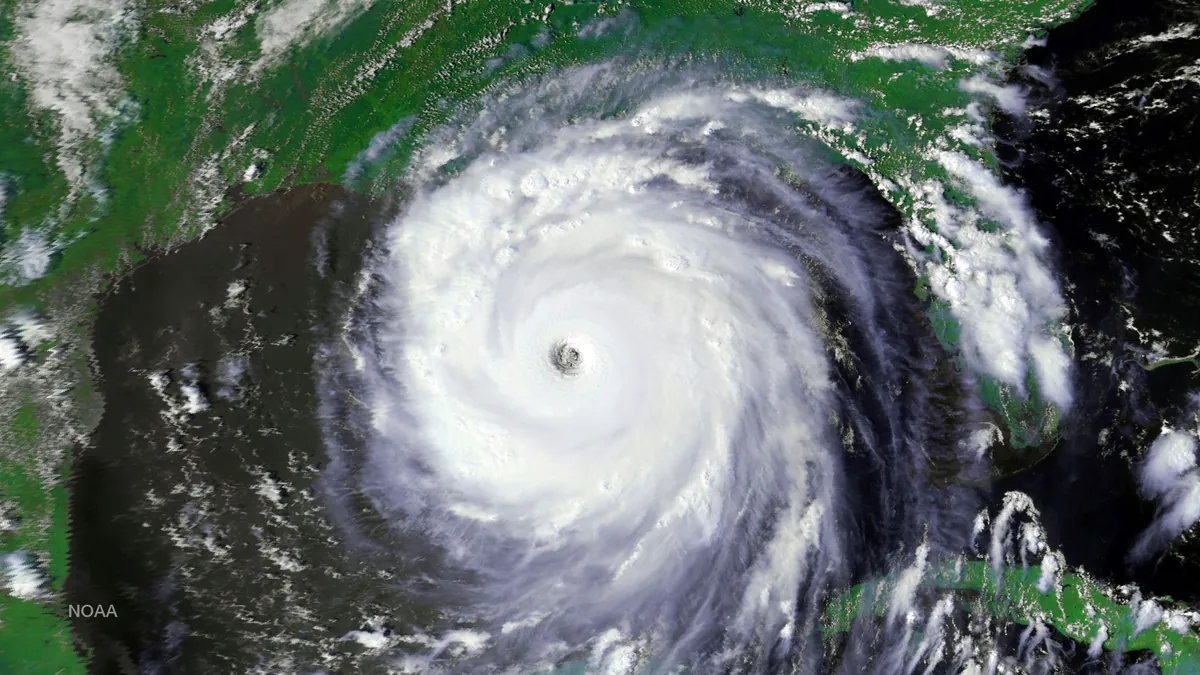
The eye is the roughly circular area of comparatively light winds at the centre of a severe tropical cyclone.
Sources differ on its usual width: NOAA's satellite service gives around 5 to 30 miles, and the National Weather Service gives approximately 20 to 40 miles.
The eye is ringed by the eyewall, an organised band of cumulonimbus clouds that holds the highest winds in the storm.
Width varies a great deal. NOAA pages describe a hurricane as around 125 miles across or about 300 miles wide.
Although tornado winds can be stronger, hurricanes cause far more damage because of their size and duration. Tornadoes cause about a tenth as much economic damage per year, on average.
Five categories, wind only
The Saffir-Simpson scale rates hurricanes by sustained wind: Category 1 is 74 to 95 mph, Category 2 is 96 to 110 mph and Category 3 is 111 to 129 mph.
Category 4 covers 130 to 156 mph, and Category 5 is 157 mph or higher.
Hurricanes of Category 3 and above are known as major hurricanes.
The scale is based only on maximum sustained wind speed. It does not account for storm surge, rainfall flooding or tornadoes.
A season in numbers
The Atlantic hurricane season runs from 1 June to 30 November, with its peak date on 10 September.
From 1991 to 2020 the Atlantic averaged 14 named storms, 7 hurricanes and 3 major hurricanes a year.
The eastern Pacific season runs from 15 May to 30 November. Its 1991 to 2020 average was 15 named storms, 8 hurricanes and 4 major hurricanes a year.
The deadliest and the most intense
The Galveston hurricane of 8 September 1900 is described as the deadliest weather disaster in United States history. About 8,000 deaths are attributed to it, with estimates from 6,000 to 12,000.
The National Park Service puts the toll in the city of Galveston at 6,000 to 8,000, and 10,000 to 12,000 for the whole island.
In 1988 Hurricane Gilbert reached peak winds of 185 mph and a minimum central pressure of 888 millibars, a 70-millibar fall in 24 hours. That was the lowest pressure recorded in the western hemisphere until Hurricane Wilma in 2005.
Sources
- National Hurricane Center, Saffir-Simpson Hurricane Wind Scale
- National Hurricane Center, Glossary of NHC Terms
- NOAA National Environmental Satellite, Data, and Information Service, How Does a Hurricane Form?
- National Weather Service, Hurricane Facts
- National Hurricane Center, Tropical Cyclone Climatology
- National Hurricane Center, Hurricanes in History
- NOAA Storm Prediction Center, Tornado Frequently Asked Questions
- National Park Service, Galveston Hurricane of 1900