The human body
Human skin
The largest organ covers 1.5 to 2 square metres, renews its outer layer about every four weeks, and wrinkles in water through an automatic reflex.

At a glance
1.5 to 2.0 square metres
Average adult skin surface area
about 16 percent
Skin's share of total body weight, per one review
28 to 30 days
Complete epidermal turnover in young adults
0.05 to 1.5 mm
Epidermis thickness, from eyelids to palms and soles
15 to 30 layers
Cell layers in the stratum corneum
The body's largest organ
The skin is the largest organ of the human body. One review puts it at approximately 16% of total body weight.
The average adult skin surface area is 1.5 to 2.0 square metres. A review of burn wound infections gives the weight of an adult male's skin as between 6 and 10 kilograms.
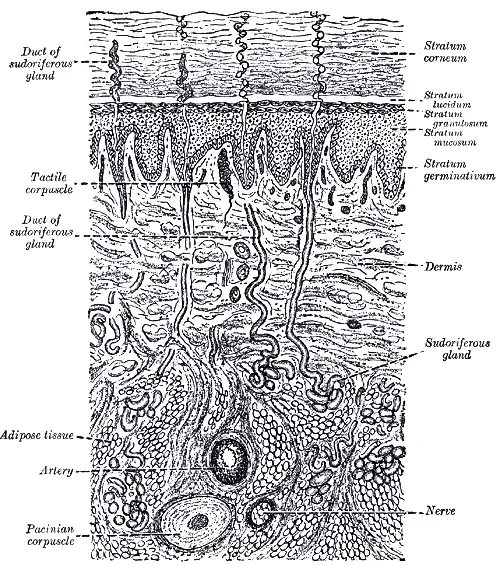
Skin has three layers: the epidermis on the outside, the dermis beneath it and the hypodermis, or subcutaneous layer, below that.
The hypodermis stores fat and provides insulation and cushioning.
Thin at the eyelid, thick at the foot
The epidermis is only 0.05 millimetres thick on the eyelids and 1.5 millimetres thick on the palms and the soles of the feet. Another review puts the sole at up to 1 millimetre.
The epidermis is made of four or five layers of epithelial cells, depending on where it is on the body. Thick skin, with a fifth layer called the stratum lucidum, is found only on the palms and the soles.
The outermost layer, the stratum corneum, is usually 15 to 30 cells deep. It is only 10 to 20 micrometres thick and does most of the work of the skin's barrier.
Melanocytes, the cells that make the pigment melanin, are scattered through the deepest layer of the epidermis, the stratum basale.
The dermis is the thickest of the three layers, at 1.5 to 4 millimetres, and makes up roughly 90% of the thickness of the skin.
Within the dermis, the deeper reticular layer is much thicker than the papillary layer above it.
A new surface every month
Complete cell turnover in the epidermis occurs every 28 to 30 days in young adults. In older adults it slows to about 45 to 50 days.
The keratinocyte layer is replaced over a period of about 4 weeks.
Why fingertips wrinkle in water
Fingertips wrinkle after a long soak in water, and the process is active: blood vessels constrict below the skin, under the control of the autonomic nervous system, which also regulates breathing and heart rate.
It is an automatic reflex. Tiny blood vessels in the skin constrict after water exposure, and so does the skin of the fingertips.
In a Berlin study of 40 volunteers, wrinkling was induced by bathing both hands in warm water at 40 degrees Celsius for half an hour.
Researchers at Newcastle University reported that people were 12% faster at handling wet marbles when their fingers were wrinkled, with no difference for dry objects. One of them compared the wrinkles to the treads on a car tyre.
The Berlin team could not reproduce that result. It concluded that wrinkled fingers give no advantage in gripping wet or dry objects and do not change touch sensitivity, so the purpose of the wrinkles remains debated.
Sources
- National Cancer Institute SEER Training Modules, Layers of the Skin
- National Library of Medicine (PubMed Central), Burn Wound Infections
- National Library of Medicine (PubMed Central), Bioengineering the microanatomy of human skin
- OpenStax, Layers of the Skin
- Cleveland Clinic, Skin: Layers, Structure and Function
- Newcastle University, Get a grip: why we get wrinkly fingers and toes
- Max Delbrueck Center for Molecular Medicine, Better Grip with Wrinkly Fingers? MDC-Researchers find no Proof