Earth and weather
Mount Tambora
Tambora's 1815 eruption on Sumbawa is the largest known in historic times and sent about 60 million tonnes of sulphur into the stratosphere.
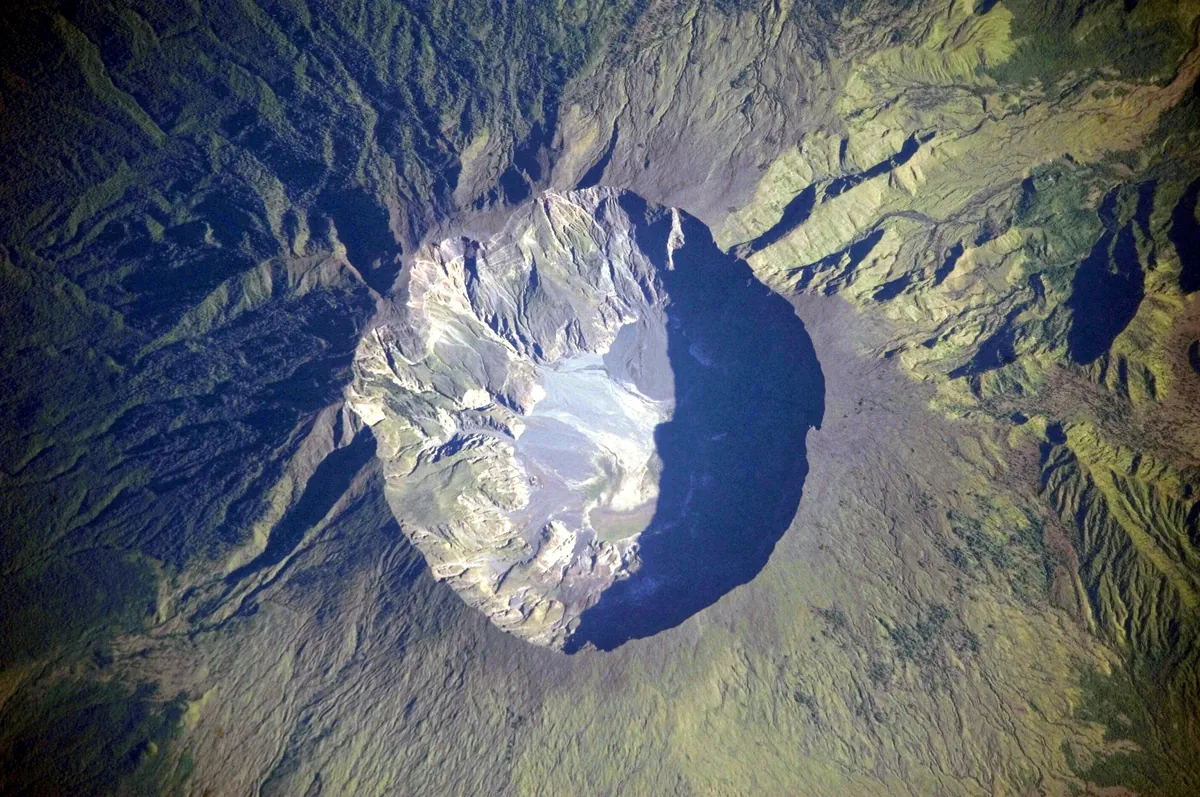

At a glance
10 April 1815
Climax of the eruption
6 km
Width of the caldera
1,100 metres
Depth of the caldera
60 million tonnes
Sulphur injected into the stratosphere, 2003 estimate
1,300 km
Distance at which ash was recognised
71,000 people
Deaths on Sumbawa and Lombok, 2003 estimate
Five days in April 1815
Tambora, a volcano on the island of Sumbawa in Indonesia, began erupting on 5 April 1815 and reached its climax on 10 April.
The volcano had already been active between 1812 and 1815.
A 2003 review by Clive Oppenheimer called it the largest known historic eruption, releasing roughly 140 gigatonnes of magma, or about 50 cubic kilometres of dense rock.
A 2004 study estimated a smaller magma volume, about 30 to 33 cubic kilometres.
NASA estimates the eruption produced about 150 cubic kilometres of tephra, the fragments thrown out of a volcano. NOAA puts the ash at about 31 cubic miles, and rates the eruption 7 on the Volcanic Explosivity Index.
Ash from the eruption was recognised at least 1,300 kilometres away to the northwest.
A mountain removed
Before the eruption, the peak is estimated to have stood about 4,000 metres high.
When the magma chamber emptied, the peak was removed and left a caldera 6 kilometres across and 1,100 metres deep.
In 2004, researchers found a buried village and the remains of two adults, which NASA describes as remnants of the former Kingdom of Tambora.
Sulphur in the stratosphere
Oppenheimer estimated that the eruption injected about 60 million tonnes of sulphur into the stratosphere, six times the amount released by the 1991 Pinatubo eruption.
A 2004 study estimated that Tambora released 53 to 58 million tonnes of sulphur dioxide in roughly 24 hours on 10 and 11 April 1815. That was enough to form 93 to 118 million tonnes of stratospheric sulphate aerosols.
The aerosols formed a veil around the globe that disrupted the climate, and ash reduced the sunlight reaching Earth's surface.
The year without a summer
The summer of 1816, the year after the eruption, became known as the Year Without a Summer.
NOAA says Northern Hemisphere average temperatures dropped about one degree Fahrenheit. The UCAR education site instead gives a global average drop of 3 degrees Celsius, so the two sources differ.
In New England, snow fell in July 1816 and temperatures reached the 30s Fahrenheit.
Crops were killed by frost or a lack of sunshine, and food became scarce.
The cooling, crop failures, food shortages and flooding reached North America, Western Europe and parts of Asia.
Counting the dead
Oppenheimer's 2003 review puts the toll at over 71,000 people who died during or after the eruption on Sumbawa and the neighbouring island of Lombok.
NOAA estimates 11,000 deaths from pyroclastic flows and more than 100,000 from the food shortages that followed over the next decade.
Sources
- NOAA, This Day In History: Mount Tambora Explosively Erupts in 1815
- NASA Earth Observatory, Mount Tambora Volcano, Sumbawa Island, Indonesia
- Progress in Physical Geography, Climatic, environmental and human consequences of the largest known historic eruption: Tambora volcano (Indonesia) 1815
- Geophysical Research Letters, Magma volume, volatile emissions, and stratospheric aerosols from the 1815 eruption of Tambora
- UCAR Center for Science Education, Mount Tambora and the Year Without a Summer