Geography
Russia
Russia covers about 17 million square kilometres across Europe and Asia, with 11 time zones spanning a ten-hour difference between Kaliningrad and Kamchatka.
At a glance
about 17.1 million km²
Area; sources give 17.08 to 17.13 million
11
Time zones in force since 26 October 2014
50.8 %
Forest share of land area, 2024
about 143.5 million
Population, 2025 (World Bank)
4,400 km
Length of the Lena River
over 1,600 metres
Depth of Lake Baikal
The largest country by area
Russia is the largest country in the world by area, and it spans two continents, Europe and Asia.
Sources give its area as between 17.08 and 17.13 million square kilometres: 17,075,200 in National Geographic's figure, 17,098,242 in the Infoplease almanac and 17,125,190 for 2024 in World Bank data.
Russia's land area was 16,376,870 square kilometres in 2024.
The country stretches from the Baltic Sea in the west to the Pacific Ocean in the east, and from the Arctic Ocean in the north to the Black Sea and the Caucasus in the south. It has coasts on three oceans: the Atlantic, the Pacific and the Arctic.
In 2025 Russia had a population of about 143.5 million people, according to World Bank data.
Forest covered 50.8 percent of Russia's land area in 2024, and agricultural land 13.2 percent.
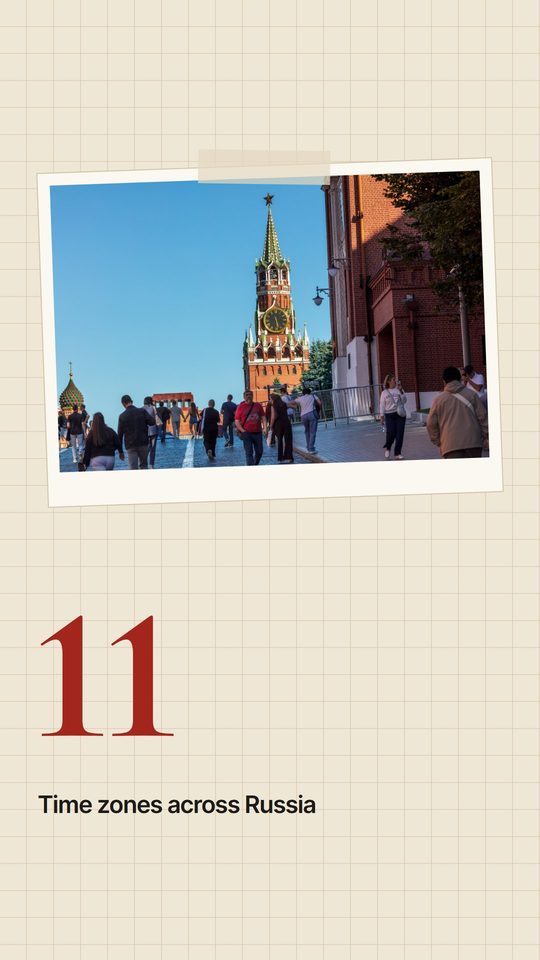 Watch the ShortRussia's 11 time zones
Eleven time zones in one country
Russia has 11 time zones, a count in force since 26 October 2014.
Putin signed the law on 22 July 2014. It set out 11 zones, and at 2 a.m. on 26 October 2014 clocks went back one hour, with no seasonal shift after that.
Kaliningrad keeps Moscow time minus one hour, while Kamchatka and Chukotka keep Moscow time plus nine hours. That is a ten-hour spread, so noon in Kaliningrad is 10 p.m. in Kamchatka.
Moscow time is GMT+3, the winter time Russia adopted permanently in 2014. The summer time it replaced was GMT+4.
From 2011 to 2014 Russia ran on year-round summer time, and several zones were merged to cut the count to nine. The merging prompted street protests in Kamchatka.
Kaliningrad, an exclave on the Baltic Sea, is the westernmost zone. Its land borders are with Lithuania and Poland.
The Lena, Baikal and the Kamchatka volcanoes
The Lena River winds 4,400 kilometres across northeastern Siberia from its headwaters in the Baikal Mountains.
With about 500 tributaries it drains a basin of 2.5 million square kilometres, and over the last 7,000 years it has built the Arctic Ocean's largest delta.
Lake Baikal in south-east Siberia is the deepest lake in the world, at over 1,600 metres, and perhaps more than 25 million years old, the oldest as well. UNESCO gives its depth as 1,700 metres.
Baikal holds 20 percent of the world's unfrozen freshwater reserve according to UNESCO, and roughly 20 percent of the world's total surface fresh water according to the US Geological Survey.
It is the largest freshwater lake on Earth by volume, with 23,000 cubic kilometres of water, as much fresh water as the Great Lakes of North America combined.
The Volcanoes of Kamchatka World Heritage site groups six areas that hold most of the peninsula's volcanic features, with a high density of active volcanoes.
Kamchatka's sites also contain the world's largest known variety of salmonid fish.
Sources
- National Geographic Kids, Russia
- Infoplease, Russia
- World Bank, Surface area (sq. km): Russian Federation
- World Bank, Land area (sq. km): Russian Federation
- World Bank, Population, total: Russian Federation
- World Bank, Forest area (% of land area): Russian Federation
- World Bank, Agricultural land (% of land area): Russian Federation
- Interfax, Putin signs standard winter time law
- SBS News, Russia turns back the clocks
- NASA Earth Observatory, Lena River Sedimentation
- US Geological Survey, Lake Baikal: A Touchstone for Global Change and Rift Studies
- UNESCO World Heritage Centre, Lake Baikal
- UNESCO World Heritage Centre, Volcanoes of Kamchatka