Food and drink
Chocolate
Cacao was a bitter drink in Mesoamerica long before Fry and Sons of Bristol introduced solid eating chocolate in 1847.

At a glance
1900 to 1500 BC
Date range of the oldest cacao residue found in Mesoamerica
1847
Year Fry and Sons introduced solid eating chocolate
4.37 million tonnes
World cocoa bean production, 2023/24 cocoa year
1.67 million tonnes
Côte d'Ivoire's cocoa bean production, 2023/24 cocoa year
71.3 %
Africa's share of cocoa beans, 2023/24 cocoa year
Residue in a Mokaya jar
Cacao residue was found inside a Bayo Brown tecomate, a neckless jar, at Paso de la Amada on the Pacific coast of Chiapas, Mexico, a site of the Mokaya people. The vessel dates to between 1900 and 1500 BC.
It was the only one of 16 vessel fragments tested from the site that was positive, identified by theobromine, a compound that is a unique marker for cacao among Mesoamerican plants.
The find pushed the chemical evidence of cacao use in Mesoamerica back by roughly 700 years.
A vessel from El Manatí, an Olmec site on the Gulf Coast, carries cacao residue dated to about 1750 BC.
A bitter drink, not a sweet bar
Maya chocolate was a spicy drink used in ceremonies and traded to people who could not grow cacao.
The Aztec made a hot chocolate drink that nobles and warriors drank, and they also used cacao seeds as money.
It was made from dried, ground cacao beans, sometimes thickened with ground maize and flavoured with chili, vanilla or cinnamon. It was unsweetened and bitter.
The Spanish sweetened the bitter drink with sugar and kept it secret from the rest of Europe for nearly a century.
Linnaeus named the tree Theobroma cacao in 1753.
How the drink became a bar
The first English chocolate house opened in 1657.
In 1828 the Dutch chemist Coenraad van Houten invented a cocoa press that separated cocoa butter from the chocolate, leaving cocoa powder.
In 1847 Fry and Sons of Bristol, England, introduced the first solid eating chocolate.
In 1868 Richard Cadbury introduced the first box of chocolates.
In the 1870s Daniel Peter and Henri Nestlé developed the first milk chocolate bar using powdered milk, and in the same decade Rodolphe Lindt invented a machine that gave chocolate a smoother texture.
In 1893 Milton S. Hershey saw chocolate processing equipment at the World's Columbian Exposition in Chicago and later built a factory and a town in Pennsylvania.
Where the beans come from now
The International Cocoa Organization estimates world cocoa bean production at 4.37 million tonnes in the 2023/24 cocoa year, down from 5.02 million tonnes in 2022/23.
Africa supplied 71.3 percent of the 2023/24 total, down from 74.1 percent the year before. The Americas supplied 22.4 percent and Asia and Oceania 6.3 percent.
Côte d'Ivoire produced 1.67 million tonnes in 2023/24, down from 2.24 million tonnes in 2022/23.
Ghana produced 449,000 tonnes in 2023/24, down from 654,000 tonnes in 2022/23.
Ecuador produced 419,000 tonnes in 2023/24, Brazil 182,000 tonnes and Indonesia 180,000 tonnes.
What one tree yields
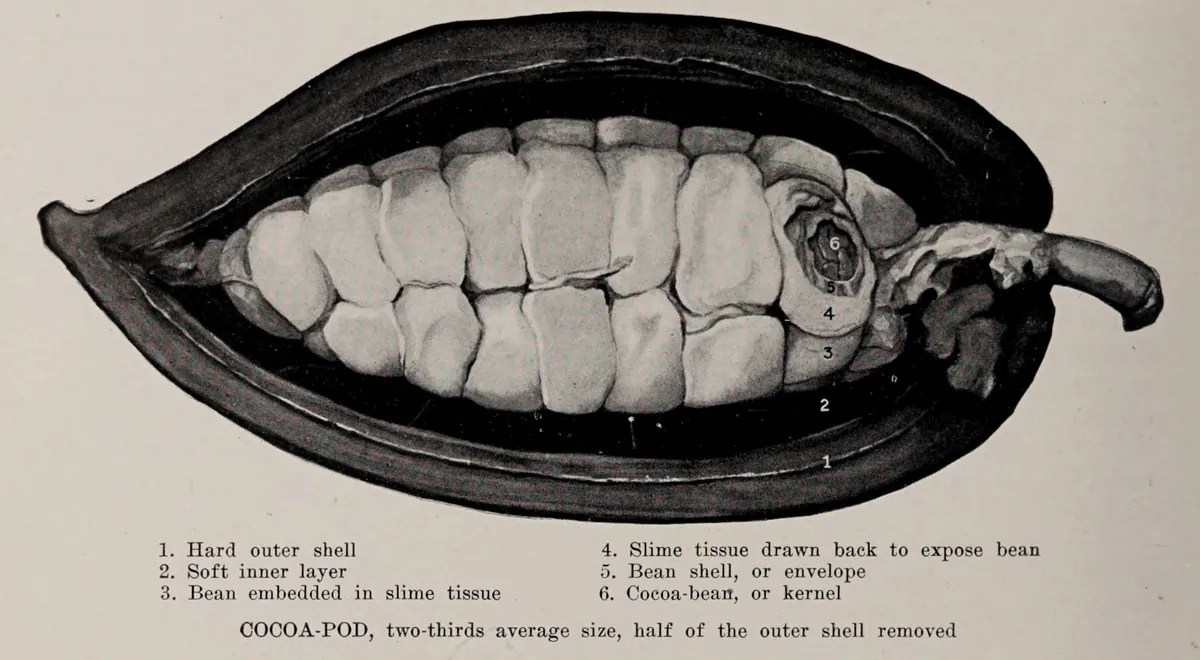
A healthy cocoa tree produces about 25 pods a year, which gives approximately 2 pounds (about 0.9 kilograms) of dry cocoa.
One farmer guide classes 20 or more pods a year per tree as good, 15 to 18 as average and 10 or fewer as poor.
Sources
- Yale University, Human Relations Area Files, The Mesoamerican origins of chocolate featuring eHRAF Archaeology
- Antiquity (Cambridge University Press), Oldest chocolate in the New World
- Academy of Natural Sciences of Drexel University, Chocolate History
- Natural History Museum of Utah, Highlights from the history of chocolate
- International Cocoa Organization, Quarterly Bulletin of Cocoa Statistics, Vol. LI, No. 2: Production of cocoa beans
- Food and Agriculture Organization of the United Nations, Organic Cocoa Production: A guide for Farmer Field Schools in Sierra Leone