Food and drink
Coffee
Arabica coffee is named for Arabia but comes from Ethiopia, and in 2025/26 the world grew an estimated 178.8 million 60-kilogram bags.

At a glance
178.8 million bags
World coffee production, 2025/26 estimate (60 kg bags)
63.0 million bags
Brazil's coffee production, 2025/26 estimate
30.5 million bags
Vietnam's robusta production, 2025/26 estimate
2,500 beans
Dried coffee seeds in a kilogram
113 to 247 mg
Caffeine in 12 fluid ounces of regular brewed coffee
A name that points to the wrong place
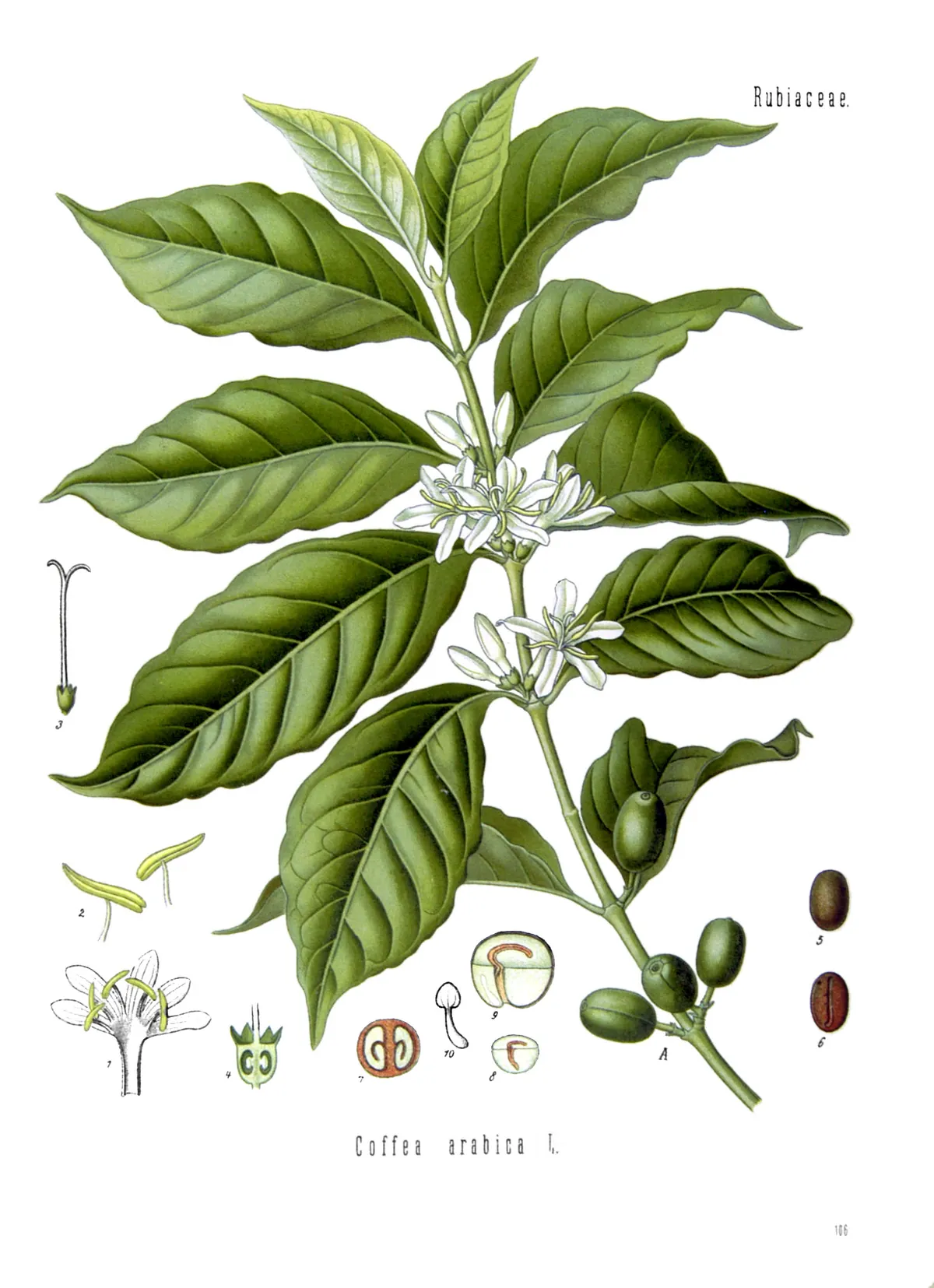
Coffea arabica originated in Ethiopia, where it grows at altitudes of 1,375 to 1,830 metres.
The species name suggests Arabia, but the plant is not native to the Arabian Peninsula.
Coffee belongs to the Rubiaceae, the coffee family, and arabica is an evergreen shrub or small tree that reaches up to 5 metres tall when unpruned.
Arabica is tetraploid, with 44 chromosomes. Robusta coffee is a different species, Coffea canephora.
From flower to roasting bean
The fruit is a drupe about 1.5 centimetres long that ripens from green through yellow to crimson, and it takes 7 to 9 months to mature.
Each fruit usually holds two seeds, 8.5 to 12.5 millimetres long, and these seeds are the coffee beans. There are about 2,500 dried seeds in a kilogram.
Trees begin bearing 3 to 4 years after planting and reach full bearing at 6 to 8 years.
Arabica grows from 5 degrees north to 34 degrees south and from sea level to 2,500 metres, with annual rainfall of 800 to 2,500 millimetres.
The seven seeds and the single plants
Arabica cultivation was initiated in fifteenth- to sixteenth-century Yemen.
Arabica was first planted in Java in 1690, and it reached Surinam, Martinique and Jamaica in the early 1700s.
Almost all contemporary arabica cultivars descend from the Typica or Bourbon lineages. With this narrow base and a recent origin, cultivated arabica has particularly low genetic diversity.
Counting the world's bags
The US Department of Agriculture estimates world coffee production at 178.8 million bags of 60 kilograms in 2025/26, about 10.7 million tonnes, and forecasts a record 189.7 million bags for 2026/27.
Of the 2025/26 total, arabica made up 94.4 million bags and robusta 84.4 million bags.
Brazil produced an estimated 63.0 million bags in 2025/26, about 35 percent of the 2025/26 world total. Its 2026/27 harvest is forecast at a record 71.9 million bags.
Vietnam followed with an estimated 31.7 million bags in 2025/26, then Colombia with 12.5 million, Indonesia with 12.4 million and Ethiopia with 11.6 million.
Vietnam is the largest robusta producer, with 30.5 million bags in 2025/26 against 25.0 million for Brazil.
Arabica trees alternate between high-yielding on-years and lower-yielding off-years. In Brazil the on-year crop can rise 5 to 10 million bags and fall by a similar amount the following year.
What a cup holds
The caffeine in 12 fluid ounces (about 355 millilitres) of regular brewed, non-specialty coffee ranges from 113 to 247 milligrams.
The same size of black tea holds about 71 milligrams and green tea about 37 milligrams.
Caffeine content varies by product and container size.
Sources
- Nature Genetics (PubMed Central), The genome and population genomics of allopolyploid Coffea arabica reveal the diversification history of modern coffee cultivars
- North Carolina State University Extension, Coffea arabica
- Purdue University, Coffea arabica
- US Department of Agriculture, Foreign Agricultural Service, Coffee: World Markets and Trade
- US Food and Drug Administration, Spilling the Beans: How Much Caffeine Is Too Much?