Food and drink
Vanilla
An orchid flower that opens for one day, a 12-year-old who learned to pollinate it by hand in 1841, and a spice second only to saffron in price.

At a glance
1841
Year Edmond Albius hand-pollinated vanilla on Réunion
1 day
How long each vanilla flower stays open
200 tonnes
Vanilla exported from Réunion in 1898
about 1,500 flowers
Pollinated by one worker in a day
42 %
Madagascar's share of world production, 2018 to 2023
An orchid that needs help
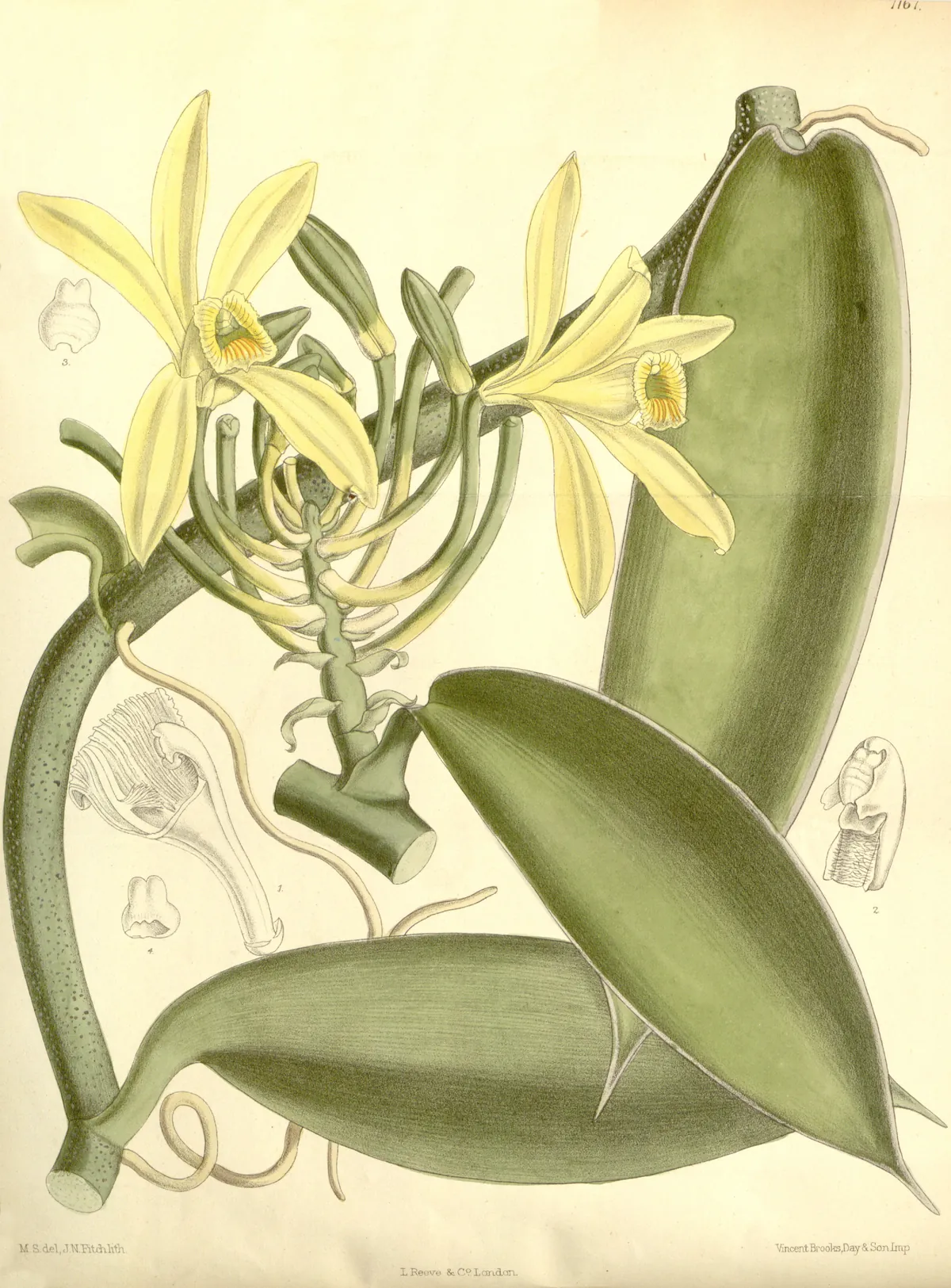
Vanilla flavour comes from the seed pods of an orchid. Vanilla planifolia, which is native to Mexico, is the orchid grown for commercial vanilla.
The plant is an epiphyte: in the wild it grows on the surface of other plants and takes in moisture from the air.
Each flower opens for a single day. If it is not pollinated that day, it falls off.
In its native range the plant is believed to be pollinated mainly by large, hairy orchid bees of the genus Eulaema.
Vanilla vines taken out of Mexico grew well but did not set fruit, because the Mexican bees that pollinated them were absent.
Edmond Albius and the thin stick
Edmond Albius was born in 1829 on the island of Bourbon, now Réunion, and was enslaved. In 1841, aged about 12, he hand-pollinated a vanilla vine on the plantation of Ferréol Bellier-Beaumont.
Bellier-Beaumont had already taught him to hand-pollinate watermelon plants.
A flap of tissue called the rostellum keeps the pollen apart from the stigma. Albius lifted it with a thin stick and pressed the pollen onto the stigma with his thumb.
The Belgian botanist Charles Morren had described artificial pollination of vanilla earlier, but his work stayed within a small circle of academic botanists.
Albius was freed in 1848, when France abolished slavery in its colonies, and took the surname Albius. A request for a stipend on his behalf brought no reply from the governor.
He died in 1880, aged 51, in poverty. A statue of him was put up on Réunion around 1980.
Réunion overtakes Mexico
Réunion shipped 2 tonnes of vanilla beans to France in 1858, 20 tonnes in 1867 and 200 tonnes in 1898.
By the end of the 19th century Réunion had overtaken Mexico as the world's largest vanilla producer.
The pollination method spread from Réunion to the Seychelles and Madagascar. Beans from this region are known as Bourbon vanilla.
A pod that has been successfully pollinated takes about nine months to ripen.
Why vanilla costs so much
Vanilla is the world's second-most expensive spice, after saffron.
Every flower is pollinated by hand, in a narrow window on the morning it opens. One worker can pollinate about 1,500 flowers in a day.
Vines usually flower in the third year after planting, and plantations take 3 to 4 years to start yielding.
The world price of vanilla averaged $131.33 per kilogram from 2000 to 2024. It fell as low as $19.36 in 2007 and reached $442.65 in 2018.
Madagascar supplied about 40% of the world's vanilla in 2017, and Mexico about 6%.
From 2018 to 2023 Madagascar contributed 42% of world production and Indonesia 24%.
The United States is the top importer of vanilla. In 2023 it received 2.83 million pounds, and Madagascar supplied an average of 76% of US vanilla imports over 2012 to 2024.
Sources
- Linnean Society of London, Edmond Albius
- Brooklyn Botanic Garden, Vanilla beans ripen in the Tropical Pavilion
- National Geographic, The little boy who should've vanished but didn't
- Lapham's Quarterly, The Marriage of Vanilla
- Kerala Agricultural University, Vanilla flowering
- Choices, Agricultural and Applied Economics Association, Sourcing Vanilla Closer to Home: Market Potential for US Production