Space
Jupiter
Jupiter is more than twice as massive as every other object in the Solar System combined, the Sun excepted, yet it spins once in under 10 hours.
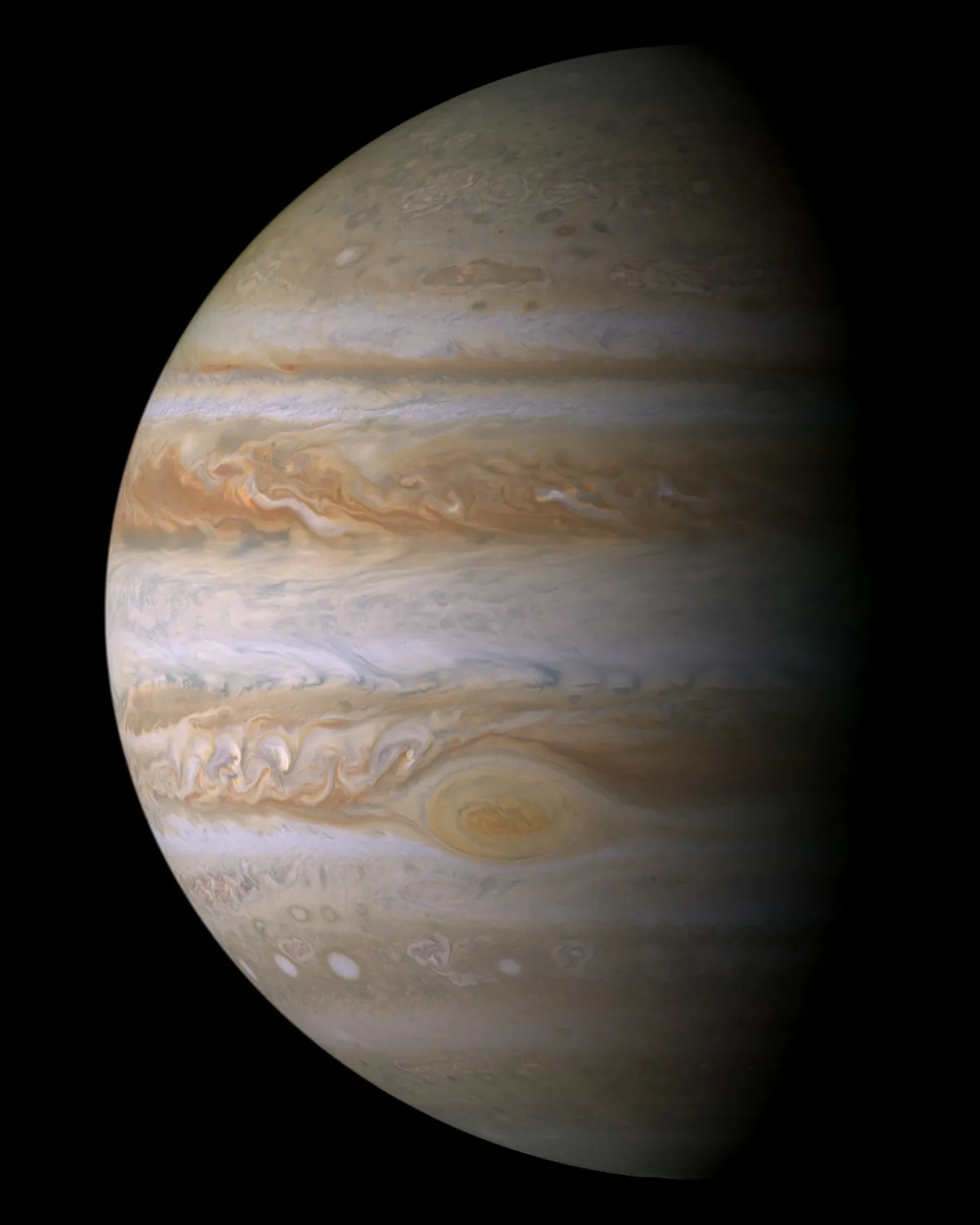

At a glance
142,984 km
Diameter, 11.2 times Earth's
9.9 hours
Length of one day
4,333 Earth days
Time to orbit the Sun once
778 million km
Average distance from the Sun
5 August 2011
Launch of the Juno spacecraft
More than every other planet put together
Jupiter is more than twice as massive as every other object in the Solar System combined, the Sun excepted.
Its diameter is about 142,984 kilometres, 11.2 times Earth's.
Jupiter is made mostly of hydrogen and helium, like the Sun.
Its mean density is 1,326 kilograms per cubic metre, about a quarter of Earth's 5,513.
Gravity at the 1-bar level, the pressure at sea level on Earth, is 25.92 metres per second squared, about 2.6 times Earth's.
The equatorial radius at the 1-bar level is 71,492 kilometres, against 6,378.1 kilometres for Earth.
A ten-hour day and a twelve-year year
Jupiter turns once in about 9.9 hours, the shortest day of any planet in the Solar System.
Earth's day lasts 23.9 hours, so a day on Jupiter is less than half as long as a day on Earth.
One orbit of the Sun takes 4,333 Earth days, about 12 Earth years.
Jupiter lies on average 778 million kilometres, or 5.2 astronomical units, from the Sun.
Sunlight takes about 43 minutes to reach Jupiter.
The storm wider than Earth
The Great Red Spot is a swirling oval of clouds that is larger than Earth. NASA describes it as twice as wide as Earth.
NASA says astronomers have watched the Great Red Spot for more than 300 years, while the Planetary Society says at least 200 years.
The Great Red Spot is a storm, a swirling oval of clouds, not a solid feature of the planet.
Four large moons and a faint ring
Jupiter's four largest moons are Io, Europa, Ganymede and Callisto. Galileo Galilei first observed them in 1610 with an early telescope.
Ganymede is the largest moon in the Solar System and is bigger than the planet Mercury.
Three of the four large moons, Europa, Ganymede and Callisto, are thought to hold oceans beneath their icy crusts.
Jupiter's rings were discovered in 1979 by Voyager 1. They are made of small, dark particles and are hard to see except when lit from behind by the Sun.
What Juno found
NASA's Juno spacecraft launched on 5 August 2011 and entered orbit around Jupiter on 4 July 2016.
Juno was the first spacecraft to orbit an outer planet from pole to pole.
Juno found that Jupiter's belts and zones, which are alternating jet streams, extend about 3,000 kilometres below the cloud tops.
Juno was sent to study Jupiter's core, map its magnetic field and measure water and ammonia in the deeper atmosphere.
Juno's orbit period has shortened from 53 days to 33 days.
Sources
- NASA, Jupiter facts
- The Planetary Society, Jupiter
- NASA, Jupiter fact sheet
- NASA, Juno
- NASA, Jupiter moons
- European Space Agency, Juice factsheet
- The Planetary Society, Titan