Space
Saturn
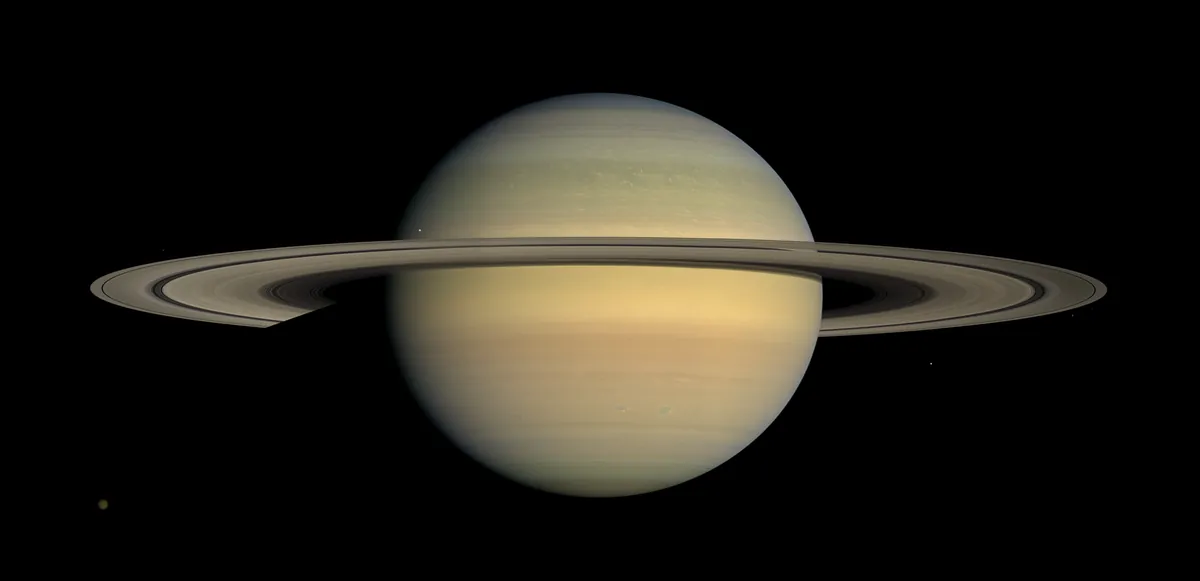
Saturn is the only planet less dense than water, and its rings span about 250,000 kilometres yet are only 10 to a few tens of metres thick.

At a glance
0.687 g/cm3
Average density, less than water
10.7 hours
Length of one day
29.4 Earth years
Time to orbit the Sun once
274 moons
Confirmed moons, as of March 2025
282,000 km
Reach of the rings, NASA's figure
A giant that would float
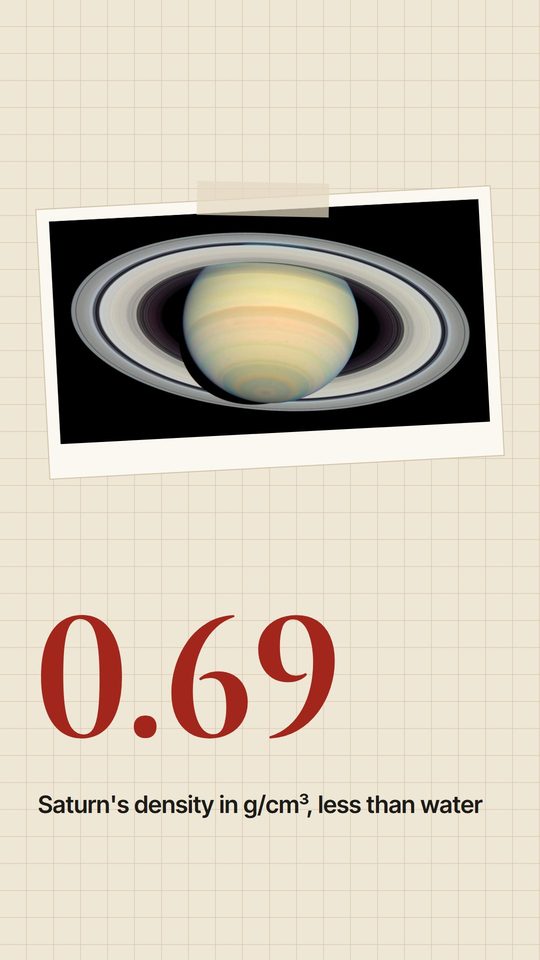
Saturn is the only planet in the Solar System with an average density lower than that of water. In a pool big enough to hold every planet, it would be the only one to float.
Saturn's bulk density is 0.687 grams per cubic centimetre. The next lowest is Jupiter at 1.33, and Earth's is 5.51.
Saturn's equatorial diameter is about 120,500 kilometres, roughly nine times Earth's, and its mass is about 95 times Earth's.
About 764 Earths would fit inside Saturn, yet the planet has only about 95 times Earth's mass.
 Watch the ShortSaturn would float
Rings that are wide but thin
The rings are made of billions of small chunks of ice and rock coated with other materials such as dust.
The ring system is about 250,000 kilometres wide, and NASA measures its reach at up to 282,000 kilometres from the planet. The main rings are only about 10 metres thick on average, and a few tens of metres at most.
The Cassini Division, a gap about 4,700 kilometres wide, separates Ring A from Ring B.
Data from the Cassini spacecraft showed the rings to be made up of thousands of icy ringlets.
Wind, gas and cold
Winds in Saturn's upper atmosphere reach about 400 to 500 metres per second near the equator.
Saturn's black-body temperature is 81 kelvin, and it is 134 kelvin at the level in its atmosphere where the pressure equals 1 bar.
Saturn is mostly hydrogen and helium. Its clouds show shades of yellow, brown and gray.
Short days, long years and 274 moons
A day on Saturn lasts about 10.7 hours, the second shortest of any planet.
One orbit of the Sun takes about 29.4 Earth years, or 10,756 Earth days.
Saturn averages about 1.4 billion kilometres from the Sun, and sunlight takes about 80 minutes to reach it.
Its axis is tilted by 26.73 degrees to its orbit, a little more than Earth's 23.4 degrees.
As of March 2025, Saturn had 274 confirmed moons, more than any other planet.
William Herschel spotted the moon Enceladus on 28 August 1789. It is only about 500 kilometres across.
What Cassini and Huygens found
Cassini launched on 15 October 1997, began its close study of Saturn in 2004 and stayed for 13 years.
Cassini's mission ended with a deliberate plunge into Saturn on 15 September 2017, after it had used up nearly all its propellant.
Europe's Huygens probe landed on Titan on 14 January 2005.
Sources
- NASA, Saturn: Facts
- European Space Agency, Saturn the gas giant
- NASA Jet Propulsion Laboratory, Planetary Physical Parameters
- NASA, Saturn Fact Sheet
- BBC Sky at Night Magazine, Rings of Saturn
- NASA, Enceladus
- NASA, Cassini