Space
Mars
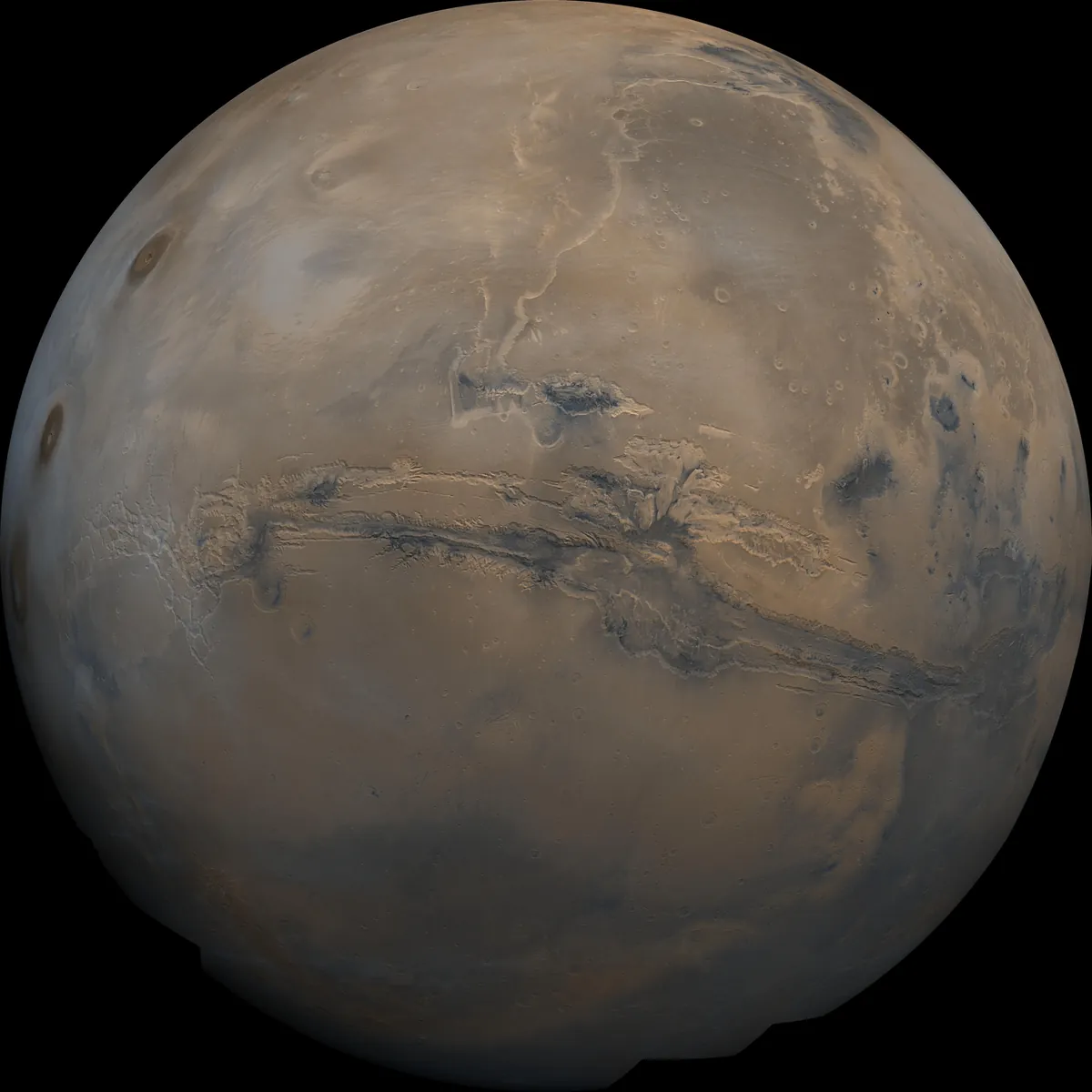
Mars is red because its iron has rusted, and it has the Solar System's largest volcano, Olympus Mons, and its largest canyon, Valles Marineris.

At a glance
24.6 hours
Length of one rotation
687 Earth days
Length of one year
3.73 m/s2
Mean surface gravity
3,870 km
Length of Valles Marineris
2 moons
Phobos and Deimos
The rust that colours the planet
Mars looks red because iron in its rocks, soil and dust has oxidised, or rusted. The dust is spread through the air.
The iron reacted at some point with liquid water, or with water and oxygen in the air, much as iron rusts on Earth.
Over time the rusted material was broken down into dust and spread around the planet by winds. The process continues today.
A 2025 analysis suggests the colour is better matched by ferrihydrite, an iron oxide containing water, than by dry hematite. Ferrihydrite forms in the presence of cool water.
Half the width of Earth, with a similar day
Mars has a radius of 3,390 kilometres, about half of Earth's.
Mars has a mean diameter of 6,779 kilometres and a mass 0.107 times Earth's.
One rotation takes 24.6 hours, compared with Earth's 23.9 hours.
Mean surface gravity is 3.73 metres per second squared, 0.38 times Earth's.
Mars orbits the Sun at an average distance of 228 million kilometres, 1.5 times Earth's distance, and sunlight takes about 13 minutes to reach it.
A year on Mars lasts 669.6 sols, which is 687 Earth days. Its axis is tilted by about 25 degrees.
Cold, thin air and a missing magnetic field
The atmosphere is made up mostly of carbon dioxide, nitrogen and argon.
Mean surface pressure on Mars is 6.36 millibars.
Temperatures range from as high as 20 degrees Celsius to as low as about minus 153 degrees Celsius.
Mars has no global magnetic field today.
Water today exists mainly as ice near the poles and as briny water that flows seasonally on some slopes.
The largest volcano and the largest canyon
Olympus Mons is the largest volcano in the Solar System, and its base is about the size of Arizona.
Olympus Mons stands more than 40 kilometres tall from base to summit, by NASA's measure.
Valles Marineris is the largest canyon in the Solar System. It extends about 3,870 kilometres, spans about 600 kilometres at its widest and descends about 9.3 kilometres at its deepest.
Two small moons and the machines on the ground
Mars has two moons, Phobos and Deimos. Asaph Hall discovered both, and he found Phobos on 17 August 1877.
Phobos measures about 27 by 22 by 18 kilometres and circles Mars about three times a day.
Phobos is drawing closer to Mars by about 1.8 metres per century. NASA expects it to crash into Mars or break apart in about 50 million years.
Deimos is about half the size of Phobos and orbits two and a half times farther from Mars.
Ingenuity landed in Jezero Crater on 18 February 2021.
The helicopter made its first flight on 19 April 2021 and completed 72 flights across nearly three years. Its last flight was on 18 January 2024.
Sources
- NASA, Mars: Facts
- European Space Agency, Have we been wrong about why Mars is red?
- Brown University, Why is Mars red? Scientists may finally have the answer
- NASA, Mars Fact Sheet
- NASA, Phobos
- NASA, Ingenuity Mars Helicopter