Space
The Moon
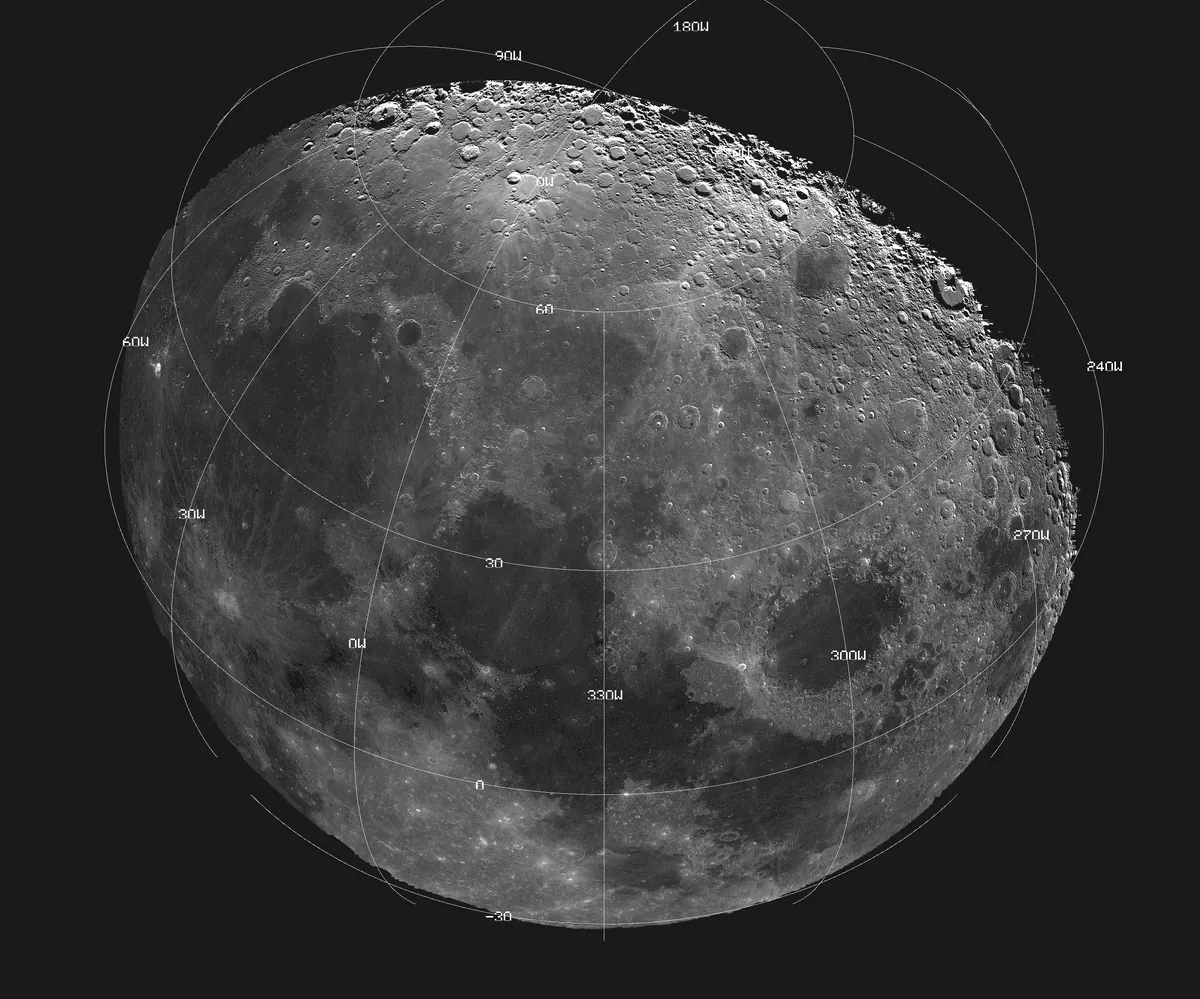
The Moon spins once for every orbit of Earth, so one face always points at us, yet its far side is not dark and gets as much sunlight as the near side.

At a glance
384,400 km
Average distance from Earth
3,475 km
Diameter
27.3 days
Time for one orbit of Earth
1/6
Surface gravity compared with Earth's
6
Apollo missions that landed on the Moon
A far side with no permanent night
There is no permanent dark side of the Moon. The far side gets as much sunlight as the near side, and each part of the Moon has day and night as it rotates.
The Moon takes precisely as long to spin once on its axis as it does to complete its monthly orbit of Earth. This match is called synchronous rotation, or tidal locking, and it keeps the same side facing us.
Earth's gravity raised a bulge in the Moon, and as the Moon flexed in the constant tug of war, energy was released as heat while its spin slowed to match its orbit.
All the large moons in the Solar System are tidally locked with their planets.
The Moon wobbles slightly as it orbits, which lets observers on Earth see a little more than half of its surface. Regions that are sometimes visible make up around 18% of the far side's area.
A small neighbour that drifts away
The Moon's radius is about 1,740 kilometres, which makes its diameter about 3,475 kilometres, or 0.27 times Earth's.
It is the fifth largest natural satellite in the Solar System.
The average distance from Earth is 384,400 kilometres. The distance runs from about 363,300 kilometres at its closest to about 405,500 kilometres at its farthest.
The Moon drifts away from Earth. NASA puts it at about an inch a year, and Royal Museums Greenwich at approximately 3.8 centimetres a year.
The Sun is about 400 times wider than the Moon and about 400 times farther from Earth, so the two look about the same size in our sky.
One orbit of Earth takes 27.3 days, but the cycle of phases seen from Earth takes 29.5 days.
Weak gravity and harsh swings in temperature
Surface gravity is 1.62 metres per second squared, about one-sixth of Earth's.
The Moon has only a thin exosphere in place of an atmosphere, and it is not breathable.
Surface temperatures reach about 127 degrees Celsius in full sun and fall to about minus 173 degrees Celsius in darkness.
Born from a collision, filled by lava
The leading theory is that a Mars-sized object collided with Earth billions of years ago, and debris from that collision formed the Moon.
The impact is dated to about 4.5 billion years ago.
The dark plains called maria were filled with lava between 4.2 and 1.2 billion years ago.
Robotic probes and the Apollo landings
More than 105 robotic spacecraft have been launched to explore the Moon.
Apollo 11 launched on 16 July 1969, and its lunar module Eagle landed in the Sea of Tranquility on 20 July.
Neil Armstrong stepped onto the surface first, and Buzz Aldrin followed about 20 minutes later. The two spent 21 hours and 36 minutes on the Moon's surface.
Six Apollo missions landed on the Moon, and the final one took place in December 1972.
Apollo astronauts brought back a total of 382 kilograms of lunar rocks and soil.
The Soviet probe Luna 3 took the first picture of the far side on 7 October 1959. China's Chang'e 4 landed there in 2019.
India's Chandrayaan-1 made the first definitive detection of water on the Moon in 2008.
Sources
- NASA, Top Moon questions
- BBC Sky at Night Magazine, Dark side of the Moon? There's no such thing
- NASA, Tidal locking
- NASA, Moon Facts
- NASA, Moon Fact Sheet
- Royal Museums Greenwich, Interesting facts about the Moon
- NASA, All About the Sun
- NASA, Apollo 11 Mission Overview
- NASA, The Apollo Program