Space
Moons of the Solar System
Two moons, Ganymede and Titan, are wider than the planet Mercury, and the Solar System held 461 officially recognized planetary moons as of October 2026.

At a glance
5,262.4 km
Diameter of Ganymede, the largest moon
5,150 km
Diameter of Titan, the second largest
4,879 km
Diameter of Mercury, for comparison
293 moons
Confirmed moons of Saturn, as of August 2026
461 moons
Officially recognized moons of planets, including Pluto, as of October 2026
Two moons wider than a planet
Ganymede, which orbits Jupiter, is the largest moon in the Solar System. Its diameter is about 5,262 kilometres.
Titan, which orbits Saturn, is the second largest moon, with a diameter of about 5,150 kilometres.
Mercury, the smallest planet, has a diameter of about 4,879 kilometres, so both Ganymede and Titan are wider than it.
Callisto, the third of the giants, measures about 4,821 kilometres across, just short of Mercury.
Neptune's moon Triton is about as big as Pluto.
Smaller than they sound
Earth's Moon has a diameter of about 3,475 kilometres.
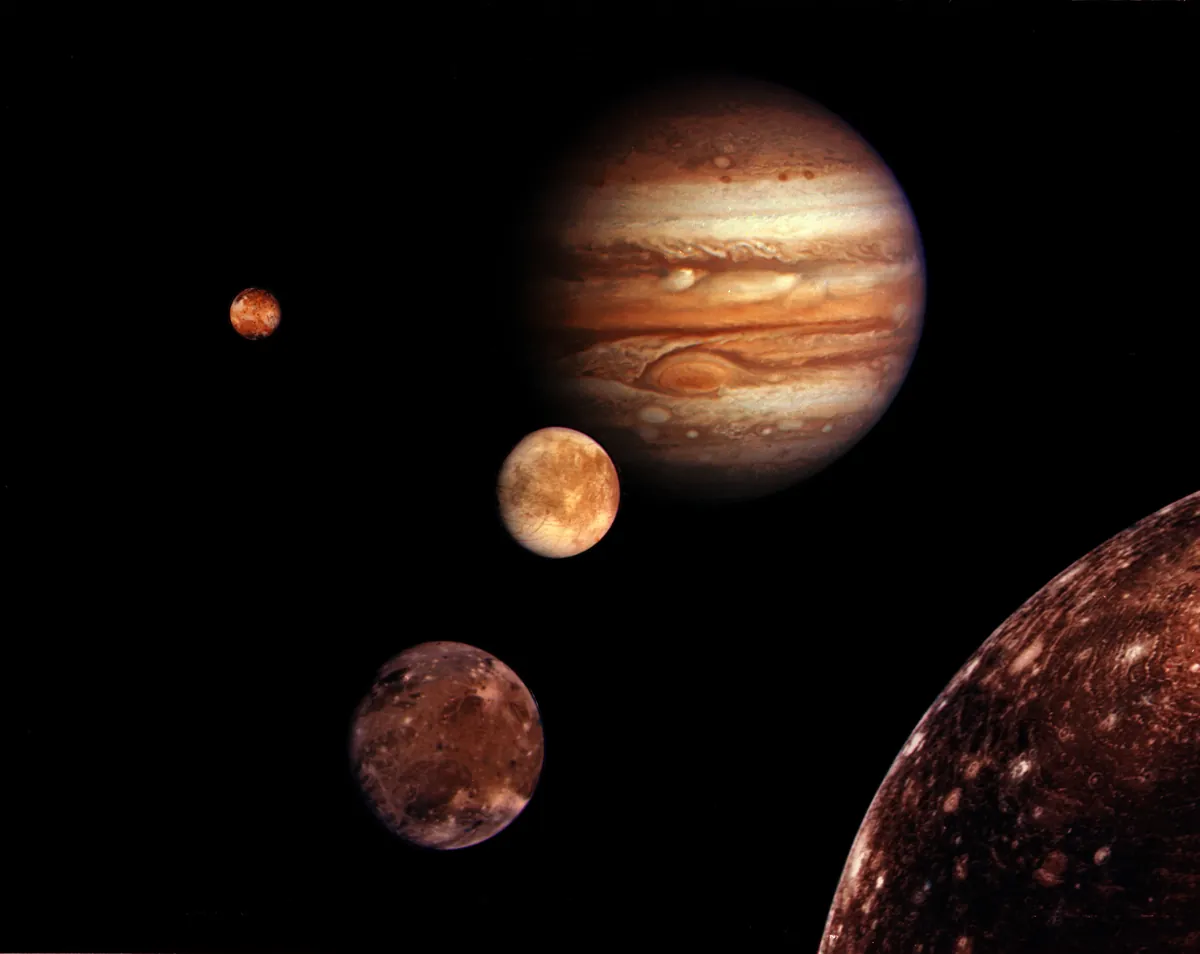
Io, the innermost of Jupiter's four large moons, is about 3,640 kilometres across, not much larger than the Moon.
Europa is about 3,122 kilometres across, slightly smaller than Earth's Moon, and is the fourth largest of Jupiter's moons.
Galileo Galilei first observed Jupiter's four largest moons, Io, Europa, Ganymede and Callisto, in 1610 with an early telescope.
Callisto is Jupiter's second-biggest moon and ranks among the three largest moons in the Solar System.
Europa is the sixth-closest moon to Jupiter.
Oceans, haze and a magnetic field
Ganymede is one of three Jovian moons thought to hold oceans of liquid water beneath their icy crusts.
Titan is the only moon in the Solar System known to have a substantial atmosphere. Its surface pressure is about 60% higher than Earth's.
Titan has clouds, rain, rivers, lakes and seas of liquid hydrocarbons such as methane and ethane.
Scientists believe Europa has a saltwater ocean under its icy shell that holds about twice as much water as Earth's oceans.
Saturn's small moon Enceladus has a global ocean beneath a thick icy shell.
Counting moons
As of August 2026, Saturn had 293 confirmed moons, far more than any other planet.
As of October 2026, there were 461 officially recognized moons orbiting planets, including the dwarf planet Pluto.
Mars has two moons, Phobos and Deimos, which are lumpy and dark rather than round.
Pluto has five moons. The largest, Charon, is about half Pluto's size.
Missions heading to the big moons
The European Space Agency's Juice spacecraft launched on 14 April 2023 and is due to reach Jupiter in July 2031. It will then make an orbital tour of Ganymede.
NASA's Europa Clipper launched on 14 October 2024.
NASA's Dragonfly rotorcraft is planned to launch to Titan in 2028 and spend three years making multiple landings.
Sources
- NASA, Ganymede
- NASA, Titan
- NASA, Europa
- NASA, Saturn moons
- NASA, Jovian satellite fact sheet
- NASA, Saturnian satellite fact sheet
- NASA, Mercury fact sheet
- NASA, Moon fact sheet
- NASA, Jupiter moons
- NASA, Callisto
- NASA, Moons facts
- The Planetary Society, Titan
- The Planetary Society, Europa
- The Planetary Society, Io
- European Space Agency, Juice factsheet
- The Planetary Society, Mercury