Space
Pluto
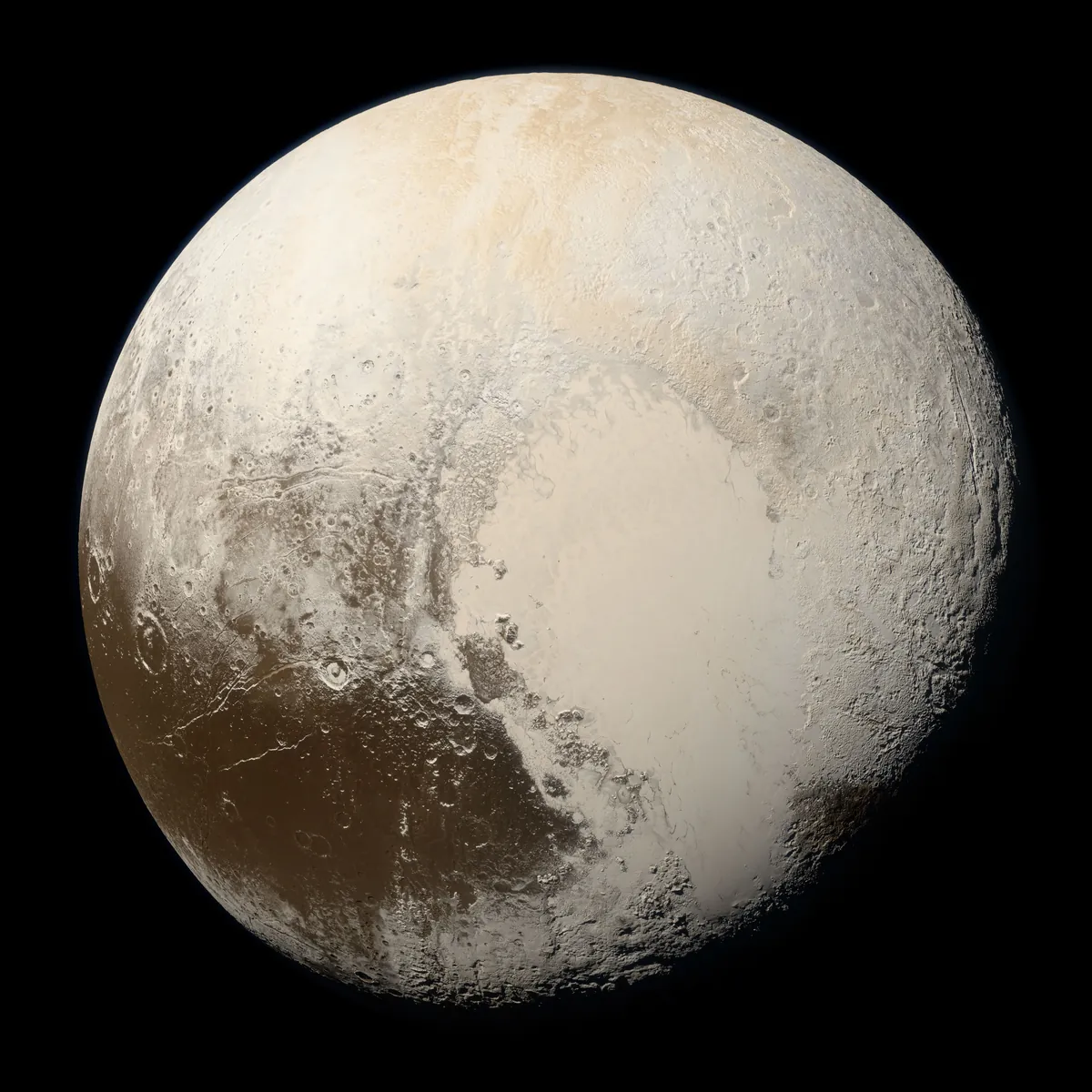
Pluto is about 2,370 kilometres wide, takes 248 years to orbit the Sun and became a dwarf planet in 2006, nine years before New Horizons reached it.

At a glance
2,370 km
Diameter, as measured by New Horizons
248 Earth years
Time to orbit the Sun once
5 moons
Known moons, Charon the largest
14 July 2015
Day New Horizons flew past
2006
Year the IAU reclassified Pluto as a dwarf planet
A small, cold world
Pluto is about 2,370 kilometres across, according to New Horizons measurements that came out slightly larger than earlier estimates.
That is roughly one-fifth of Earth's width. NASA's facts page gives 2,377 kilometres at the equator.
Its mean density is 1,854 kilograms per cubic metre.
NASA puts Pluto's average surface temperature at about minus 232 degrees Celsius.
Pluto has a thin, tenuous atmosphere made mostly of molecular nitrogen, with methane and carbon monoxide also detected.
NASA says the surface can be as cold as about minus 240 degrees Celsius.
A 248-year orbit
Pluto takes about 248 Earth years to orbit the Sun once.
Its distance from the Sun ranges from 30 to 49.3 astronomical units, and averages about 5.9 billion kilometres.
The orbit is tilted 17.16 degrees from the plane of the planets.
One rotation of Pluto takes about 153 hours, or roughly 6.4 Earth days.
At its closest to the Sun Pluto is about 4,435 million kilometres away, and at its farthest about 7,304 million kilometres.
Five moons, one nearly its own size
Pluto has five moons: Charon, Nix, Hydra, Kerberos and Styx.
Charon is about half the size of Pluto and orbits it about every 6.4 Earth days. New Horizons measured it at about 1,208 kilometres across.
Charon was discovered on 22 June 1978.
New Horizons found that Charon's equatorial tectonic belt suggests it once had a water-ice ocean.
From ninth planet to dwarf planet
Pluto was discovered in 1930.
The International Astronomical Union reclassified Pluto as a dwarf planet in 2006.
The IAU's 2006 definition says a planet must orbit the Sun, be massive enough to be nearly round, and have cleared the neighbourhood around its orbit.
NASA says Pluto was reclassified because other objects might cross its orbit.
New Horizons at Pluto and beyond
New Horizons launched on 19 January 2006 and flew past Pluto on 14 July 2015, passing about 7,800 kilometres above its surface at closest approach.
New Horizons is the only spacecraft to have visited Pluto.
The probe found a heart-shaped feature in a nitrogen-rich region called Tombaugh Regio.
The heart includes Sputnik Planitia, a nitrogen glacier about 1,000 kilometres wide.
On 1 January 2019 New Horizons flew past Arrokoth, a Kuiper Belt object about 35 kilometres long, made of two lobes.
Some evidence hints that Pluto may have an internal water-ice ocean today.
Sources
- NASA, Pluto facts
- NASA, Pluto fact sheet
- NASA, New Horizons
- The Planetary Society, Pluto
- NASA, What is a planet?
- NASA, Pluto moons