Space
Venus
Venus turns once in 243 Earth days but circles the Sun in 225, so its day is longer than its year, and at about 467 degrees Celsius it is the hottest planet.

At a glance
243 Earth days
Time to rotate once
225 Earth days
Time to orbit the Sun once
467 °C
Surface temperature, NASA's figure
90 to 93 times
Surface pressure compared with Earth's at sea level
12,104 km
Equatorial diameter
A day longer than a year
Venus takes about 243 Earth days to rotate once, the longest rotation of any planet in the Solar System.
It orbits the Sun in only about 225 Earth days (224.7), so one turn on its axis takes longer than a full trip around the Sun.
Venus spins backward compared with Earth, so the Sun rises in the west.
A solar day on Venus, from one sunrise to the next, lasts 2,802 hours, about 117 Earth days.
Its axial tilt is very slight, only three degrees.
The hottest planet and its thick atmosphere
Estimates of Venus's surface temperature run from 462 to 467 degrees Celsius. NASA's figure is about 467 degrees (872 degrees Fahrenheit), hot enough to melt lead.
Venus is hotter than Mercury even though Mercury is closer to the Sun. The heat comes from a carbon dioxide greenhouse effect.
The atmosphere is mostly carbon dioxide, about 96% of it, with about 3% nitrogen.
Surface pressure is about 90 to 93 times Earth's at sea level.
Dense clouds of sulfuric acid cover the planet, and winds at their tops have been measured as high as 360 kilometres per hour.
About 50 kilometres up, the temperature is between 30 and 70 degrees Celsius.
Earth's near twin, without a moon
Venus's equatorial diameter is about 12,104 kilometres, against 12,756 kilometres for Earth.
Venus has 0.815 times Earth's mass and a surface gravity of 8.87 metres per second squared, 0.903 times Earth's.
Venus has no moon and no rings.
Venus's escape velocity is 10.36 kilometres per second, against 11.19 for Earth, and its mean density is 0.951 times Earth's.
A bright neighbour close to the Sun
It is the second brightest natural object in the night sky after the Moon, and can sometimes be seen in daylight.
Venus goes from new to full in a cycle of 584 days.
At its closest Venus is about 38 million kilometres from Earth.
Venus averages 108 million kilometres from the Sun, or 0.72 astronomical units.
Volcanoes under the cloud
Venus has thousands of volcanoes, and one mountain reaches 11 kilometres high.
Pancake-shaped volcanic domes on Venus can be as wide as 62 kilometres.
Probes sent to Venus
The Soviet Venera probes flew between 1961 and 1984, and ten of them made it to the surface.
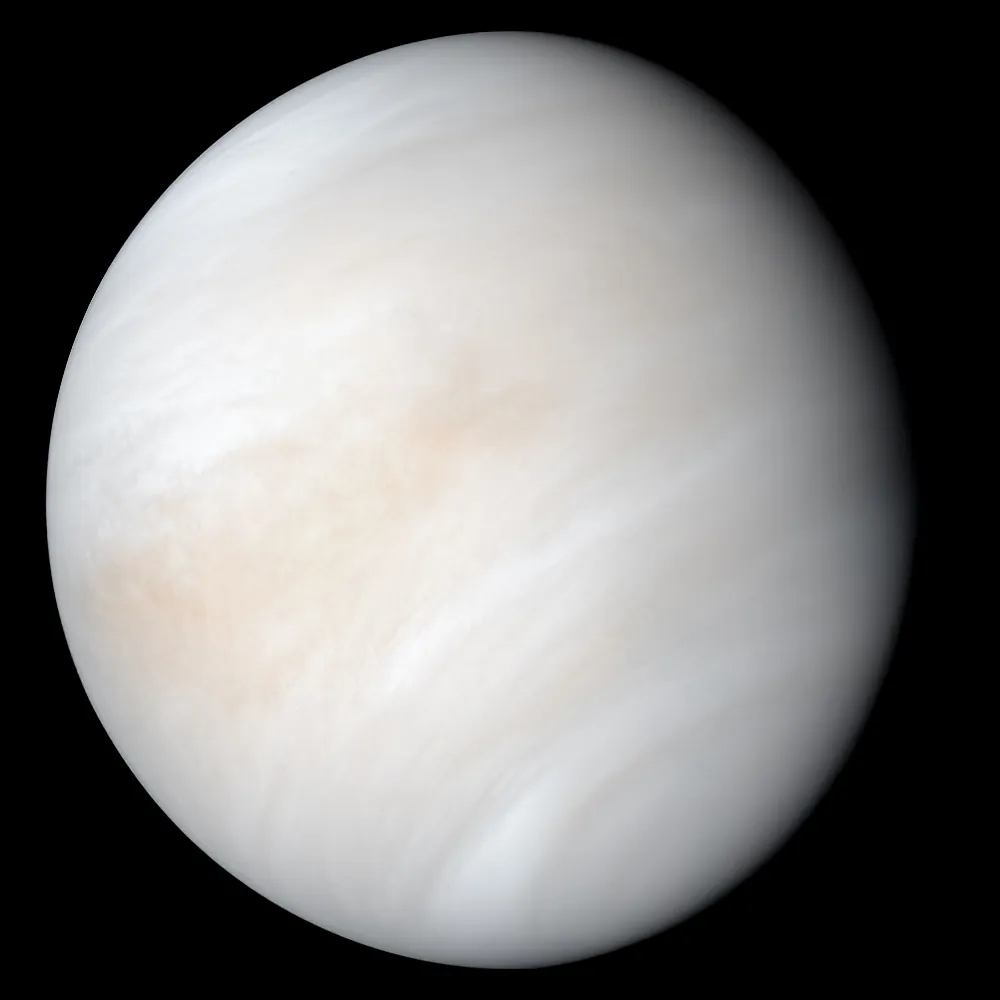
NASA's Mariner 10 photographed Venus in February 1974 as it flew past.
NASA's Magellan mapped the surface by radar and ended its five-year mission to Venus in 1994.
Sources
- NASA, Venus Facts
- Royal Museums Greenwich, Interesting facts about Venus
- European Space Agency, Venus compared to Earth
- NASA, Venus Fact Sheet